
 En
 Español
 русский
 عربى

FL-929 Light-Up Children’s Scooter: A Safer, More Engaging Way to Move, Play, and Grow
Date:Nov 10, 2026
Content
- 1 A Product Built Around Active Play
- 2 Distinctive Light and Spray Effects
- 3 Stable Riding for Beginners
- 4 Adjustable Height for Longer Product Use
- 5 Comfortable and Natural Handling
- 6 Quiet, Smooth, and Durable Wheels
- 7 Wide Non-Slip Footrest for Secure Stance
- 8 Lightweight and Compact for Everyday Family Life
- 9 Suitable Use Scenarios
- 10 Advantages Over Conventional Children’s Scooters
- 11 Manufacturing Strengths Behind the Product
- 12 Quality Management and Certification Background
- 13 From Mold Development to Final Assembly
- 14 OEM and Wholesale Opportunities
- 15 Responsible Product Positioning
- 16 Maintenance and Care Recommendations
- 17 Why the FL-929 Has Strong Market Potential
- 18 Q&A: Common Questions About the FL-929
- 18.1 What is the FL-929?
- 18.2 What makes the light-and-spray function different?
- 18.3 Is the scooter suitable for beginners?
- 18.4 Can the handlebar height be adjusted?
- 18.5 Is the scooter easy to carry?
- 18.6 Are the wheels noisy?
- 18.7 What type of surface is recommended?
- 18.8 Does the scooter replace a helmet or protective gear?
- 18.9 Who manufactures the FL-929?
- 18.10 What manufacturing capabilities does the company have?
- 18.11 Does the manufacturer support OEM orders?
- 18.12 What certifications are associated with the company and its products?
- 19 Conclusion
- 20 References
- 21 Product: FL-929 Light Up Children Scooter
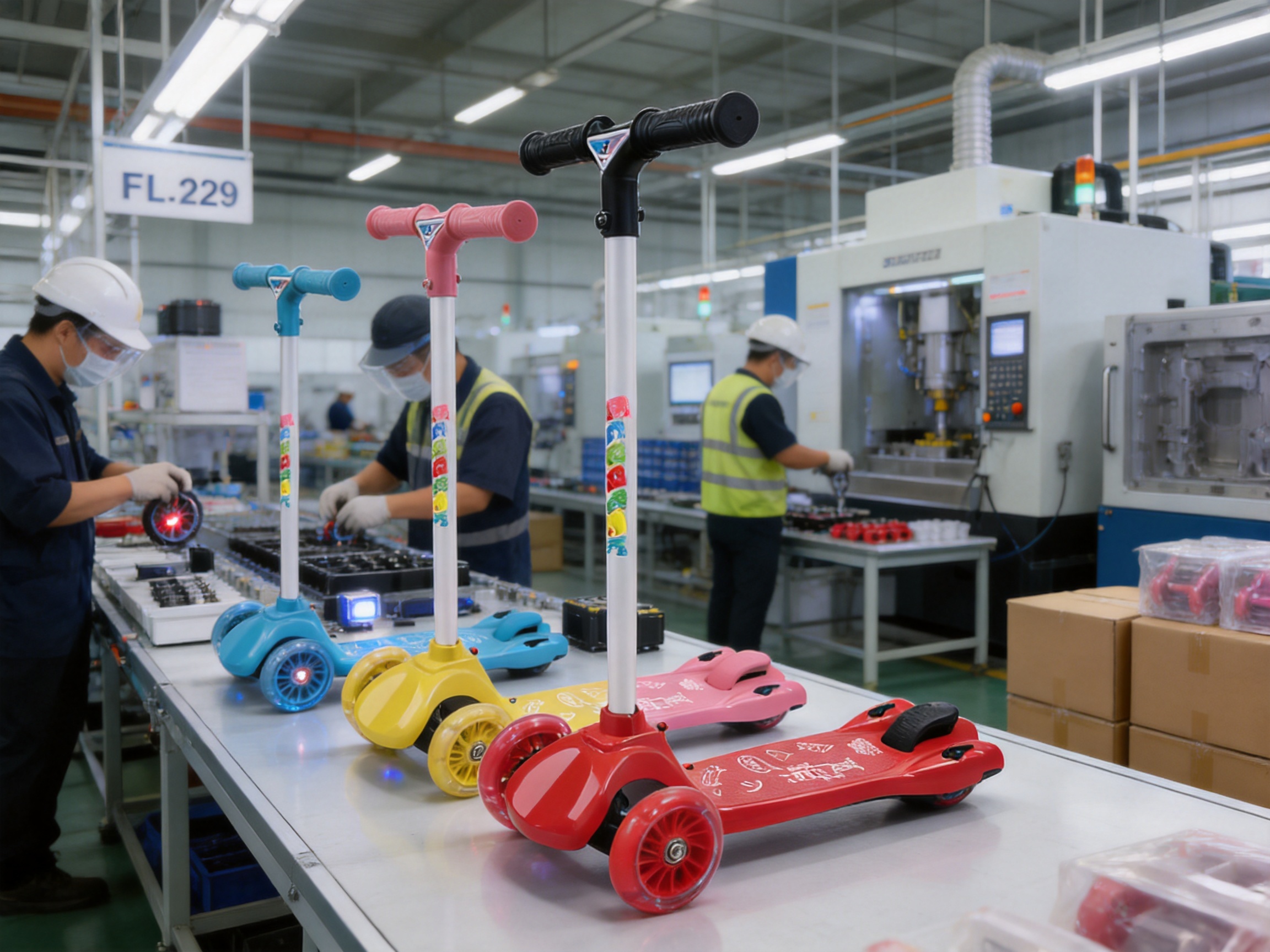
Children’s scooters have evolved far beyond simple ride-on toys. Today, parents and buyers look for products that combine movement, stability, comfort, durability, visual appeal, and practical value. Children, meanwhile, are attracted to products that feel exciting, interactive, and different from ordinary outdoor toys. The FL-929 Light-Up Children’s Scooter responds to both needs by combining a stable three-wheel-style riding concept, adjustable handlebars, a wide non-slip deck, quiet wheels, colorful lighting, and a playful spray effect.
Designed for children’s daily outdoor activities, short neighborhood trips, park play, and selected indoor play environments, the FL-929 is intended to make gliding more enjoyable while supporting early balance development. Its light-and-spray concept gives the scooter an eye-catching identity, while its structural features focus on confidence and ease of use for beginners. Rather than relying only on decoration, the product brings together several practical design elements that can help children learn, play, and remain active for longer periods.
The scooter is produced by Ningbo Feile Sporting Goods Co., Ltd., an established Chinese sporting goods manufacturer specializing in children’s scooters, inline skates, roller skates, and ice skates. With in-house mold, injection molding, sewing, assembly, research, and development capabilities, the company is positioned to support product development from initial concept through finished production. This manufacturing background is important for importers, distributors, retailers, and private-label buyers seeking a reliable source for skating and scooter equipment.
A Product Built Around Active Play
The FL-929 is more than a basic scooter with decorative lights. Its concept is based on combining physical activity with sensory engagement. When children glide, the scooter’s colorful taillights and spray effect create a dynamic visual experience. The result is a product that encourages children to spend more time moving rather than treating the scooter as a static toy.
For many children, the first challenge of scooter riding is not motivation but confidence. A product may be technically suitable for beginners, yet a child who feels unstable can quickly lose interest. The FL-929 addresses this challenge through a lowered center of gravity, a broad footrest, non-slip surface texturing, and a handlebar system designed for adjustment as children grow. These features work together to create a more approachable learning experience.
Its design also responds to a common problem in the children’s product market: children grow quickly, while many entry-level products are limited to a narrow age or height range. The adjustable handlebar allows the riding position to be changed for different users and stages of growth. This can extend the useful life of the scooter and reduce the need for frequent replacement.
At the same time, the FL-929 maintains a lightweight and compact format. Families can carry it to parks, keep it in a vehicle, or store it in a corner of the home. A product that is fun but difficult to transport may be used less often. By keeping portability in the design equation, the scooter is better suited to real family routines.
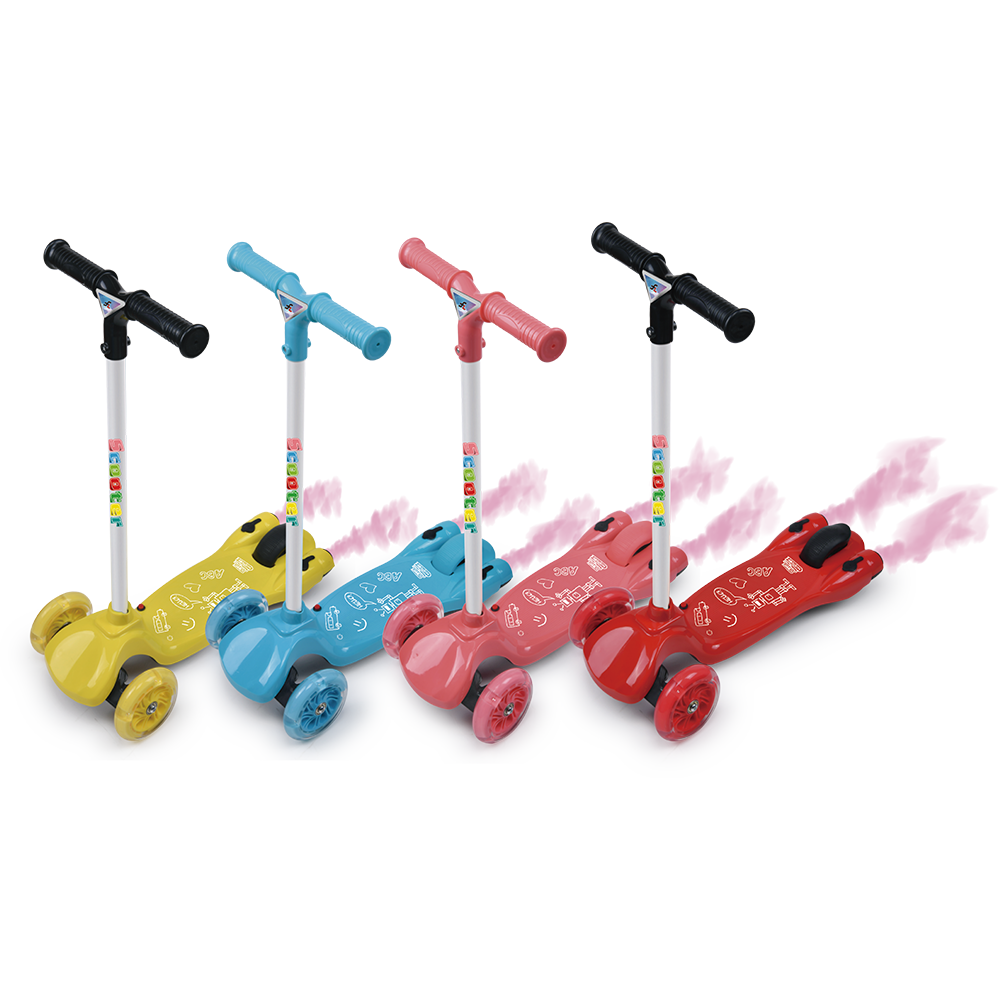
FL-929 Light Up Children Scooter
Distinctive Light and Spray Effects
The most recognizable feature of the FL-929 is its creative combination of light and spray effects. The dedicated rear device is designed to provide a continuous light while producing a gentle spray effect during use. This gives children a special visual experience that differs from conventional scooters.
Lighting can make a children’s scooter more attractive in several ways. It helps the product stand out in a retail display, gives the scooter a stronger identity in product photography, and adds excitement during outdoor play. For children, the light becomes part of the game. Every movement can feel more animated, helping transform ordinary gliding into an imaginative activity.
The spray function adds another layer of play value. According to the supplied product information, the effect is designed to be safe, odorless, and gentle on the skin. However, responsible use remains important. Parents and caregivers should follow the product instructions, use only the recommended liquid if applicable, avoid spraying toward the eyes or face, and keep the scooter away from electrical hazards or slippery surfaces. The effect should enhance play without replacing normal supervision.
From a commercial perspective, the light-and-spray concept gives distributors a strong point of differentiation. Many children’s scooters compete through color, wheel size, or general styling. The FL-929 offers a more complete play proposition by combining transportation, exercise, visual effects, and interactive entertainment in one product. This can help retailers present it as a feature-rich gift item rather than simply another basic scooter.
The feature is also useful for seasonal marketing. It can support outdoor toy campaigns, birthday and holiday promotions, summer activity collections, and back-to-school leisure categories. Retailers may position it alongside protective gear, inline skates, roller skates, and other children’s sports equipment to create a broader active-play display.
Stable Riding for Beginners
Balance is central to the early scooter experience. A child who can stand securely and control the direction of movement is more likely to develop confidence. The FL-929 uses a scientifically lowered center of gravity to support a stable riding position. This design approach helps keep the scooter closer to the ground and can reduce the feeling of being top-heavy.
A lower center of gravity may be especially valuable for young or inexperienced riders. Instead of requiring children to make constant corrections, the scooter is designed to provide a steadier platform while they learn. This does not eliminate the need for practice or supervision, but it can make the learning process less intimidating.
The broad footrest is another important part of the stability system. A wide deck gives the child more room to position the riding foot and maintain balance. The non-slip textured surface helps improve grip, particularly when the child is wearing ordinary sports shoes. A secure stance can reduce unnecessary foot movement and help children focus on steering and forward motion.
The deck is described as spacious and thick, which also supports a feeling of durability. For parents, a substantial footrest communicates that the scooter has been designed for active use rather than occasional decorative play. For buyers and distributors, the combination of deck width, texture, and structural appearance provides useful selling points in product descriptions and packaging.
Even with these stability features, safe use depends on the child, the surface, and the riding environment. Children should wear appropriate protective equipment, ride away from traffic and steep slopes, and use the scooter under adult supervision when necessary. The FL-929 is designed to support beginner-friendly riding, but no scooter can replace safe riding habits.
Adjustable Height for Longer Product Use
Children’s height changes quickly, and a fixed-handlebar scooter may become uncomfortable or unsuitable after a relatively short period. The FL-929 includes multi-level height adjustment so that the handlebar can be adapted to children of different ages and heights.
A correctly positioned handlebar supports a more natural posture. When the grips are too low, a child may need to bend excessively. When they are too high, steering can become awkward and less controlled. The adjustable system allows parents to select a more suitable height as the child grows, helping maintain comfortable arm positioning and easier handling.
The ergonomic value of adjustable grips extends beyond comfort. A natural riding posture may help reduce unnecessary fatigue in the hands, shoulders, and back during longer play sessions. It can also help children feel more in control of the scooter, which is important during the early learning stage.
For families, adjustability improves value. Instead of buying a new scooter each time the child becomes taller, parents may be able to continue using the same product for a longer period. For retailers, this feature supports a broader target audience and makes the product easier to present as a growth-oriented purchase.
For OEM and private-label buyers, the adjustable handlebar system can also provide opportunities for market adaptation. Packaging, color options, grip materials, and user instructions can be developed for different regions while maintaining the core structural concept. A reliable adjustable mechanism, supported by accurate molding and assembly, is therefore important to overall product quality.
Comfortable and Natural Handling
The handlebar height is designed around the proportions of children rather than adult riding positions. This child-oriented approach is essential because a scooter that is technically adjustable may still be uncomfortable if its grip shape, spacing, or height range does not suit younger riders.
The grips are intended to be easy to hold and comfortable during extended play. This matters because children often use scooters in repeated short sessions rather than in one continuous journey. A comfortable grip can make it easier to start, stop, turn, and maintain control without tiring the hands too quickly.
Good handling also contributes to posture. Children naturally adjust their body position to compensate for poorly fitted equipment. A suitable handlebar height allows the upper body to remain more relaxed, while the wide deck provides a stable base below. Together, these features support an easier and more natural relationship between the rider and the scooter.
In product comparisons, comfort is sometimes overlooked in favor of visual effects. However, comfort strongly influences whether a child wants to use a scooter repeatedly. The FL-929’s light and spray effects may attract initial attention, but the adjustable and ergonomic structure helps encourage continued use.
Quiet, Smooth, and Durable Wheels
The FL-929 uses high-quality, high-elasticity, wear-resistant wheels designed for smooth gliding. Wheel performance affects more than speed. It influences noise, vibration, stability, comfort, and the overall impression of quality.
Smooth wheels help the scooter move across suitable surfaces without frequent jamming. High elasticity can help absorb some of the small irregularities found on ordinary pavements and indoor floors. Wear resistance is equally important because children’s scooters may be used repeatedly on concrete, tile, wood, or other approved surfaces.
Low rolling noise is a notable advantage for families living in apartments, residential communities, or densely populated neighborhoods. A quieter scooter is less likely to disturb nearby residents during reasonable use. The low-noise design also makes the product more suitable for certain indoor play environments, provided the surface is safe and the available space is sufficient.
Quiet operation can also improve the child’s sensory experience. Excessive wheel noise can make a product feel rough or poorly made. A smoother, quieter ride feels more controlled and refined, supporting the impression that the scooter is a carefully engineered sports product rather than a disposable toy.
Wheel durability depends on proper use and maintenance. Riders should avoid sharp debris, deep water, unsuitable rough terrain, and surfaces that exceed the product’s intended application. Regular inspection of wheels, axles, fasteners, and moving parts can help identify wear before it affects performance.
Wide Non-Slip Footrest for Secure Stance
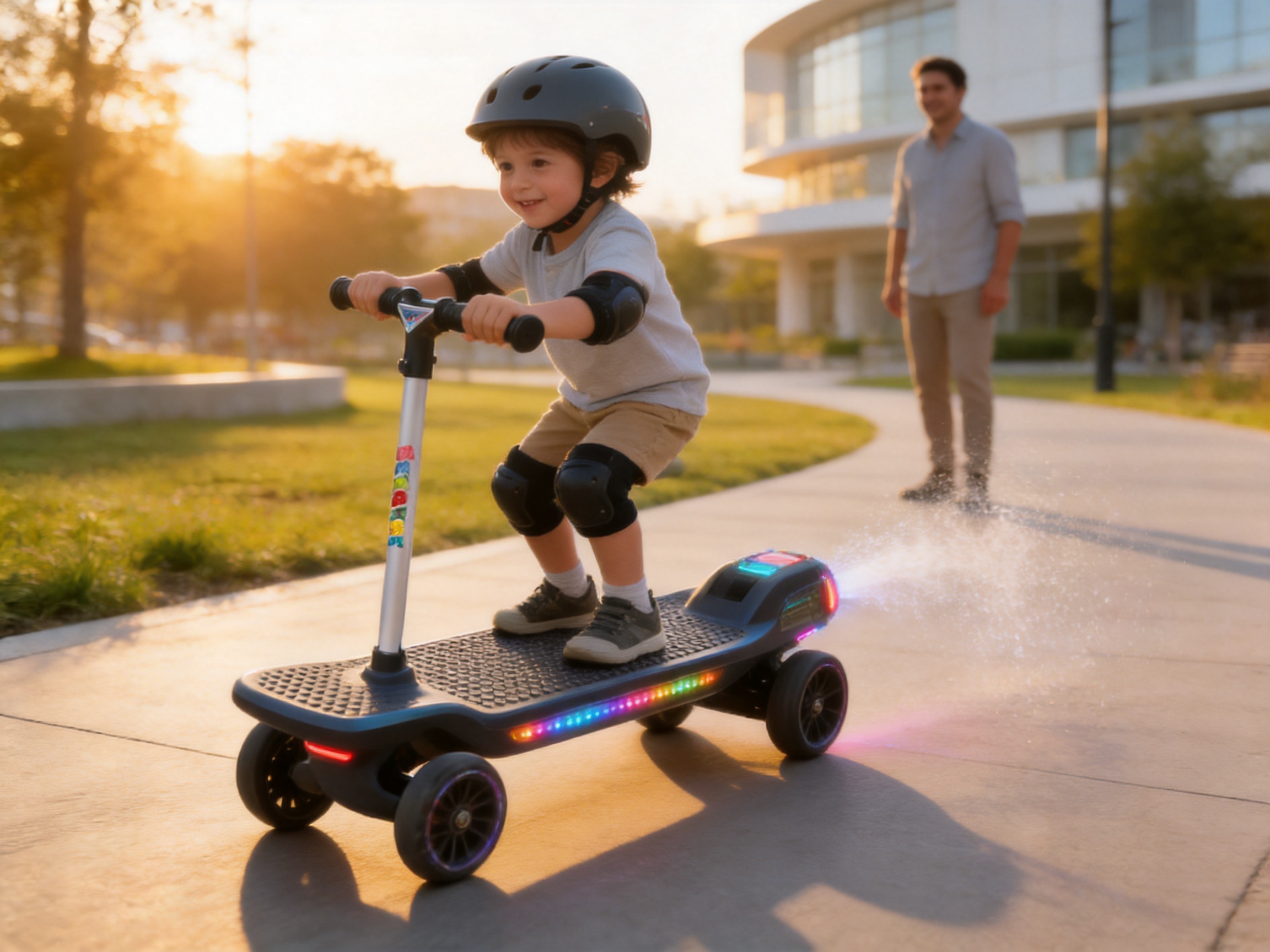
The footrest is one of the most important contact points between the child and the scooter. The FL-929 features a wide, thick footrest with a non-slip textured surface. This provides space for a more stable stance and helps reduce the likelihood of the riding foot sliding during movement.
A broad platform is particularly helpful for beginners, who may not yet have developed the balance required to stand on a narrow deck. It gives the child a clearer physical reference point and allows some flexibility in foot placement. As the child becomes more experienced, the same deck can continue to provide a secure foundation during turning and acceleration.
The textured surface is designed to improve grip. While no surface can guarantee that a child will never slip, a suitable non-slip pattern can provide additional traction when used with appropriate footwear. Parents should still avoid riding in wet conditions or on surfaces contaminated by oil, mud, or other slippery substances.
The deck’s thickness contributes to perceived strength and can support the scooter’s structural stability. For international buyers, the deck is also a visible quality feature that can be shown clearly in product photography and retail demonstrations. Close-up images of the texture, edges, and overall width can help communicate the design advantages to consumers.
Lightweight and Compact for Everyday Family Life
A scooter may be technically impressive, but practical convenience determines how often it is used. The FL-929 is designed to be lightweight and compact enough for families to carry, transport, and store with relative ease.
Parents may need to carry the scooter from a home to a vehicle, move it through a park, or take it on a family trip. A manageable weight makes these situations easier. It also allows children to participate in carrying or organizing the product when appropriate, helping them take responsibility for their sports equipment.
Compact storage is another important benefit. Homes may have limited space, especially apartments and urban residences. A scooter that can be placed in a corner, entryway, storage room, or vehicle trunk is more convenient than a bulky product that must be disassembled after every use.
Portability also broadens the product’s use cases. The FL-929 can support park visits, neighborhood play, short recreational trips, and family outings. Its value is not limited to a single location. The ability to move the scooter easily between environments helps families integrate active play into everyday schedules.
For retail and distribution, compact packaging can offer logistical advantages. Efficient product dimensions may support easier warehouse organization, container loading, and in-store display. Final packaging specifications should be confirmed with the manufacturer, but the compact product concept is favorable for businesses managing multiple sports and leisure categories.
Suitable Use Scenarios
The FL-929 is designed for a range of children’s recreational situations. Parks are a natural application because they provide open areas where children can practice balance, steering, and controlled movement. The light and spray features can make a routine park visit feel more special and encourage children to stay active.
Neighborhood play is another practical use. In suitable low-traffic areas, children can enjoy short rides close to home. The quiet wheels may be appreciated in residential settings, although riders should always follow local rules and avoid roads, driveways with moving vehicles, crowded walkways, and other hazardous areas.
The scooter may also be useful for short recreational trips. Its lightweight design can make it easier to take along when walking to a nearby destination. It should not be treated as a replacement for adult supervision or as a device for riding in traffic, but it can add active movement to ordinary family outings.
Indoor play is possible in selected environments when the space is large enough, the floor is clean and dry, and the activity is permitted. The quiet wheels may reduce disturbance, while the compact form makes the scooter easier to use in a home or indoor recreational area. The spray function should be handled carefully indoors because moisture can make floors slippery and may damage unsuitable surfaces or objects.
The product’s visual effects can also support imaginative play. Children may create games around colorful movement, pretend journeys, and outdoor exploration. This combination of exercise and play gives the scooter a broader appeal than a product focused only on transportation.
Advantages Over Conventional Children’s Scooters
Many conventional children’s scooters provide basic mobility but offer limited interaction. They may have fixed handlebars, narrow decks, ordinary wheels, and no meaningful play feature beyond movement. The FL-929 differentiates itself through a combination of functional and experiential benefits.
| Feature | FL-929 Design Benefit | Value for Children and Families | Commercial Significance |
|---|---|---|---|
| Light and spray effects | Creates an engaging visual and interactive experience | Makes gliding feel more exciting and encourages active play | Strong differentiation in retail displays and online listings |
| Adjustable handlebars | Supports multiple height positions | Improves posture and extends useful product life | Appeals to families seeking longer-term value |
| Lower center of gravity | Promotes a stable riding platform | Helps beginners build confidence | Supports positioning as a beginner-friendly model |
| Wide non-slip deck | Provides space and grip for the riding foot | Encourages a secure stance | Offers a clear, visible quality feature |
| High-elasticity wheels | Supports smooth movement on suitable surfaces | Improves riding comfort | Strengthens the product’s sports-equipment positioning |
| Low rolling noise | Reduces disturbance during use | Suitable for neighborhoods and selected indoor settings | Broadens the number of practical use scenarios |
| Lightweight compact form | Makes carrying and storage easier | More convenient for trips and home organization | Supports efficient handling and family-oriented marketing |
The main advantage is not one isolated feature but the way the features complement one another. Lighting attracts attention, spray adds novelty, stability supports learning, adjustability improves longevity, and portability makes regular use easier. This creates a balanced product proposition for both children and purchasing adults.
Compared with a purely decorative scooter, the FL-929 offers more functional design. Compared with a strictly utilitarian scooter, it offers more entertainment value. This middle position can help it appeal to buyers who want a product that is fun without sacrificing everyday practicality.
Manufacturing Strengths Behind the Product
The performance of a children’s scooter depends heavily on manufacturing consistency. A good concept must be translated into accurate molds, reliable materials, controlled assembly, and repeatable inspection. Ningbo Feile Sporting Goods Co., Ltd. brings more than a product idea to this category. The company operates an integrated manufacturing system covering several important processes.
Established in 2010, the company specializes in children’s scooters, inline skates, roller skates, and ice skates. This category focus gives the manufacturer experience with products that require a combination of plastic components, wheels, textiles, fasteners, ergonomic surfaces, and safety-related details.
The company has more than 200 employees and operates a workshop of approximately 20,000 square meters. It has five advanced automatic production lines and a professional research and development engineering team. This scale can support structured production planning, higher output capacity, and more consistent coordination between development and manufacturing departments.
The presence of mold and injection molding workshops is especially relevant to the FL-929. Scooter bodies, decks, housings, grips, and other components depend on accurate tooling and stable plastic processing. In-house capabilities can help shorten communication paths during design changes, tooling adjustments, and quality investigations.
Sewing and assembly workshops expand the company’s ability to support a wider sports-equipment portfolio. While the FL-929 is primarily a molded scooter product, the broader internal system demonstrates experience with different material categories and assembly requirements. This can benefit buyers sourcing multiple products from the same supplier.
An internal R&D engineering team can contribute to improvements in structure, appearance, usability, and manufacturing efficiency. For OEM customers, engineering support is important when adapting dimensions, colors, packaging, component specifications, or market requirements. A supplier with development capability is generally better positioned to move from an initial idea to a manufacturable product.
Quality Management and Certification Background
According to the supplied company information, Feile has passed ISO9001, BSCI, and Kmart factory certification systems. These qualifications indicate attention to quality management, social responsibility, and factory assessment requirements. Buyers should confirm the current validity, scope, and applicability of each certification during their procurement process.
The company also reports product certifications including 3C, CE, EN71, EN62115, ASTM, EMC, and EN13843:2009. Certification requirements vary according to product type, destination market, electrical functions, age grading, and applicable regulations. Importers should request the relevant test reports and declarations for the specific FL-929 configuration before placing commercial orders.
For a product with lights and a spray-related feature, component-level review is important. Buyers may need to examine electrical safety, battery or power-source specifications, moisture exposure, materials, labeling, warnings, packaging, and instructions. The precise compliance pathway depends on the final product design and target country.
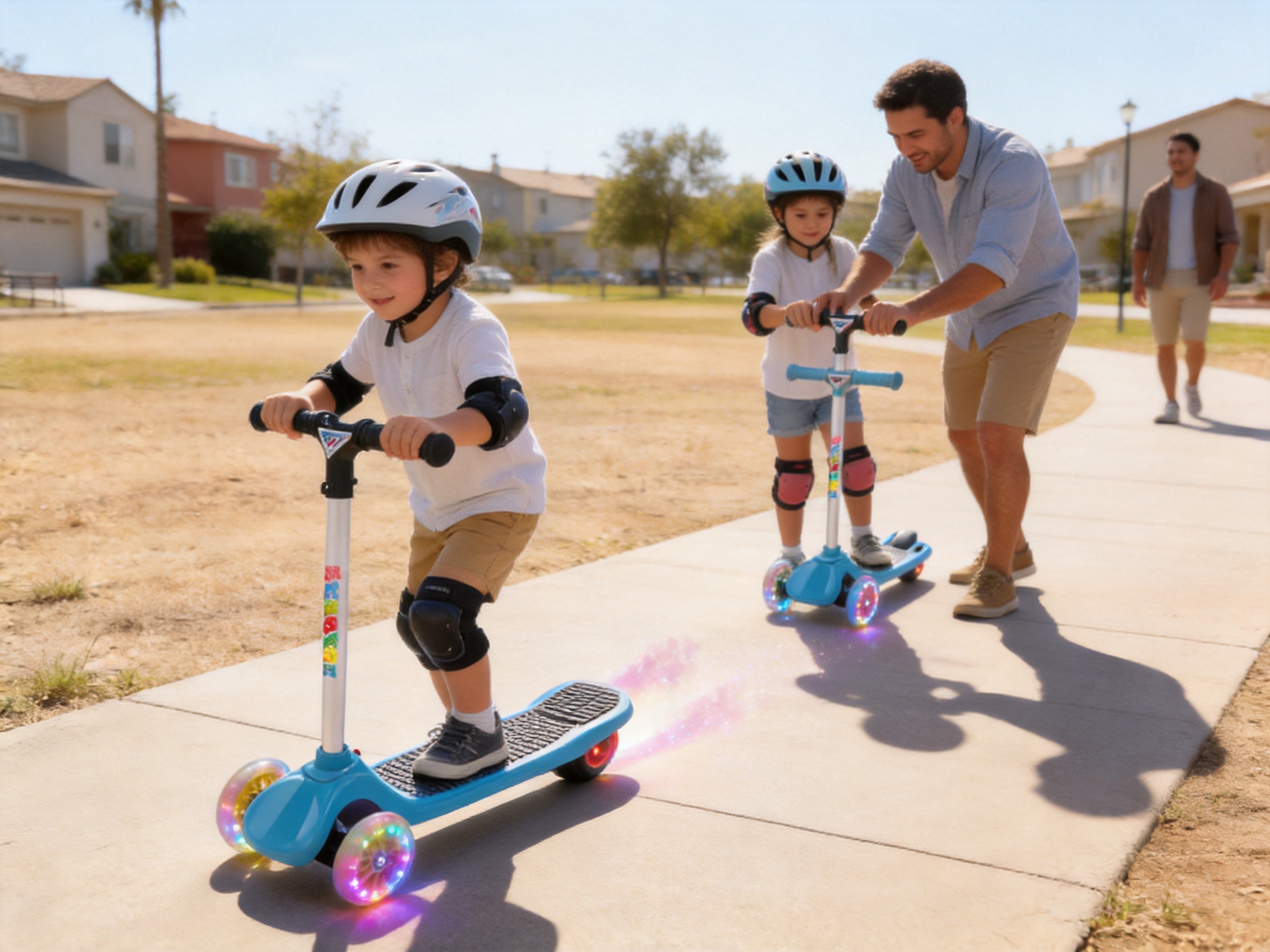
Quality management is not limited to final inspection. It begins with incoming material control and continues through molding, component preparation, assembly, functional testing, appearance checks, packaging, and shipment preparation. A structured process helps reduce problems such as inconsistent color, loose parts, rough edges, wheel misalignment, improper handlebar adjustment, or incomplete accessories.
For distributors, documentation is part of product quality. Clear specifications, carton information, user manuals, warning labels, test reports, and inspection records help support customs clearance, marketplace listings, retailer review, and after-sales service. A capable manufacturer should be able to communicate these materials efficiently.
From Mold Development to Final Assembly
The FL-929’s molded components begin with the design and tooling stage. Mold accuracy affects dimensions, surface quality, component fit, and production repeatability. Proper mold development is therefore essential for maintaining consistent handlebar interfaces, deck geometry, decorative details, and light or spray housings.
Injection molding requires control of material selection, temperature, pressure, cooling, cycle time, and visual inspection. Stable processing helps limit warping, sink marks, short shots, flash, and other defects that may affect appearance or assembly. For a children’s product, smooth edges and reliable component fit are especially important.
After molding, components move through preparation and assembly processes. Wheels, axles, grips, handlebars, deck components, lighting parts, and spray-related components must be installed according to defined procedures. Assembly accuracy affects both the look and the function of the finished scooter.
Functional checks may include handlebar adjustment, wheel rotation, structural stability, lighting operation, spray operation where applicable, and inspection of fasteners. Packaging checks help confirm that the product is protected during transport and that required accessories and instructions are included.
Automation can improve consistency in repetitive production operations, while trained personnel remain important for inspection, adjustment, and exception handling. The combination of automatic production lines, skilled workers, engineering support, and factory-level quality systems allows the manufacturer to respond to volume requirements while maintaining process control.
OEM and Wholesale Opportunities
The FL-929 is suitable for buyers looking for a distinctive children’s scooter within a broader sports-equipment portfolio. Potential customers include importers, wholesalers, sporting goods retailers, children’s product distributors, online sellers, department stores, and private-label brands.
Its design provides several clear marketing messages: light-up play, spray effects, beginner-friendly stability, adjustable height, quiet wheels, and a wide non-slip deck. These messages can be adapted for packaging, catalogs, e-commerce pages, trade-show displays, and sales presentations.
OEM buyers may also evaluate the product according to color options, logo placement, packaging design, instruction language, carton configuration, and regional compliance requirements. The exact scope of customization should be discussed with the manufacturer before production. A formal specification sheet can help define materials, dimensions, components, tolerances, testing, artwork, and inspection standards.
For wholesale buyers, the scooter can be combined with related products to create a complete children’s active-play range. Inline skates, roller skates, ice skates, helmets, knee pads, elbow pads, and other protective gear can be offered alongside scooters. This category strategy may increase average order value and give retailers a more coherent sports-equipment assortment.
The company’s location in Yuyao, Ningbo, Zhejiang Province, provides access to an established manufacturing region known for plastics and industrial supply chains. Its proximity to Ningbo Airport and the wider Shanghai logistics network can support export-oriented business, although actual transportation arrangements, lead times, and shipping costs should be confirmed for each order.
Responsible Product Positioning
Marketing a children’s scooter requires a careful balance between excitement and responsibility. The FL-929 should be presented as a recreational product that encourages movement and play, not as a substitute for supervision or safety equipment.
Product listings should clearly state the intended user range, weight limits, riding environment, assembly requirements, and protective equipment recommendations when these details are confirmed. Buyers should avoid making unsupported claims such as guaranteed injury prevention, completely risk-free use, or suitability for every surface.
The light and spray effects should be explained accurately. If the product requires water, a liquid refill, batteries, or another operating component, instructions should describe the correct method. Consumers should understand how to maintain the spray system, how to prevent slipping, and how to store the scooter safely after use.
Retailers can improve customer satisfaction by providing practical riding advice. Children should use helmets and suitable protective pads, remain away from traffic, avoid steep slopes, check the riding surface, and stop using the scooter if any component becomes loose or damaged.
Maintenance and Care Recommendations
Regular care can help preserve the FL-929’s performance and appearance. After outdoor use, parents should remove dirt, leaves, and small debris from the deck, wheels, and moving areas. The scooter should be dried if it becomes wet, particularly around electrical components and the spray system.
The wheels should be checked for cracks, excessive wear, embedded stones, or restricted rotation. The handlebar should be inspected to make sure it remains securely locked at the selected height. Fasteners and structural connections should be reviewed periodically, especially when the scooter is used frequently.
The non-slip deck should be kept clean so that dirt and moisture do not reduce its grip. If the light or spray function does not operate normally, the product should be removed from use until the issue is identified. Parents should use only manufacturer-approved replacement parts and follow the supplied instructions.
Storage in a dry, moderate environment can help protect plastic, metal, wheels, and electrical components. Avoid leaving the scooter exposed to intense sunlight, heavy rain, extreme heat, or freezing conditions for long periods. Appropriate storage is particularly important for families who want to use the product over multiple seasons.
Why the FL-929 Has Strong Market Potential
The children’s recreation market continues to value products that combine physical activity with entertainment. Parents want children to spend less time passively consuming content, while children respond strongly to products that offer immediate visual and interactive appeal. The FL-929 addresses both sides of this market demand.
Its light and spray effects make the product visually memorable. Its adjustable construction provides a practical reason to purchase. Its stable platform supports beginner use. Its compact format supports everyday convenience. Its quiet wheels make it more acceptable in residential settings. Together, these features create a product with more complete positioning than a basic scooter.
The model can be marketed across several channels. Sporting goods stores can place it within children’s mobility equipment. Toy retailers can promote its light and spray experience. Online sellers can highlight its adjustable height and wide deck. Gift retailers can present it as an active-play gift. Distributors can include it in seasonal outdoor collections or broader skating and scooter programs.
Its appeal is also suitable for international markets because the core benefits are widely understandable: fun, comfort, stability, adjustability, portability, and durability. Localization remains necessary for language, warnings, compliance, and packaging, but the fundamental product story can be adapted efficiently.
Q&A: Common Questions About the FL-929
What is the FL-929?
The FL-929 is a children’s scooter featuring colorful lighting and a spray effect designed to make gliding more interactive and visually engaging. It also includes adjustable handlebars, a lowered center of gravity, a wide non-slip footrest, and quiet, wear-resistant wheels.
What makes the light-and-spray function different?
The feature combines a continuous light effect with a gentle spray effect during riding. This gives children a more immersive play experience than a conventional scooter with no interactive effects. Users should follow the supplied instructions and avoid directing spray toward the face or eyes.
Is the scooter suitable for beginners?
The FL-929 is designed with beginner-friendly features, including a lowered center of gravity, a broad deck, and a non-slip footrest. These features are intended to support stability and confidence, although children still need practice, supervision, and appropriate protective equipment.
Can the handlebar height be adjusted?
Yes. The scooter has multi-level handlebar height adjustment. This allows the riding position to be adapted for children of different heights and can extend the product’s useful life as a child grows.
Is the scooter easy to carry?
The FL-929 is designed to be lightweight and compact, making it easier to carry to parks, take on trips, place in a vehicle, and store at home.
Are the wheels noisy?
The high-elasticity wheels are designed for smooth and quiet rolling on suitable surfaces. Their low-noise performance makes the scooter appropriate for many neighborhood settings and selected indoor environments where riding is permitted.
What type of surface is recommended?
Suitable clean, dry, and reasonably smooth surfaces are recommended. Riders should avoid traffic areas, steep slopes, wet floors, loose gravel, sharp debris, and other surfaces that may reduce control or damage the wheels.
Does the scooter replace a helmet or protective gear?
No. The scooter does not replace safety equipment. Children should use a properly fitted helmet and suitable protective pads according to their age, ability, and riding environment.
Who manufactures the FL-929?
The product is manufactured by Ningbo Feile Sporting Goods Co., Ltd., a Chinese sporting goods company established in 2010 and specializing in children’s scooters, inline skates, roller skates, and ice skates.
What manufacturing capabilities does the company have?
The company reports more than 200 employees, a 20,000-square-meter workshop, five advanced automatic production lines, a professional R&D engineering team, and mold, injection molding, sewing, and assembly workshops.
Does the manufacturer support OEM orders?
The company is positioned as an OEM sporting goods manufacturer and can discuss private-label or customized requirements with buyers. Specific options, minimum order quantities, colors, packaging, testing, and lead times should be confirmed directly for each project.
What certifications are associated with the company and its products?
The supplied company information reports ISO9001, BSCI, and Kmart factory certification systems, along with product certifications including 3C, CE, EN71, EN62115, ASTM, EMC, and EN13843:2009. Buyers should verify the current documents and confirm their relevance to the exact product configuration and destination market.
Conclusion
The FL-929 Light-Up Children’s Scooter combines practical riding support with a distinctive play experience. Its colorful lights and spray effect help it stand apart from ordinary scooters, while the lowered center of gravity, wide non-slip footrest, adjustable handlebars, quiet wheels, and compact structure address the everyday needs of children and families.
For children, the product offers movement, visual excitement, and a more enjoyable way to develop balance and coordination. For parents, it offers adjustability, portability, low-noise operation, and a design intended to support confident beginner use. For retailers and distributors, it provides a differentiated product story with several clear selling points.
The manufacturing foundation behind the product further strengthens its commercial potential. Ningbo Feile Sporting Goods Co., Ltd. combines category experience with mold development, injection molding, automatic production lines, engineering support, assembly capacity, and reported quality and compliance systems. This combination can support both standard product supply and broader OEM cooperation.
As with any children’s mobility product, responsible use, correct supervision, protective equipment, maintenance, and market-specific compliance remain essential. When these requirements are properly addressed, the FL-929 can serve as an attractive addition to children’s scooters, skating equipment, and active-play product lines worldwide.
References
1. Product information supplied for the FL-929 Light-Up Children’s Scooter, including design features, applications, dimensions, and image references.
2. Company information supplied for Ningbo Feile Sporting Goods Co., Ltd., including manufacturing facilities, workforce, production lines, research and development capabilities, and product categories.
3. General principles of children’s scooter design, including stability, handlebar ergonomics, deck grip, wheel performance, portability, and supervised use.
4. General considerations for children’s sports-equipment quality management, factory assessment, product testing, labeling, and market-specific compliance.
5. General safety guidance for children’s wheeled recreational products, including helmet use, protective equipment, surface selection, supervision, inspection, and maintenance.
Product: FL-929 Light Up Children Scooter

Recommended Articles

Get in Touch
Your email address will not be published. Required fields are marked *
Have a project in mind? Contact with us!
We are happy to answer your questions. Please fill out this form
and one of our professional team will get back to you as soon as possible.

We specialize in producing various types of children's toy cars, children's skateboards, and ice skates.
