
 En
 Español
 русский
 عربى

Outdoor Children’s Scooter: A Safer, More Adaptable Choice for Everyday Riding
Date:Oct 09, 2026
Content
- 1 1. Designed Around the Real Needs of Young Riders
- 2 2. Stable Two-Wheel Architecture for Outdoor Use
- 3 3. Multi-Level Handlebar Adjustment That Extends Product Use
- 4 4. A Broad, Non-Slip Deck for More Secure Foot Placement
- 5 5. High-Elasticity Wheels for Quiet and Smooth Gliding
- 6 6. Lightweight Construction for Families on the Move
- 7 7. Healthier Riding Posture and Early Exercise Habits
- 8 8. A Practical Alternative to Short-Term Children’s Products
- 9 9. Product Advantages Compared with Typical Alternatives
- 10 10. Manufacturing Strengths Behind the Product
- 11 11. Research, Development, and Product Improvement
- 12 12. Quality Systems and International Market Readiness
- 13 13. Safety Guidance for Parents, Retailers, and Operators
- 14 14. Recommended Use Environments
- 15 15. Information for Wholesale and OEM Buyers
- 16 16. Frequently Asked Questions
- 16.1 Q1: What age group is the FL-770 designed for?
- 16.2 Q2: Can the handlebar height be adjusted?
- 16.3 Q3: Is the scooter intended for outdoor riding?
- 16.4 Q4: Are the wheels designed to reduce noise?
- 16.5 Q5: Does the scooter have a non-slip standing area?
- 16.6 Q6: Is the scooter suitable for tricks or jumps?
- 16.7 Q7: What protective equipment should a child wear?
- 16.8 Q8: What manufacturing capabilities does the supplier have?
- 16.9 Q9: Can international buyers request OEM or private-label services?
- 16.10 Q10: What certifications are associated with the product range?
- 16.11 Q11: How should the scooter be maintained?
- 16.12 Q12: What makes this model attractive to retailers?
- 17 17. Conclusion
- 18 References
- 19 Product: FL-770 Outdoor Children Scooter
Choosing a first scooter for a child involves more than selecting an attractive color or a low purchase price. Parents, schools, retailers, and distributors need to consider stability, adjustability, construction quality, portability, comfort, and the manufacturer’s ability to deliver consistent production at scale. The FL-770 outdoor children’s scooter is designed around these practical requirements. It is intended for children aged approximately three to eight and is built for outdoor gliding, daily exercise, short neighborhood trips, and recreational play.
The scooter combines a stable two-wheel structure, a low center of gravity, a height-adjustable handlebar, wide non-slip pedals, quiet high-elasticity wheels, and a lightweight frame. Together, these features create a product that is easy for young riders to understand and convenient for adults to carry, store, clean, and manage. It is suitable for children’s parks, community squares, playgrounds, camping areas, and selected indoor spaces with appropriate flooring.
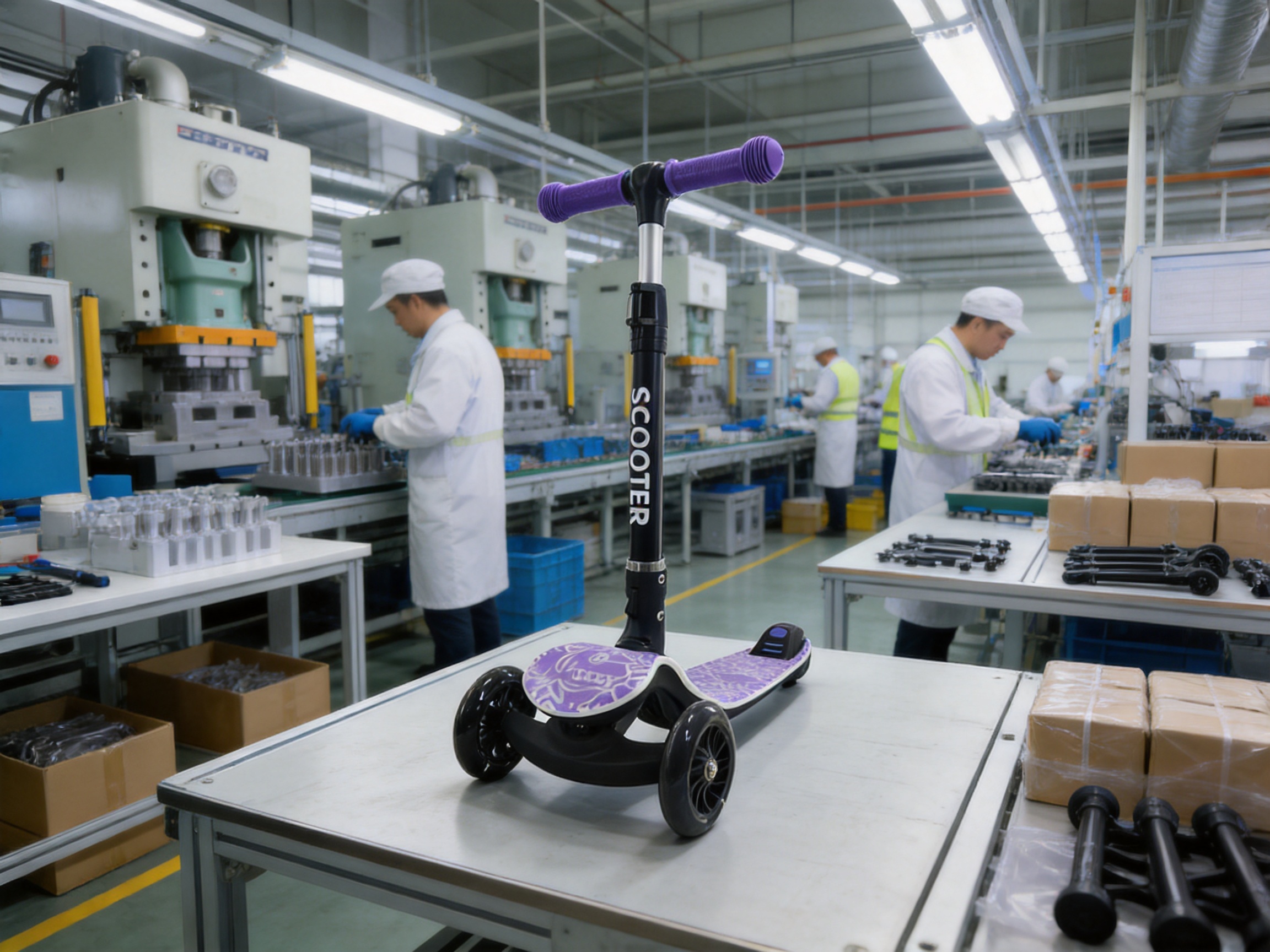
For wholesale buyers and original equipment manufacturing customers, the product also represents the advantages of an experienced sporting-goods factory. Ningbo Feile Sporting Goods Co., Ltd. has specialized in children’s scooters, inline skates, roller skates, and ice skates since 2010. Its production capabilities include mold development, injection molding, sewing, assembly, product research and development, quality management, and export-oriented compliance support.
1. Designed Around the Real Needs of Young Riders
Young children learn differently from older children and adults. They need equipment that responds predictably, supports basic balance, and does not demand advanced athletic technique from the beginning. A scooter that is too tall, too heavy, narrow underfoot, or difficult to steer can quickly become frustrating. By contrast, an appropriately designed children’s scooter can turn short outdoor sessions into enjoyable opportunities for movement and skill development.
The FL-770 addresses this early learning stage with a simple operating concept. The rider stands on a broad deck, holds the handlebar, and develops balance while gliding and steering. The structure is intentionally uncomplicated, allowing children to concentrate on body control instead of managing unnecessary mechanisms. This simplicity is especially valuable for preschool users who are still developing coordination and confidence.
The recommended age range is approximately three to eight years. Since children within this range can differ considerably in height and physical development, the adjustable handlebar is an important part of the design. Rather than requiring a completely new scooter whenever a child grows, the handlebar can be adjusted through multiple levels to improve fit over a longer period.
Parents should always confirm the product’s actual dimensions, handlebar settings, and weight capacity before purchase. Age guidance is a useful starting point, but the child’s height, coordination, footwear, riding environment, and ability to follow safety instructions should also be considered.
2. Stable Two-Wheel Architecture for Outdoor Use
Outdoor surfaces are rarely as uniform as a smooth indoor floor. Pavement may contain small joints, slight changes in texture, dust, or minor undulations. A children’s scooter intended for outdoor use therefore needs a structure that remains predictable when the surface is not perfectly flat.
The FL-770 uses a scientifically arranged two-wheel balance structure together with a low center of gravity. This configuration helps keep the riding platform close to the ground and supports a stable stance. A lower center of gravity can make the scooter feel less top-heavy, particularly when a young rider is learning to maintain balance or is moving at a moderate speed.
Stability does not mean that the scooter eliminates the need for supervision or protective equipment. Rather, it means that the product is designed to give beginners a dependable foundation. The rider still needs to learn how to start, glide, steer, slow down, and stop. Adults should introduce the scooter on a clear, level surface before moving to busier outdoor areas.
Compared with lightweight products that prioritize minimum material use over riding confidence, the FL-770 emphasizes a more secure relationship between the deck, wheels, handlebar, and rider. The result is a scooter that can support basic balance practice while remaining suitable for regular leisure use.
Why a Low Center of Gravity Matters
A low center of gravity can improve the feeling of control during ordinary gliding. When the rider’s standing position is closer to the ground, small body movements are less likely to create an exaggerated rocking sensation. This can be helpful for children who are transitioning from walking and running activities to wheeled sports.
The design also supports easier mounting and dismounting than a taller platform might provide. Young riders can place one foot on the deck with greater confidence, maintain a more natural posture, and practice shifting their weight gradually. These factors contribute to a more comfortable learning experience.
3. Multi-Level Handlebar Adjustment That Extends Product Use
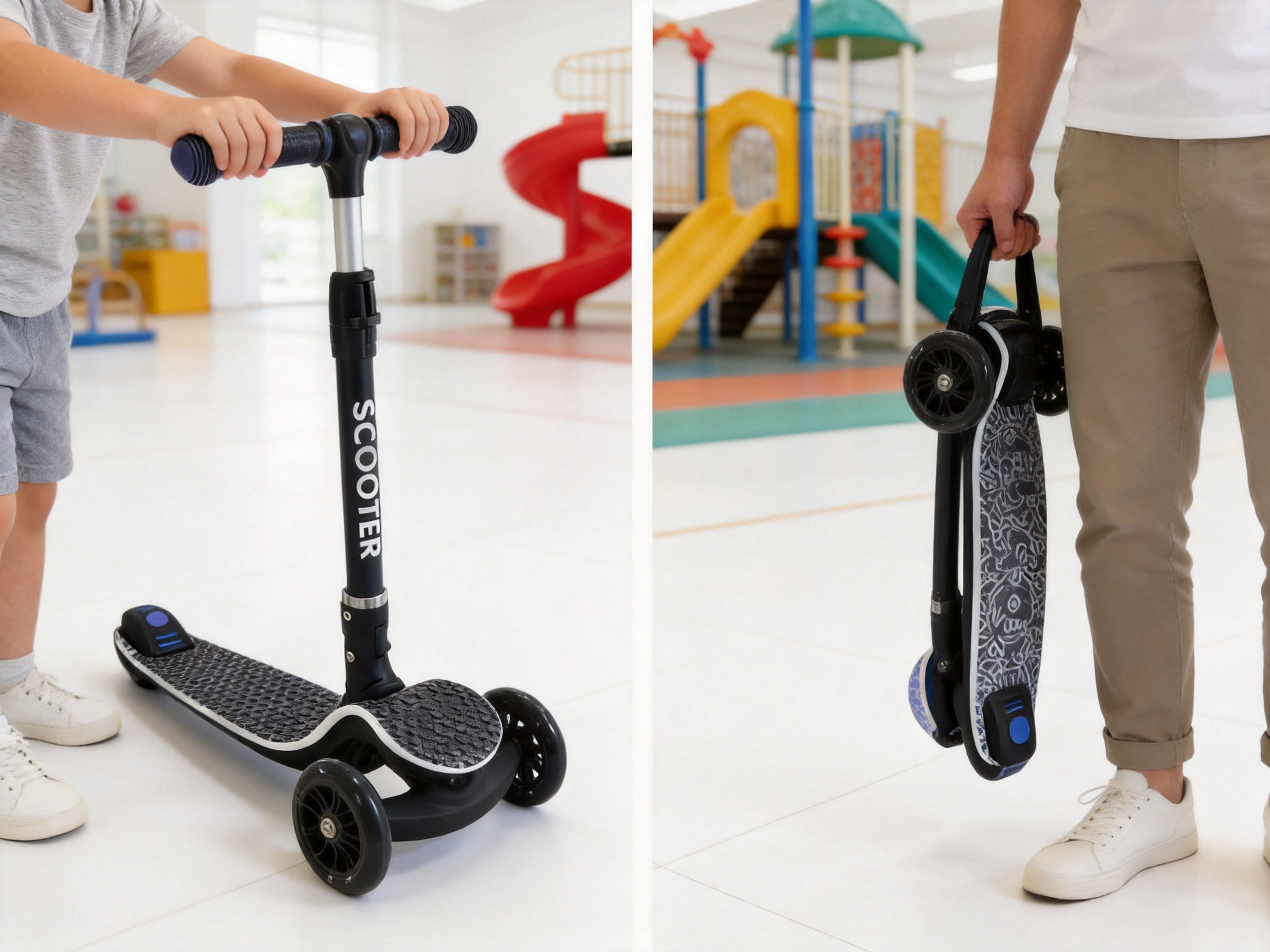
Children grow quickly, and fixed-height equipment can become uncomfortable or unsuitable within a relatively short time. A handlebar that is too low may encourage bending or hunching, while a handlebar that is too high can reduce control. The FL-770 includes a dedicated multi-level adjustable handlebar to accommodate changes in the rider’s height.
Correct handlebar height helps the child keep the upper body in a natural position. The rider should be able to hold the grips without excessive shoulder elevation or excessive forward bending. A balanced posture can make steering feel more intuitive and reduce unnecessary fatigue during play.
The adjustability also creates a commercial advantage for retailers and distributors. A product that can serve children across several developmental stages may be easier to present as a longer-term purchase rather than a short-lived novelty. Parents may view the scooter as more valuable when it remains useful as the child grows.
Although the supplied product information emphasizes use for children aged three to eight, any reference to younger or smaller children should be interpreted carefully. Product fit must be verified against the manufacturer’s dimensional specifications and the individual child. Children should not use the scooter if they cannot stand securely, hold the handlebar confidently, or understand basic riding instructions.
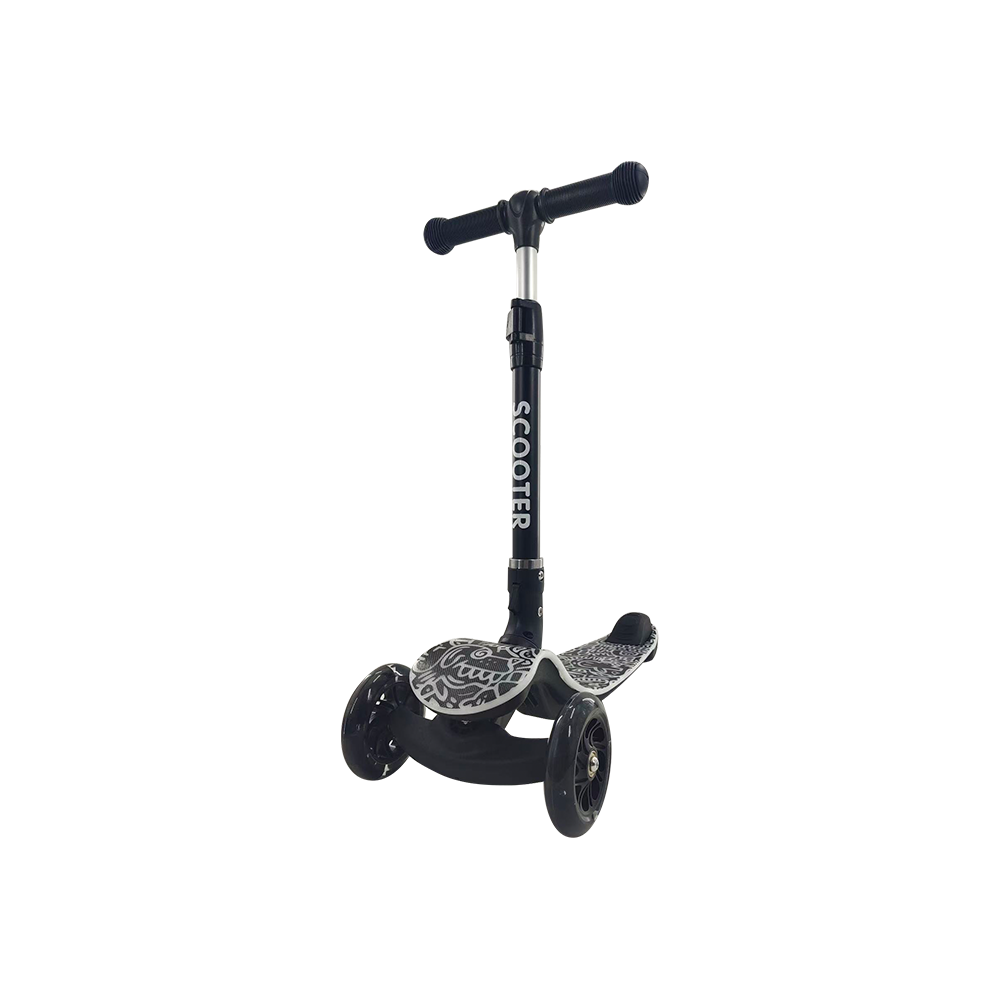
FL-770 Outdoor Children Scooter
4. A Broad, Non-Slip Deck for More Secure Foot Placement
The deck is one of the most important contact points between the child and the scooter. A narrow or slippery surface can make it difficult for a beginner to place the supporting foot correctly. The FL-770 uses a larger pedal area with a non-slip textured surface, providing a more generous foothold during gliding.
A wider deck allows the child to position the foot without needing precise athletic technique. This can be particularly useful during the early stages of learning, when the rider is still experimenting with stance and balance. The texture helps improve grip under ordinary conditions and can reduce the likelihood of foot movement caused by minor surface moisture or dust.
The deck also supports more comfortable recreational use. Children may ride for short periods, pause, restart, and change direction. A stable standing area makes these transitions easier to manage. For adults, the wider pedal can make the product easier to introduce because the child does not have to master a narrow stance immediately.
Like any non-slip surface, the deck should be kept reasonably clean and dry. Mud, sand, ice, oil, and heavy water exposure can affect traction. Routine inspection is recommended, especially for products used frequently in parks, playgrounds, or community areas.
5. High-Elasticity Wheels for Quiet and Smooth Gliding
The FL-770 is fitted with thickened, wear-resistant wheel cores designed to support smooth movement across suitable concrete, rubberized playground surfaces, and other relatively even areas. The wheels are also described as high-elasticity and quiet, making them suitable for both outdoor and selected indoor recreational environments.
Noise can affect where a children’s scooter is practical to use. Loud rolling sounds may disturb other people in residential buildings, classrooms, community centers, or homes. Quieter wheels allow children to enjoy active play without creating the same level of rolling noise associated with some hard or poorly damped wheels.
Wheel elasticity can also contribute to a more comfortable ride by helping the wheels respond to small surface irregularities. This does not make the scooter suitable for rough trails, stairs, gravel, or damaged pavement. It does, however, support more controlled gliding on ordinary recreational surfaces.
The wheels are intended to provide a balance between smooth movement, durability, and everyday convenience. For a children’s product, this balance is more valuable than extreme speed. A scooter that moves predictably and quietly is generally more appropriate for skill development than one optimized only for rapid acceleration.
Indoor and Outdoor Flexibility
The product can be used outdoors in children’s parks, community squares, playgrounds, and similar environments. It can also be used indoors for leisure play when the floor is clear, level, and appropriate for wheeled equipment. Adults should ensure that furniture, stairs, glass doors, electrical cables, and other obstacles are removed from the riding area.
Indoor use should always follow the rules of the facility. Some buildings do not permit scooters because of flooring, traffic, noise, or liability concerns. The quiet wheel design expands the potential use environment, but it does not replace site-specific safety policies.
6. Lightweight Construction for Families on the Move
Children’s equipment often needs to travel beyond the home. Families may take a scooter to a park, camping location, school activity, vacation destination, or neighborhood gathering. A product that is difficult to carry can reduce how often it is used, even if its riding performance is satisfactory.
The FL-770 uses a lightweight design with a simple overall structure. Adults can carry it more easily when the child becomes tired or when the riding session ends. Its uncomplicated shape also makes it convenient to place in a storage area, vehicle, closet, or corner of a home.
Portability is particularly relevant for families with more than one child. Parents may need to carry a scooter, protective equipment, food, bags, and other outdoor items at the same time. Reducing unnecessary bulk can make outings more manageable.
For retailers, lightweight construction can also simplify handling during warehousing, display preparation, and order fulfillment. Packaging design, carton dimensions, and shipping weight should be confirmed with the manufacturer for each order, but the product concept is clearly oriented toward practical transportation and storage.
7. Healthier Riding Posture and Early Exercise Habits
Active play during childhood supports the development of balance, coordination, spatial awareness, and confidence in movement. A scooter cannot replace varied physical activity, but it can provide an engaging way for children to practice these abilities during outdoor leisure time.
The adjustable handlebar is intended to support a more natural gliding posture. When the handlebar is correctly positioned, the rider is less likely to bend excessively at the waist or hunch the shoulders. A comfortable posture can make short exercise sessions more enjoyable and may encourage children to use the product regularly.
The scooter also allows children to practice weight transfer. They learn to push with one foot, place both feet securely, lean gently while steering, and respond to changes in direction. These actions involve coordination between the legs, arms, eyes, and core muscles.
Parents should treat riding as active recreation rather than formal training. Short sessions on appropriate surfaces are usually more suitable than expecting a young child to ride for a long time. Rest breaks, water, shade, and supervision remain important, especially during warm weather.
8. A Practical Alternative to Short-Term Children’s Products
Many children’s products are purchased during a particular developmental stage and then replaced as the child grows. While replacement may sometimes be necessary, adjustable equipment can help reduce the frequency of upgrading. The FL-770’s multi-level handlebar is intended to extend its useful period across several years of childhood.
This longer-use approach offers several potential advantages over a fixed-height scooter. Families may obtain more value from one product, retailers can position it as an adaptable model, and distributors can offer a product with a clearer long-term use story. The scooter’s design also combines multiple practical features rather than focusing on a single visual selling point.
Compared with products that use complicated electronic functions, lights, or entertainment features, the FL-770 emphasizes fundamental riding quality. Its value is found in stability, fit, grip, wheel performance, portability, and construction. This functional focus can appeal to parents who prefer durable exercise equipment over products that are quickly outgrown or dependent on batteries.
For institutional buyers, the straightforward design may also be easier to explain and maintain. Staff members can teach basic use without introducing multiple electronic controls. Nevertheless, institutions should establish their own inspection, storage, cleaning, and supervision procedures.
9. Product Advantages Compared with Typical Alternatives
Every scooter category includes different designs, price levels, and intended uses. The FL-770 should be compared with products that serve a similar age group and riding environment. Its advantages are most apparent when the buyer values adaptable sizing, stable outdoor handling, quiet operation, a generous standing area, and ease of transport.
| Evaluation Area | FL-770 Design Approach | Potential Benefit for Users |
|---|---|---|
| Target user | Children approximately three to eight years old | Supports early skill development and recreational riding |
| Handlebar | Multi-level adjustable structure | Improves fit as the child grows and supports natural posture |
| Balance | Two-wheel structure with low center of gravity | Provides a stable foundation for beginner riders |
| Deck | Large pedal area with non-slip texture | Offers a more secure foothold and easier stance adjustment |
| Wheels | High-elasticity, wear-resistant, quiet wheel cores | Supports smooth, lower-noise movement on suitable surfaces |
| Portability | Lightweight and uncomplicated construction | Makes carrying and storage easier for families and retailers |
| Use environment | Outdoor recreation and selected indoor areas | Provides flexibility for parks, playgrounds, neighborhoods, and homes |
| Manufacturing support | Factory with molding, injection, sewing, assembly, and R&D resources | Supports product consistency, customization discussions, and supply coordination |
A heavier scooter may feel substantial, but it can be inconvenient for a young child and difficult for a parent to carry. A very compact scooter may be easy to store, but its deck or handlebar may provide less room for a growing rider. A fixed-height design may cost less initially, but it can become unsuitable sooner. The FL-770 seeks a middle position by combining a lightweight format with adjustable fit and a stable riding platform.
It is also important to distinguish a children’s recreational scooter from a high-performance stunt scooter. The FL-770 is designed for ordinary gliding and exercise, not jumps, tricks, ramps, aggressive downhill riding, or professional competition. Using the product within its intended purpose is essential for safety and durability.
10. Manufacturing Strengths Behind the Product
A well-designed product depends on more than its visible features. Manufacturing control affects dimensional consistency, assembly quality, durability, packaging, and the ability to respond to customer requirements. The production background of the supplier is therefore an important consideration for importers, wholesalers, retailers, and private-label customers.
Ningbo Feile Sporting Goods Co., Ltd. was established in 2010 and specializes in children’s scooters, inline skates, roller skates, and ice skates. This focused product experience allows the company to understand the functional demands of wheeled sporting goods, including wheel fitting, plastic component production, ergonomic considerations, fastening, assembly, and product presentation.
The company operates a workshop of approximately 20,000 square meters and employs more than 200 people. It has five advanced automatic production lines and a professional research and development engineering team. These resources can support repeatable production and provide a foundation for serving both standard product orders and customer-specific sourcing programs.
Integrated Mold and Injection Molding Capabilities
In-house or closely coordinated mold and injection molding capabilities can improve communication between product development and manufacturing. For a scooter, molded parts may include structural components, deck elements, wheel-related components, housings, protective pieces, and other plastic assemblies. Effective mold development influences fit, appearance, strength, repeatability, and production efficiency.
When the engineering and production teams work within an integrated system, design adjustments can be evaluated more efficiently. This may be useful when customers request changes to color, texture, surface treatment, packaging configuration, or selected components. Exact customization options, minimum order quantities, tooling fees, and lead times must be confirmed for each project.
Injection molding also supports consistent production volumes when process parameters are properly controlled. Material selection, mold temperature, injection pressure, cooling time, trimming, and visual inspection can all affect the final component. An experienced factory is better positioned to establish repeatable procedures across large orders.
Sewing and Assembly Workshops
The company’s facilities include sewing and assembly workshops in addition to molding operations. This broader manufacturing structure is useful for a product range that includes skates, protective gear, soft goods, straps, padding, packaging accessories, and assembled sporting products.
Assembly quality is particularly important for scooters because multiple components must function together. The handlebar, deck, wheels, fasteners, and other parts need to be correctly aligned and securely fitted. A disciplined assembly process can reduce variation and help ensure that finished units meet defined specifications.
Customers purchasing for international markets may also benefit from a single supplier capable of coordinating multiple product categories. A buyer sourcing scooters, inline skates, roller skates, ice skates, or protective equipment can discuss product planning with a factory familiar with the wider skating and scooter sector.
11. Research, Development, and Product Improvement
Children’s sporting products must evolve with changes in consumer expectations, safety requirements, materials, retail presentation, and usage habits. The company maintains a professional R&D engineering team and launches new products each year to address market and customer needs.
Product development in this sector may involve more than appearance. Engineers may evaluate handlebar adjustment systems, deck dimensions, wheel materials, structural balance, comfort, packaging, color combinations, and manufacturing efficiency. The objective is to create equipment that is attractive while remaining useful, safe, and practical.
The FL-770 reflects a development approach centered on fundamental riding needs. Its features are not limited to decorative elements. Adjustable height, low-center stability, non-slip footing, quiet wheels, and portability all respond to specific concerns faced by children and caregivers.
For OEM and private-label buyers, an established R&D team can be valuable when adapting an existing model. Possible discussions may include branding, color matching, packaging artwork, instruction materials, component changes, and market-specific documentation. The feasibility of each request depends on tooling, order quantity, technical requirements, and applicable regulations.
12. Quality Systems and International Market Readiness
International buyers need confidence that a supplier understands quality management and market compliance. The company has passed ISO9001, BSCI, and Kmart factory certification systems, according to the supplied company information. These credentials indicate experience with structured quality processes, social responsibility expectations, and retailer-oriented factory evaluation.
The company also reports certifications and compliance achievements including 3C, CE, EN71, EN62115, ASTM, EMC, and EN13843:2009 across its product range. Certification applicability depends on the specific product, configuration, destination market, and current regulatory requirements. Buyers should request current certificates, test reports, declarations, and technical files for the exact FL-770 version being ordered.
Compliance should not be treated as a substitute for responsible use. A certified product still requires appropriate supervision, protective gear, maintenance, and correct riding conditions. From a supply-chain perspective, however, documented testing and established quality procedures can simplify market preparation and reduce uncertainty.
International customers should also confirm labeling rules, language requirements, warning statements, packaging marks, country-of-origin information, age grading, importer details, and shipping documentation before production begins. Early communication helps prevent avoidable delays after goods are manufactured.
13. Safety Guidance for Parents, Retailers, and Operators
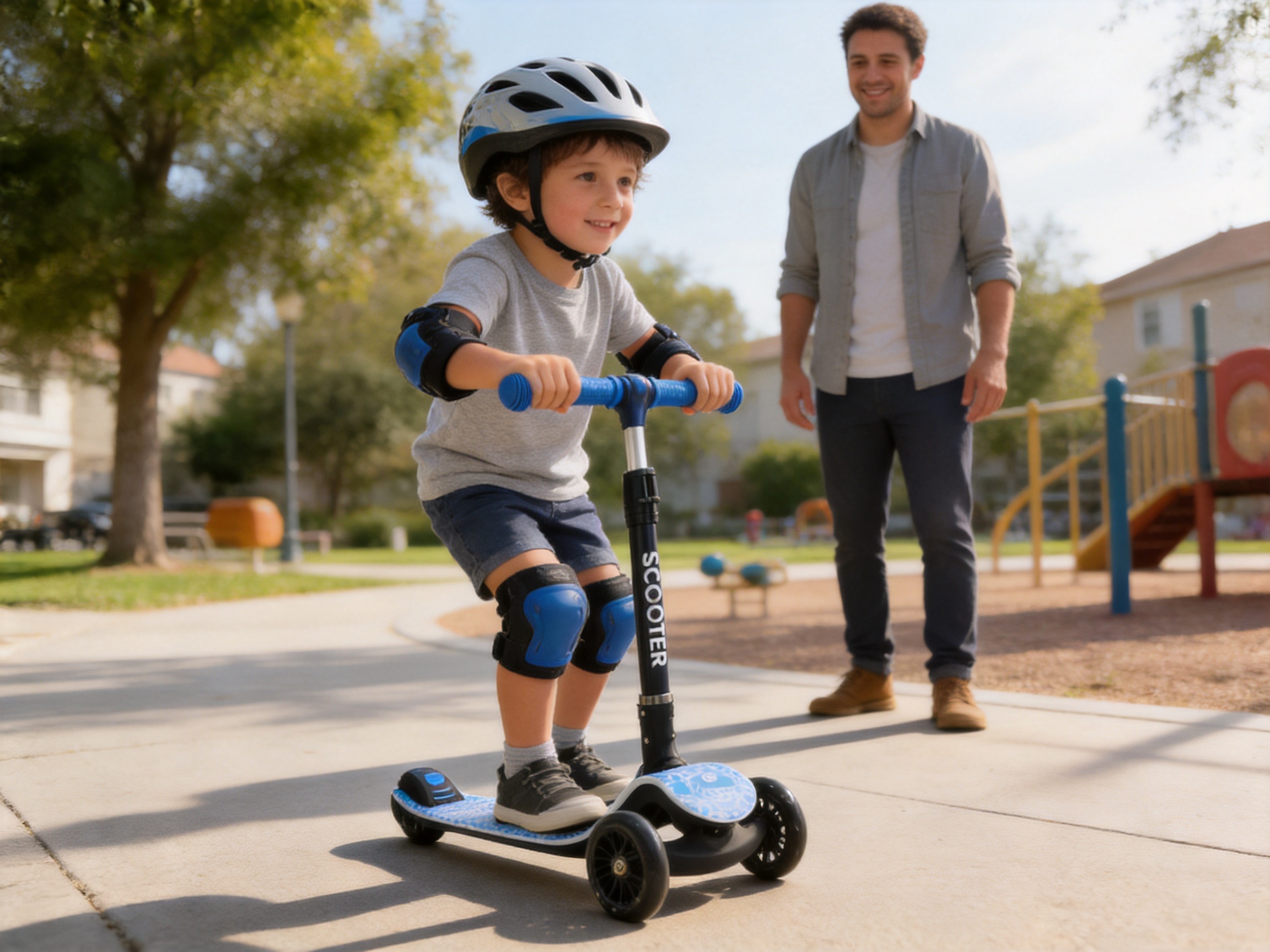
The FL-770 is intended for recreational use, but all wheeled products require responsible supervision. Children should wear a properly fitted helmet and appropriate protective equipment, including knee and elbow protection where suitable. Protective gear is especially important while the child is learning or riding in unfamiliar areas.
Initial practice should take place on a flat, dry, open surface away from vehicles, stairs, water, steep slopes, cyclists, and pedestrians. Adults should demonstrate how to stand on the deck, push gradually, steer gently, slow down, and step off safely. Children should not be encouraged to ride faster than they can control.
Before each use, an adult should inspect the wheels, deck, handlebar, adjustment mechanism, fasteners, and visible structural components. Any loose, cracked, bent, or damaged part should be addressed before the scooter is used again. The adjustment mechanism should be locked correctly at the selected height.
Riding at night, in heavy rain, on wet leaves, on ice, over loose gravel, or near traffic creates additional hazards. The scooter should not be used for stunts, jumps, towing, racing in crowded areas, or activities outside its intended recreational purpose.
Retailers can support safer use by displaying clear age guidance, protective equipment recommendations, maintenance instructions, and warnings at the point of sale. Distributors can include translated manuals and region-specific safety materials with each shipment.
14. Recommended Use Environments
The scooter is suitable for a range of ordinary family and community activities. In children’s parks, it can provide an active alternative to sedentary play. In community squares, it can support short recreational sessions when pedestrian traffic is controlled. In playgrounds, it may be used on appropriate paved or rubberized areas that are free of obstacles.
For camping trips, the lightweight construction makes transportation more convenient. Children can use the scooter on suitable paths around a campsite, provided the ground is level enough and adults have confirmed that the area is safe. Natural trails, steep slopes, loose stones, and roots are not appropriate for this type of scooter.
Neighborhood use can make short journeys more enjoyable for preschool children, but adults should remain alert to driveways, parked cars, intersections, bicycles, pets, and other road hazards. The product should not be treated as a road vehicle or used in active traffic.
At home, indoor use can enrich after-school exercise and leisure time. A clear hallway, playroom, gymnasium, or other approved area may be appropriate. Hard furniture edges and fragile objects should be removed or protected, and the floor should provide adequate traction.
15. Information for Wholesale and OEM Buyers
For commercial customers, product performance is only one part of a successful purchase. Buyers should evaluate the manufacturer’s production capacity, engineering support, quality systems, communication, packaging capabilities, and export experience.
The supplier’s location in Yuyao, Ningbo, Zhejiang Province provides access to an established manufacturing region known for plastics production. The company address is No. 27 Maosheng Road, Lianghui Economic District, Yuyao City, Ningbo, Zhejiang Province, China. Its proximity to Ningbo transportation infrastructure and access to wider regional logistics networks can support international shipment planning.
Potential customers should discuss the following points before placing an order:
First, confirm the exact product specification, including dimensions, colors, materials, wheel details, handlebar adjustment levels, product weight, recommended age, and applicable load limits.
Second, request current photographs, samples, inspection standards, test reports, certificates, packaging drawings, carton information, and instruction materials for the selected version.
Third, clarify whether the order is standard production, OEM, private label, or a modified design. Changes to molds, components, artwork, or packaging may affect price and lead time.
Fourth, establish quality inspection procedures. These may include incoming material checks, in-process inspection, assembly inspection, functional testing, appearance inspection, carton inspection, and pre-shipment sampling.
Finally, agree on payment terms, production schedules, shipping marks, documentation, after-sales procedures, spare-part policies, and the process for resolving quality issues. Clear arrangements benefit both the supplier and the buyer.
16. Frequently Asked Questions
Q1: What age group is the FL-770 designed for?
The product is specially designed for children approximately three to eight years old. Actual suitability depends on the child’s height, coordination, physical development, and ability to follow safety instructions. Parents should review the manufacturer’s dimensional and load specifications before use.
Q2: Can the handlebar height be adjusted?
Yes. The scooter features a dedicated multi-level adjustable handlebar. Adjustment helps accommodate children as they grow and supports a more natural riding posture. The adjustment mechanism must be secured correctly before the child rides.
Q3: Is the scooter intended for outdoor riding?
Yes. It is designed specifically for outdoor gliding and is suitable for appropriate paved, concrete, rubberized, and other relatively even recreational surfaces. It can also be used indoors where the facility permits scooters and the floor and surrounding space are suitable.
Q4: Are the wheels designed to reduce noise?
Yes. The high-elasticity wheel design and thickened, wear-resistant wheel cores are intended to support smooth, quiet rolling. Noise levels will still vary according to the floor, rider weight, speed, and surface condition.
Q5: Does the scooter have a non-slip standing area?
Yes. The product includes a larger pedal area with a non-slip texture to provide a more secure foothold during gliding. The deck should still be kept free of mud, oil, excessive water, and other substances that may reduce traction.
Q6: Is the scooter suitable for tricks or jumps?
No. The FL-770 is designed for ordinary recreational gliding, exercise, and short trips. It is not intended for stunt riding, ramps, jumps, aggressive downhill use, or professional competition.
Q7: What protective equipment should a child wear?
A properly fitted helmet is strongly recommended. Knee pads, elbow pads, and other suitable protective equipment may provide additional protection, especially for beginners. Protective equipment should be used together with adult supervision and safe riding practices.
Q8: What manufacturing capabilities does the supplier have?
The supplier has experience in children’s scooters, inline skates, roller skates, and ice skates. Its reported facilities include mold, injection molding, sewing, assembly, and R&D capabilities, supported by more than 200 employees, a 20,000-square-meter workshop, and five automatic production lines.
Q9: Can international buyers request OEM or private-label services?
The company provides OEM-oriented manufacturing and one-stop sourcing support. Buyers should discuss branding, colors, packaging, component changes, minimum order quantities, tooling, testing, and lead times directly with the sales and engineering teams.
Q10: What certifications are associated with the product range?
The company reports certifications and compliance achievements including 3C, CE, EN71, EN62115, ASTM, EMC, and EN13843:2009. Buyers should request documentation for the exact product model, configuration, and destination market because certification requirements differ by product and region.
Q11: How should the scooter be maintained?
Keep the scooter clean and dry, inspect wheels and fasteners regularly, check that the handlebar adjustment is locked, and stop using the product if cracks, looseness, bending, or other damage is found. Maintenance should follow the manufacturer’s instructions.
Q12: What makes this model attractive to retailers?
The FL-770 combines a child-focused design, adjustable fit, stable structure, quiet wheels, non-slip deck, and lightweight portability. These features create a clear product story for parents seeking a practical scooter that can remain useful as a child grows.
17. Conclusion
The FL-770 outdoor children’s scooter is built around the essential requirements of early recreational riding: stability, comfort, adaptability, grip, quiet movement, and portability. Its low-center two-wheel structure supports beginner confidence, while the adjustable handlebar helps the product accommodate changes in a child’s height. The wide non-slip pedal provides a secure standing area, and the high-elasticity wheels support smooth movement on appropriate indoor and outdoor surfaces.
Compared with fixed-height or overly specialized alternatives, the scooter offers a balanced combination of practical features. It is not designed as a stunt machine or a high-speed performance vehicle. Its strength lies in dependable everyday use for parks, playgrounds, neighborhood activities, camping trips, and supervised indoor recreation.
The manufacturing background of Ningbo Feile Sporting Goods Co., Ltd. further supports the product’s commercial potential. With experience dating from 2010, a substantial workshop, automatic production lines, engineering resources, molding and assembly capabilities, international certifications, and a broader skating and scooter product portfolio, the company is positioned to support standard orders as well as OEM and private-label programs.
For families, the model offers an approachable way to encourage active play. For retailers and distributors, it provides a product with an understandable value proposition. For international sourcing customers, it offers access to an experienced sporting-goods manufacturer capable of coordinating product development, production, compliance support, and supply-chain communication.
References
1. Product information supplied for the FL-770 Outdoor Children Scooter, including specifications, features, intended uses, and dimensions.
2. Ningbo Feile Sporting Goods Co., Ltd. company profile and manufacturing capability information.
3. General principles of children’s wheeled-product safety, including adult supervision, protective equipment, surface selection, and pre-use inspection.
4. ISO 9001 quality management system principles for manufacturing organizations.
5. General product-safety and conformity considerations associated with CE, EN71, EN62115, ASTM, EMC, 3C, and EN13843:2009 requirements.
6. General ergonomic considerations for adjustable-handlebar children’s sporting equipment.
Product: FL-770 Outdoor Children Scooter

Recommended Articles

Get in Touch
Your email address will not be published. Required fields are marked *
Have a project in mind? Contact with us!
We are happy to answer your questions. Please fill out this form
and one of our professional team will get back to you as soon as possible.

We specialize in producing various types of children's toy cars, children's skateboards, and ice skates.
