
 En
En
 Español
 русский
 عربى
عربى
Why Large-Wheel Children’s Scooters Are Raising the Standard for Outdoor Riding
Date:Sep 09, 2026
Content
- 1 Designed for More Than Smooth Sidewalks
- 2 The Advantages of an Oversized Wheel Structure
- 3 Stable Two-Wheel Balance and Confident Handling
- 4 Multi-Adjustable Handlebars for Extended Use
- 5 Lightweight Construction for Daily Convenience
- 6 Practical Applications for Children and Families
- 7 Comparison with Ordinary Small-Wheel Scooters
- 8 Manufacturing Strengths Behind the Product
- 9 Quality Systems and Certification Experience
- 10 OEM and International Sourcing Advantages
- 11 Materials, Safety, and Responsible Use
- 12 How the FL-1250 Supports Child Development
- 13 Product Positioning for Retailers and Distributors
- 14 Why Integrated Manufacturing Matters
- 15 Environmental and Operational Considerations
- 16 Ordering and Customization Considerations
- 17 Q&A: FL-1250 Big Wheel Children Scooter
- 17.1 What is the main advantage of the FL-1250?
- 17.2 Is the scooter suitable for beginners?
- 17.3 Can the handlebar height be adjusted?
- 17.4 Is the FL-1250 an extreme off-road scooter?
- 17.5 Where can children use the scooter?
- 17.6 Does the scooter support physical development?
- 17.7 Is the scooter easy to carry and store?
- 17.8 What is the listed product size?
- 17.9 What safety equipment should children wear?
- 17.10 What manufacturing capabilities does the supplier have?
- 17.11 Does the company support OEM orders?
- 17.12 Which certifications are associated with the company and its products?
- 18 Overall Product Assessment
- 19 References
- 20 Product: FL-1250 Big Wheel Children Scooter
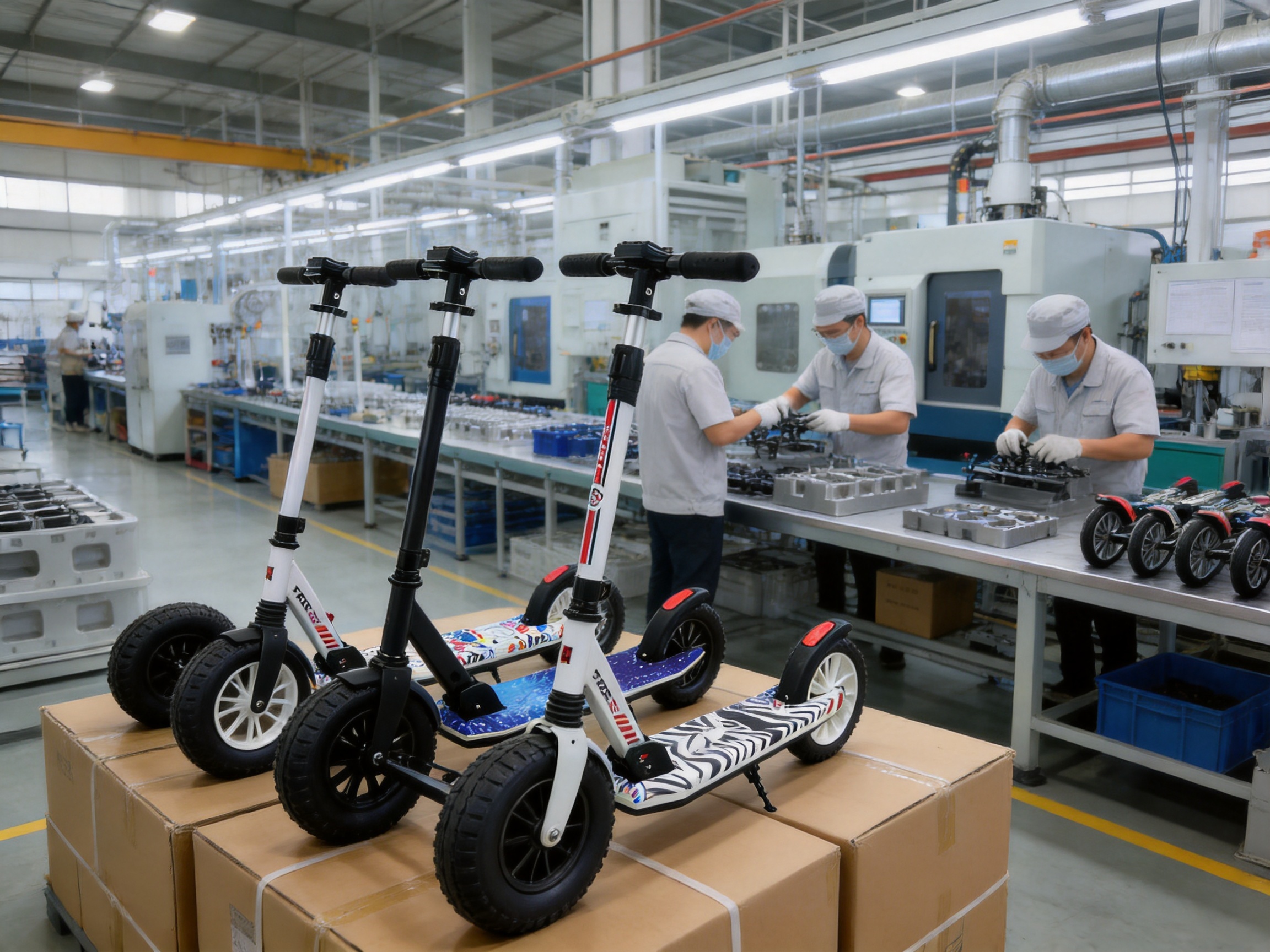
Children’s scooters have developed far beyond the simple small-wheel designs that were once associated mainly with smooth sidewalks and indoor play areas. Today, families are looking for products that combine stability, comfort, portability, durability, and genuine outdoor capability. The FL-1250 Big Wheel Children Scooter is designed to answer those expectations with an upgraded large-wheel structure, an adjustable handlebar system, a balanced two-wheel layout, and a lightweight construction that supports everyday use.
Rather than being limited to perfectly even pavement, the FL-1250 is intended for a broader range of riding environments. Its oversized, thickened wheels are designed to roll more smoothly across cobblestone streets, cracked surfaces, community squares, parks, outdoor playgrounds, and rubberized play areas. This versatility gives children more opportunities to develop balance and coordination while allowing families to use one scooter across multiple settings.
The product is manufactured by Ningbo Feile Sporting Goods Co., Ltd., a professional sporting goods producer specializing in children’s scooters, inline skates, roller skates, and ice skates. With a production history beginning in 2010, the company combines product development, mold production, injection molding, sewing, assembly, quality control, and export-oriented manufacturing within one organization. This integrated structure supports consistent product quality and efficient OEM cooperation for international customers.
Designed for More Than Smooth Sidewalks
Many conventional children’s scooters use relatively small wheels. These wheels can provide responsive handling and a compact appearance, but they are often more sensitive to irregular surfaces. Small wheels may stop abruptly when they encounter cracks, loose debris, uneven paving joints, or soft playground flooring. For younger or less experienced riders, this can make the scooter feel unstable and uncomfortable.
The FL-1250 takes a different approach by using large, thickened wheels that are better suited to varied terrain. A larger wheel generally has a greater ability to pass over small obstacles because it does not drop as deeply into surface gaps. The result is a smoother transition when the scooter travels over uneven ground. This is particularly helpful in outdoor environments where pavement conditions cannot always be controlled.
The scooter’s off-road-oriented wheel design does not mean that it is intended for extreme mountain riding or hazardous terrain. Instead, it is built for practical everyday outdoor surfaces that children commonly encounter. These include paved park paths, cracked sidewalks, community squares, rubberized playgrounds, and other moderately uneven areas. The design gives children more freedom to ride while reducing the abrupt bumps and interruptions associated with smaller wheels.
For parents, this broader surface compatibility can make the product more useful than a basic scooter designed only for smooth flooring. A child can ride in a residential area, accompany a family walk through a park, or play on an outdoor court without requiring a perfectly finished surface. The scooter is therefore positioned as an all-purpose recreational and short-distance mobility product for children.
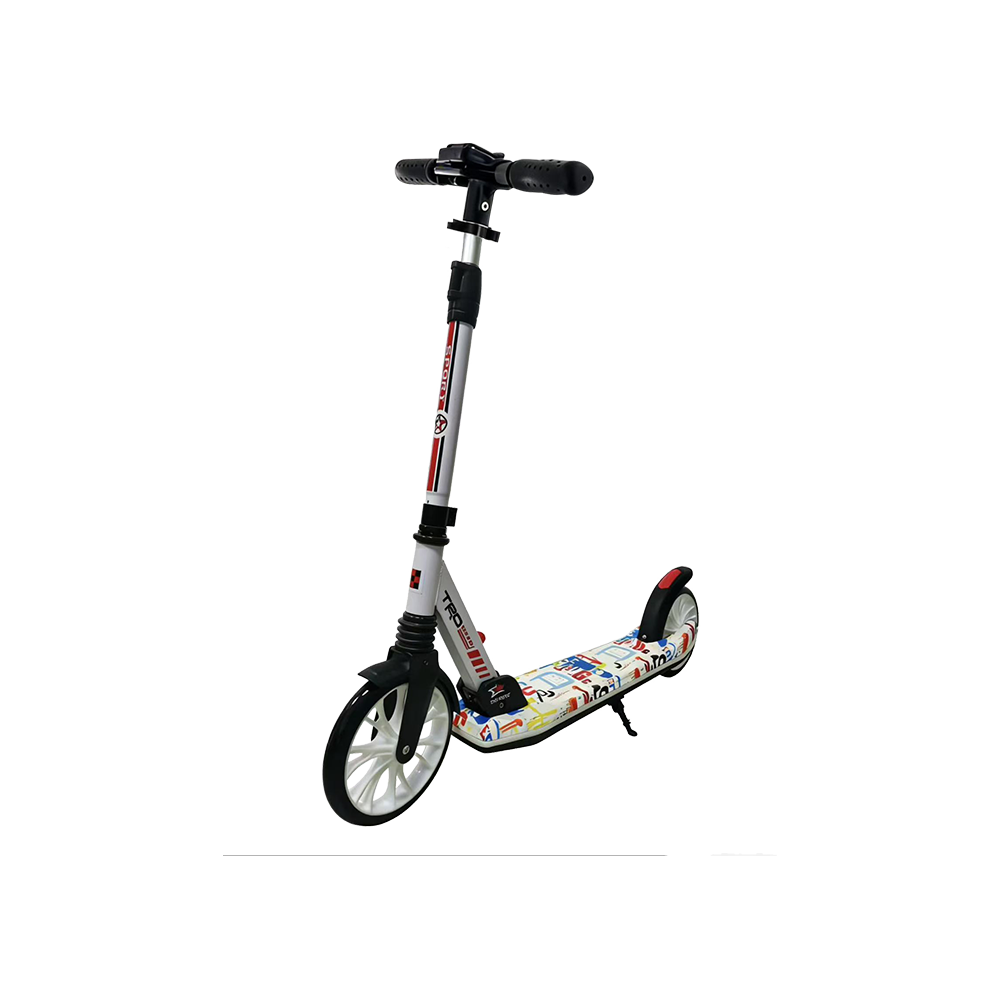
FL-1250 Big Wheel Children Scooter
The Advantages of an Oversized Wheel Structure
Improved Ability to Cross Surface Irregularities
The most distinctive feature of the FL-1250 is its large-wheel configuration. When a scooter wheel encounters a shallow crack or raised edge, wheel diameter plays an important role in how easily it can maintain forward movement. Larger wheels approach surface changes at a more gradual angle, helping them roll over minor irregularities instead of becoming trapped in them.
This characteristic is valuable on cobblestone streets and cracked surfaces. Cobblestones can create frequent vibration, while pavement cracks may catch the leading edge of a small wheel. The FL-1250’s thicker, larger wheels are intended to reduce this problem and produce a more continuous glide. Children can maintain their rhythm more easily, and parents may feel more comfortable allowing them to ride in suitable outdoor areas.
Greater Comfort on Rubberized Playgrounds
Rubberized playground flooring is designed to provide impact absorption and safety, but it can create additional rolling resistance compared with hard pavement. Small wheels may feel slow or may become less responsive on this type of surface. The FL-1250’s wheel design is intended to move more effectively across rubberized areas, allowing children to continue riding without excessive effort.
The larger contact profile can also contribute to a more composed ride. While no scooter can eliminate every vibration or bump, the overall experience can be less abrupt than that of a lightweight small-wheel model. This makes the product suitable for outdoor play sessions where comfort and confidence are important.
More Consistent Movement for Developing Riders
Children are still developing their balance, timing, and steering control. A sudden wheel stop or sharp jolt can interrupt their body position and make it difficult to recover. A scooter that rolls more predictably across ordinary outdoor surfaces can help children concentrate on steering, pushing, braking, and maintaining balance.
The FL-1250 is suitable for both beginners and more experienced young riders. Beginners may benefit from its stable rolling behavior, while advanced learners can take advantage of its ability to travel across a wider selection of surfaces. The product therefore has the potential to remain useful as a child’s confidence develops.
Stable Two-Wheel Balance and Confident Handling
The FL-1250 uses a two-wheel balanced layout with a considered center-of-gravity design. This structure is intended to provide stable gliding while still allowing children to practice steering and directional control. Unlike three-wheel scooters that may rely heavily on a broad front base, a two-wheel scooter gives children a riding experience that more closely develops traditional balancing skills.
Stability is especially important for outdoor use. When a scooter travels over a small bump, an unbalanced frame may shift suddenly or become difficult to control. A well-proportioned chassis and appropriate weight distribution help keep the scooter composed during normal riding. The FL-1250 is designed to reduce the likelihood of tipping during ordinary use, although children should always ride in appropriate areas and under suitable supervision.
The balance between stability and maneuverability is one of the product’s key advantages. A scooter that is too light or narrow may feel nervous, while one that is excessively heavy may be difficult for children to turn or transport. The FL-1250 aims to provide a stable platform without creating unnecessary bulk. Its structure supports controlled gliding, directional changes, and recreational movement in parks, squares, and playgrounds.
Suitable for Different Learning Stages
A first-time rider needs a scooter that feels predictable. The child must learn how to stand, push, steer, slow down, and stop without becoming overwhelmed by sudden movements. The FL-1250’s balanced construction can help establish this confidence during early practice.
As the rider improves, the same structure supports more active use. Children can practice turning around open spaces, maintaining speed, and coordinating their movements over different surfaces. This makes the scooter appropriate not only as a beginner product but also as a continuing recreational tool.
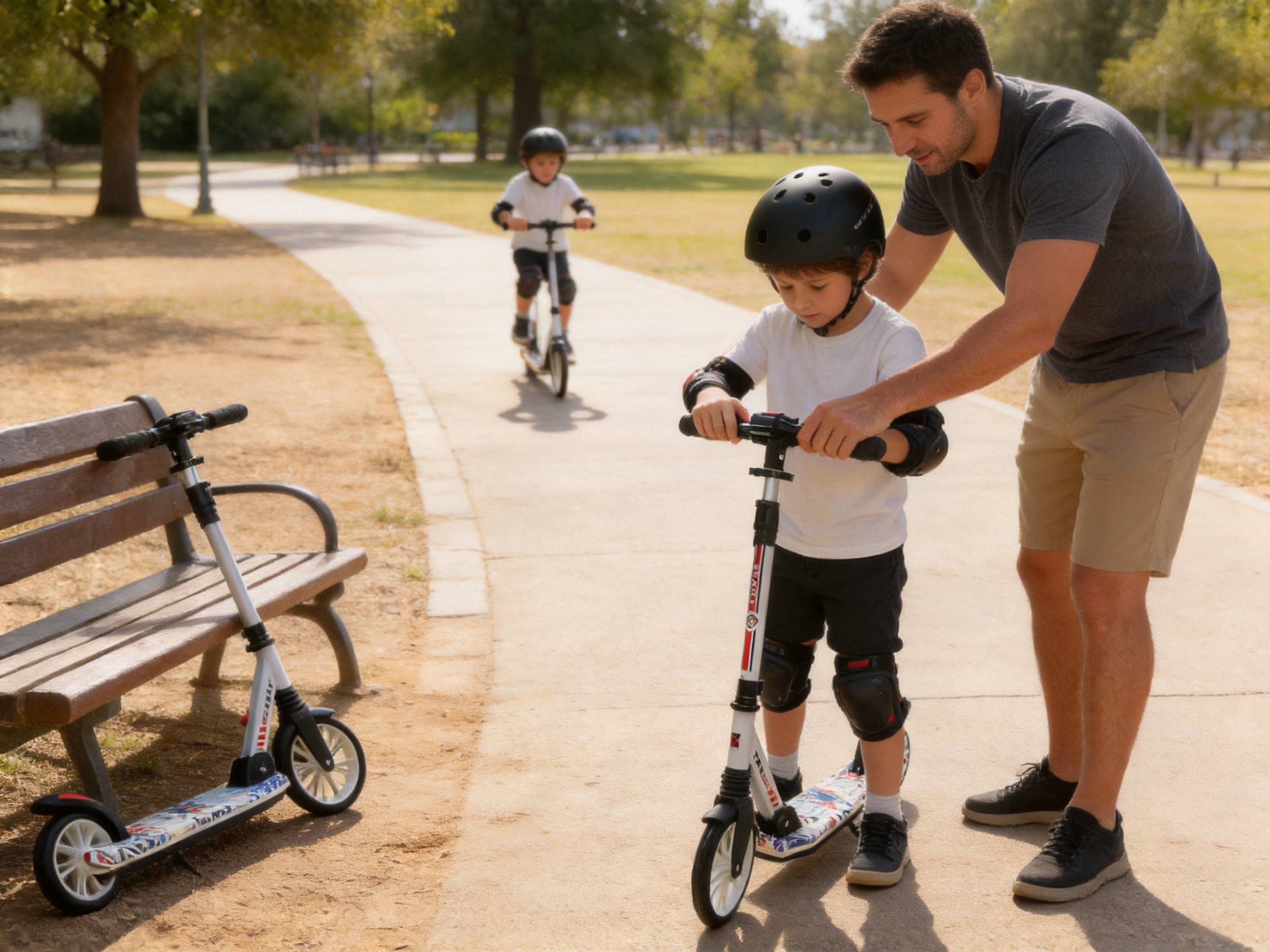
Parents should select riding locations according to the child’s age, skill level, and local safety conditions. Open, level areas away from vehicle traffic are preferable. Protective equipment, including a properly fitted helmet and suitable pads, is strongly recommended.
Multi-Adjustable Handlebars for Extended Use
Children grow quickly, and a fixed-height scooter may become uncomfortable or unsuitable after a relatively short period. The FL-1250 addresses this issue with handlebars that support multiple height adjustments. The adjustable system allows the scooter to accommodate different child heights and riding preferences over a longer period.
Correct handlebar height can influence posture, steering control, and comfort. If the handlebars are too low, a child may need to bend excessively. If they are too high, the rider may struggle to control the front end. A multi-position handlebar allows parents to select a more appropriate setting as the child grows.
This adjustability can improve the product’s value in two ways. First, it may extend the usable life of the scooter within a family. Second, it reduces the need to replace the product frequently simply because the child has become taller. For retailers and distributors, this feature also creates a clear benefit that can be communicated easily to customers seeking a longer-lasting purchase.
Supporting Different User Profiles
Children of the same age may have different heights, arm lengths, and riding habits. A handlebar system with several height positions gives the product greater flexibility across these differences. It can also make the scooter easier to share between siblings when their sizes are reasonably compatible.
For OEM buyers, adjustable handlebars provide an opportunity to position the product in several market segments. The scooter can be presented as a recreational product for older children, an outdoor mobility option for family outings, or a durable model designed to grow with the user.
As with any adjustable product, the handlebar should be locked securely before every ride. Parents and caregivers should periodically inspect the adjustment mechanism, fastening components, and frame connection for signs of wear or looseness.
Lightweight Construction for Daily Convenience
Children’s products must balance strength with manageable weight. A scooter that is too heavy may be difficult for a child to move, and parents may find it inconvenient to carry when the child becomes tired. The FL-1250 is described as lightweight and sturdy, offering a practical combination for everyday outings.
Portability is useful at many points during a family trip. A child may ride part of the way to a park and then ask an adult to carry the scooter. Families may need to place it in a vehicle, store it near an entrance, or move it between indoor and outdoor areas. A moderate overall weight helps reduce these inconveniences.
The compact design also supports home storage. Many households have limited space for sporting goods, and a scooter that does not occupy excessive room is easier to keep organized. The product can be stored after school, during bad weather, or between weekend outings without creating a significant storage burden.
Lightweight construction does not remove the need for durability. The scooter must still withstand normal steering movements, repeated pushing, transportation, and everyday handling. The manufacturing process, material selection, mold precision, and assembly quality all influence how effectively a lightweight product performs over time.
Practical Applications for Children and Families
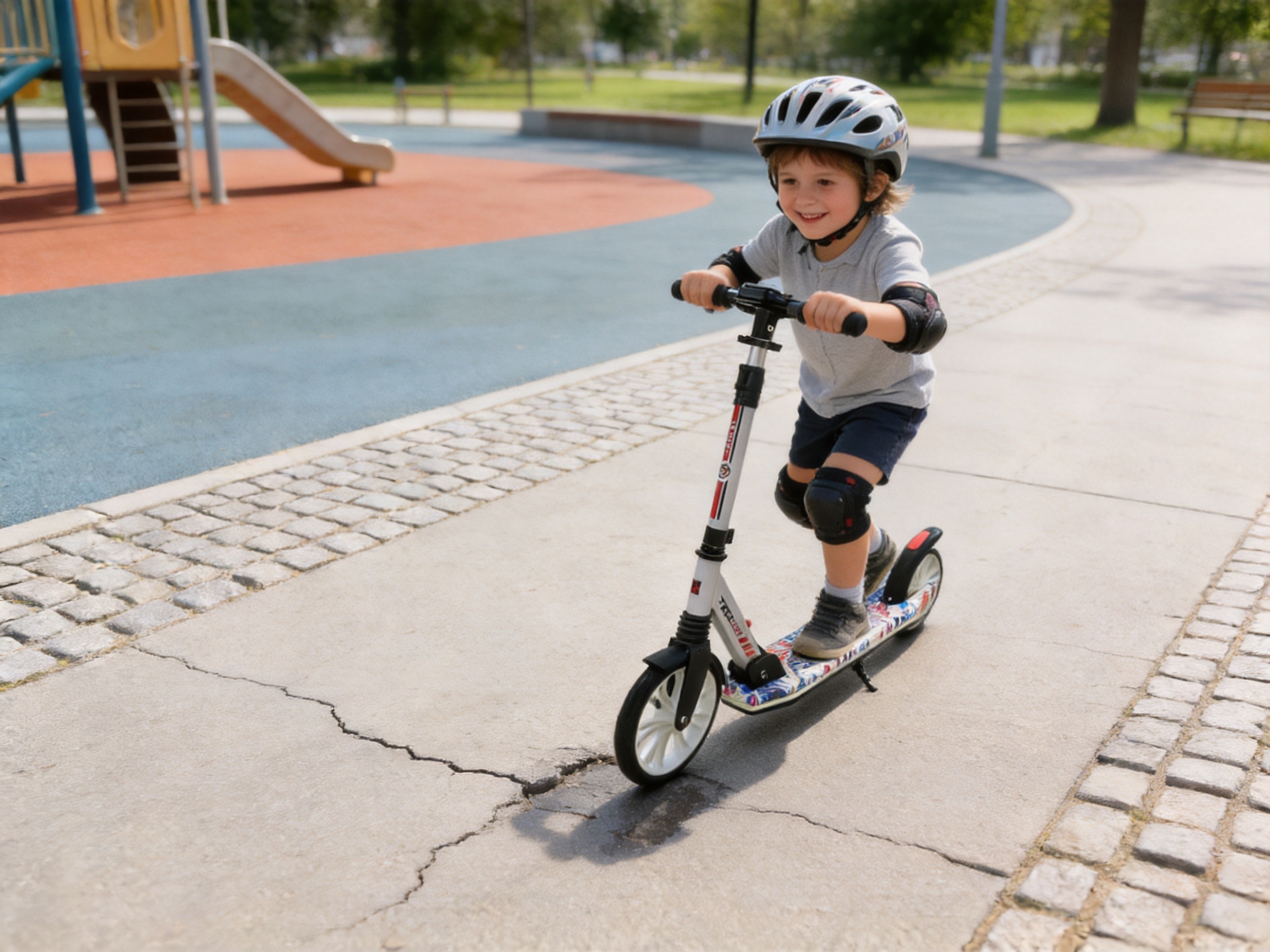
The FL-1250 is designed for outdoor sports gliding on a variety of surfaces. It can be used in parks, residential community squares, outdoor playgrounds, and other suitable open areas. These environments provide space for children to practice balance and motor coordination while enjoying active recreation.
Park Riding
Park paths often include smooth pavement, textured paving, minor cracks, and transitions between different materials. A large-wheel scooter can make these changes easier to manage than a small-wheel alternative. Children can enjoy recreational riding while accompanying parents on walks or participating in outdoor family activities.
Community Squares
Community squares and open paved areas are common places for children to practice scooter skills. They may contain joints, rough patches, and other small surface variations. The FL-1250’s stable structure and larger wheels are suited to these everyday conditions, provided the area is free from traffic and other hazards.
Outdoor Playgrounds
Outdoor playgrounds often use rubberized flooring to reduce impact. The FL-1250 is designed to perform on such surfaces, giving children another option for active play. Parents should confirm that scooters are permitted in the selected playground and should keep children away from climbing equipment, slides, swings, and crowded pedestrian areas.
Short Daily Trips
For suitable short-distance journeys, the scooter can provide a convenient means of transportation. Children may use it for brief trips around a residential area or while traveling through a pedestrian-friendly environment. It should not be used on roads with motor vehicle traffic, and local regulations should always be followed.
Indoor Recreational Use
In spacious indoor areas where scooters are permitted, the product can combine exercise and entertainment after school or during poor weather. Indoor surfaces should be clean, dry, open, and free from furniture or obstacles. Adults should ensure that the riding environment is appropriate before use.
Comparison with Ordinary Small-Wheel Scooters
The FL-1250 is not simply a standard scooter with a different visual appearance. Its large-wheel concept influences how it interacts with the riding surface, how comfortable it feels outdoors, and where it can be used. Comparing it with ordinary small-wheel scooters helps clarify its market position.
| Feature | FL-1250 Big Wheel Children Scooter | Ordinary Small-Wheel Scooter |
|---|---|---|
| Wheel design | Oversized, thickened wheels designed for improved outdoor rolling | Smaller wheels generally optimized for smoother surfaces |
| Surface adaptability | Suitable for parks, cracked pavement, cobblestones, rubberized playgrounds, and community squares | Usually most comfortable on even sidewalks and indoor floors |
| Ride comfort | Designed to reduce abrupt bumps and wheel jamming on irregular surfaces | May transmit more vibration over cracks and textured ground |
| Handlebar system | Multiple height adjustments for different child heights | May have limited or no adjustment depending on the model |
| Stability | Two-wheel balanced layout with a reasonable center of gravity | Varies according to frame geometry and wheel size |
| Portability | Lightweight and compact for carrying and storage | Often portable, but design and weight vary widely |
| Best use case | Outdoor recreation, skill development, and short trips on varied pedestrian surfaces | Indoor play or smooth-surface recreational riding |
This comparison does not mean that every small-wheel scooter performs poorly or that every large-wheel scooter is appropriate for every environment. Product selection should reflect the child’s age, skill, local riding conditions, and intended use. However, the FL-1250 offers clear functional advantages for families who want more outdoor versatility.
Its combination of wheel size, adjustable handlebars, balanced frame design, and portable construction gives it a broader performance profile. Instead of requiring families to choose between a comfortable but bulky outdoor product and a compact but surface-sensitive indoor model, the FL-1250 aims to combine useful qualities in one design.
Manufacturing Strengths Behind the Product
Product performance depends not only on the design concept but also on how consistently that design is manufactured. Ningbo Feile Sporting Goods Co., Ltd. has developed an integrated production system for children’s sporting goods. The company was established in 2010 and focuses on scooters, inline skates, roller skates, and ice skates.
The company operates a workshop of approximately 20,000 square meters and employs more than 200 people. Its facilities include five advanced automatic production lines, along with specialized mold, injection molding, sewing, and assembly workshops. This combination allows key manufacturing stages to be coordinated within the same organization.
In-House Mold Capabilities
Mold quality is fundamental to the production of plastic sporting goods. Accurate molds help determine the consistency of frame components, wheel-related parts, covers, connection points, and other molded elements. In-house mold capabilities can give a manufacturer greater control over product development and help shorten communication cycles between design and production teams.
For OEM customers, this is particularly valuable. Product modifications, branding requirements, packaging adjustments, and market-specific design requests often require close collaboration between engineering and tooling departments. An integrated mold workshop can support faster technical evaluation and more controlled implementation.
Injection Molding Production
Injection molding enables manufacturers to produce repeated plastic components with consistent dimensions and surface quality. Process control is important because temperature, pressure, cooling time, material flow, and mold condition can all affect the final part.
For a children’s scooter, consistency matters in areas such as frame fit, handlebar connections, wheel housings, protective covers, and other structural or cosmetic components. Stable injection molding processes help ensure that parts can be assembled efficiently and perform as intended in normal use.
Assembly and Production Coordination
A scooter contains multiple components that must work together. Wheels must rotate correctly, the handlebar must connect securely, adjustment positions must function properly, and the frame must maintain appropriate alignment. A coordinated assembly process helps reduce variation from one unit to another.
Feile’s assembly workshops support the final integration of components. Production teams can inspect fit, fastening, movement, and overall appearance before products proceed to packaging. This is an important part of ensuring that the finished scooter reflects the original engineering design.
Research and Development Support
The company maintains a professional R&D engineering team and launches new products each year to address market and customer needs. Research and development in children’s sporting goods involves more than appearance. Engineers must consider ergonomics, balance, material use, production efficiency, safety requirements, user age, and the practical conditions in which the product will be used.
The FL-1250 demonstrates a product-development approach centered on a specific user need: improved outdoor performance on less-than-perfect surfaces. Its oversized wheels and adjustable handlebar system are functional responses to family expectations rather than purely decorative features.
Quality Systems and Certification Experience
For international buyers, manufacturing capability must be supported by documented quality systems and product compliance experience. Ningbo Feile Sporting Goods Co., Ltd. has passed ISO9001, BSCI, and Kmart factory certification systems, according to the company information provided. These systems and audits can support process management, social responsibility expectations, and buyer confidence.
The company also reports certifications and testing related to 3C, CE, EN71, EN62115, ASTM, EMC, and EN13843:2009. The precise applicability of a standard depends on the specific product, destination market, age classification, configuration, and testing scope. Importers should always request current certificates and test reports for the exact model and shipment under consideration.
Certification is important for children’s products because buyers, retailers, and parents need confidence that products have been evaluated against relevant requirements. Testing may address mechanical safety, material properties, flammability, electrical concerns where applicable, electromagnetic compatibility where relevant, labeling, and other market-specific criteria.
A responsible supplier should be able to provide technical documentation, product specifications, inspection records, packaging information, and compliance support. These materials help importers prepare for customs, retail onboarding, product registration, and internal quality review.
OEM and International Sourcing Advantages
Feile provides one-stop sourcing for skates, scooters, and protective gear. This broad product range can be useful for distributors and retailers that want to develop a complete children’s skating and scooter category rather than source each product from a separate factory.
A buyer may be able to combine scooters with inline skates, roller skates, ice skates, helmets, knee pads, elbow pads, and related sporting goods. This can simplify supplier management and create opportunities for coordinated seasonal promotions, category displays, and product bundles.
The company’s engineering and production resources also support OEM cooperation. Buyers may discuss product colors, packaging formats, logos, accessory combinations, market positioning, and other commercial requirements. The feasibility of each request depends on order quantity, tooling needs, materials, lead time, and compliance requirements.
International experience is another important strength. The company participates in international exhibitions every year, providing opportunities to understand changing market trends and communicate directly with overseas customers. Exposure to international markets can help a manufacturer recognize differences in consumer preferences, packaging expectations, safety documentation, and retail requirements.
Support for Product Differentiation
Children’s sporting goods are highly competitive categories. Retailers often need products that are easy to explain and visibly different from basic alternatives. The FL-1250 offers several differentiating points: large wheels, improved outdoor capability, multi-adjustable handlebars, stable two-wheel construction, and lightweight portability.
These features can be translated into clear sales messages without relying on exaggerated claims. Retailers can explain that the scooter is designed for varied pedestrian surfaces, that the handlebar can be adjusted as the child grows, and that its structure supports balance practice and everyday outdoor play.
OEM customers may also use color, packaging, and accessory choices to adapt the model to specific consumer groups. For example, a distributor may focus on family outdoor recreation, active children, school-holiday gifts, or affordable mobility products for parks and community environments.
Materials, Safety, and Responsible Use
The product is intended for children, so safe use must remain a central consideration. Large wheels and a stable structure can contribute to a more controlled ride, but no design can replace proper supervision and protective equipment. Children should wear a helmet that fits correctly, and protective pads may be appropriate depending on age, skill, and riding environment.
Riders should use the scooter on suitable pedestrian surfaces and avoid roads, steep hills, wet ground, loose gravel, crowded areas, and locations with vehicle traffic. The riding area should be inspected for holes, sharp objects, slippery patches, obstacles, and sudden level changes.
Parents should check the scooter regularly. Important inspection points include wheel attachment, axle condition, handlebar locking, frame connections, grips, visible cracks, and unusual movement. If a component becomes loose or damaged, the scooter should not be used until it has been properly repaired or replaced.
The listed product size is 830x155x1000. Buyers should confirm the unit of measurement and whether the dimensions refer to the packaged product, assembled product, or a specific configuration. Clear dimensional information is important for shipping calculations, retail shelves, cartons, storage planning, and customer communication.
Children should also be taught basic riding behavior. They should keep both hands on the handlebars, maintain a safe distance from other riders, slow down before turning, and stop when visibility is limited. The scooter should be treated as active sports equipment rather than as a toy suitable for every location.
How the FL-1250 Supports Child Development
Riding a scooter can contribute to the development of balance, coordination, body awareness, and gross motor skills. The child must coordinate leg movement with steering and maintain a stable body position while the scooter is moving. These activities can make exercise enjoyable and encourage children to spend more time outdoors.
The two-wheel structure invites children to develop active balance rather than simply relying on a wide platform. At the same time, the large wheels and stable layout can make the learning process feel more manageable. Children can gradually improve their confidence as they learn to push, glide, turn, and stop.
Outdoor riding can also support family interaction. Parents can walk or ride alongside children, helping them practice in safe areas. The scooter’s portability allows families to bring it to parks, recreation spaces, and other suitable destinations without excessive effort.
Because the handlebar can be adjusted, the product may remain relevant as a child grows. Continued use gives children more time to refine their skills and develop a consistent relationship with physical activity.
Product Positioning for Retailers and Distributors
The FL-1250 can be positioned as a premium-value children’s scooter: more capable than a basic small-wheel model while remaining practical, portable, and accessible for everyday families. Its strongest selling points are easy to understand and directly connected to real user concerns.
The large wheels address uneven outdoor surfaces. The adjustable handlebars address children’s growth. The balanced structure addresses control and confidence. The lightweight design addresses transport and storage. Together, these features create a coherent product story rather than a collection of unrelated specifications.
Retailers can present the scooter through several merchandising themes. A “family outdoor activity” display can place it alongside helmets and protective gear. A “back-to-school exercise” promotion can highlight short-distance mobility and after-school recreation. A “holiday gift” presentation can focus on the product’s attractive design, usability, and long-term value.
For online retail, product photography should clearly show the wheel scale, handlebar adjustment positions, frame structure, and recommended riding environments. Written descriptions should explain that the scooter is intended for appropriate pedestrian surfaces and should not imply that it is designed for extreme off-road conditions.
Distributors can also emphasize the manufacturing background of the supplier. A factory with mold, injection molding, sewing, assembly, engineering, and quality management capabilities can offer more than a trading relationship. It can become a long-term development partner for new product programs and category expansion.
Why Integrated Manufacturing Matters
Integrated manufacturing can improve communication between design, tooling, production, and quality departments. When these functions are separated among unrelated suppliers, technical changes may take longer to implement and may create inconsistencies. A manufacturer with multiple capabilities under one organization can often manage development with greater continuity.
For the FL-1250, integrated operations may support the accurate production of large wheel components, frame parts, adjustable handlebar interfaces, and other elements that require dimensional compatibility. Each component must fit the overall design, and production coordination helps reduce assembly problems.
Integrated manufacturing may also provide greater flexibility for OEM projects. A buyer requesting a new color, modified packaging, updated logo placement, or a market-specific configuration can communicate with a supplier that understands both engineering and production implications.
Quality control is likewise strengthened when inspection occurs throughout the process. Incoming materials, molded parts, assembled units, finished appearance, packaging, and shipment quantities can all be reviewed according to an established procedure. Buyers should still define their own inspection requirements, but a structured factory system provides a stronger foundation.
Environmental and Operational Considerations
Longer product use can contribute to more responsible consumption. A scooter with adjustable handlebars may remain useful for a longer period than a fixed-height product that is quickly outgrown. A durable and repairable design can also reduce the need for premature replacement, provided spare parts and maintenance support are available.
Manufacturers can further improve operational efficiency through automatic production lines, accurate molds, controlled material use, and organized assembly procedures. These approaches may reduce process variation and improve the utilization of labor and materials. Buyers interested in sustainability should request specific information about materials, packaging, production waste, and available recycling practices.
Packaging is another consideration for international distribution. It should protect the scooter during handling while avoiding unnecessary volume and material. Carton design, inner protection, printed instructions, labels, and shipping marks should be reviewed according to the destination market and retail channel.
Ordering and Customization Considerations
Before placing an OEM or wholesale order, buyers should confirm the product specification in detail. Important points include wheel material and dimensions, frame materials, handlebar adjustment range, color options, logo methods, packaging format, product weight, carton dimensions, loading quantity, and minimum order quantity.
Buyers should also clarify the intended market. Different countries may require different warnings, labels, manuals, certifications, or testing documents. Age grading should be reviewed carefully, and all marketing claims should match the available technical evidence.
Sample approval is recommended before mass production. A physical sample allows the buyer to assess the riding feel, finish, handlebar adjustment, wheel movement, packaging quality, and overall appearance. Any approved sample should be documented so that production units can be compared against it.
Inspection arrangements should be agreed in advance. Depending on the buyer’s program, inspections may occur before production, during production, before shipment, or through a combination of stages. Clear communication helps reduce misunderstandings and supports more reliable delivery.
Although the FL-1250 is designed as a ready product concept, OEM customers may be able to adapt its commercial presentation. Custom colors, branding, packaging, and coordinated protective equipment can help create a product line suited to a particular retailer or market.
Q&A: FL-1250 Big Wheel Children Scooter
What is the main advantage of the FL-1250?
The main advantage is its large-wheel design, which is intended to provide smoother and more stable movement across a wider range of ordinary outdoor surfaces than many small-wheel scooters. It is designed for parks, community squares, cracked pavement, cobblestone areas, and rubberized playgrounds.
Is the scooter suitable for beginners?
Yes. Its balanced two-wheel layout and reasonable center-of-gravity design are intended to provide stable gliding and manageable directional control. Beginners should still learn in an open, level, obstacle-free area under adult supervision.
Can the handlebar height be adjusted?
Yes. The handlebars support multiple height adjustments. This allows the scooter to accommodate different child heights and may extend the product’s useful life as the child grows.
Is the FL-1250 an extreme off-road scooter?
No. It is designed for improved performance on varied pedestrian and recreational surfaces, not for hazardous mountain trails, deep mud, steep slopes, or extreme sports use. Riders should remain on safe, appropriate surfaces.
Where can children use the scooter?
Suitable locations may include parks, community squares, outdoor playgrounds, residential pedestrian areas, and spacious indoor areas where scooters are permitted. The surface should be dry, open, and free from traffic and dangerous obstacles.
Does the scooter support physical development?
Yes. Scooter riding can help children practice balance, coordination, steering, body control, and gross motor skills. The FL-1250 is designed to combine physical activity with recreational enjoyment.
Is the scooter easy to carry and store?
The product is described as lightweight and compact, making it easier to carry during outings and store at home. Buyers should confirm the final product weight and packed dimensions for logistics planning.
What is the listed product size?
The supplied specification lists the dimensions as 830x155x1000. The buyer should confirm the measurement unit and whether the dimensions refer to the assembled product or packaging.
What safety equipment should children wear?
Children should wear a properly fitted helmet. Depending on the riding environment and the child’s experience, knee pads, elbow pads, and other protective equipment may also be appropriate.
What manufacturing capabilities does the supplier have?
Ningbo Feile Sporting Goods Co., Ltd. operates mold, injection molding, sewing, and assembly workshops, five automatic production lines, a 20,000-square-meter workshop, and a professional R&D engineering team. The company specializes in scooters and skating products.
Does the company support OEM orders?
The company provides one-stop sourcing for skates, scooters, and protective gear and has the production and engineering structure needed to discuss OEM projects. Buyers should confirm customization options, minimum order quantities, lead times, and technical feasibility for each request.
Which certifications are associated with the company and its products?
The supplied company information lists ISO9001, BSCI, and Kmart factory certification systems, as well as product certifications or testing related to 3C, CE, EN71, EN62115, ASTM, EMC, and EN13843:2009. Buyers should request current documentation for the exact product and target market.
Overall Product Assessment
The FL-1250 Big Wheel Children Scooter is built around a practical idea: children should be able to enjoy scooter riding on more than perfectly smooth surfaces. Its oversized, thickened wheels provide the foundation for improved outdoor performance, while the balanced two-wheel structure supports stability and skill development.
The multi-adjustable handlebars add long-term value by accommodating different heights. The lightweight structure improves portability, and the compact form makes storage easier for families. These features work together to distinguish the model from ordinary small-wheel scooters that may be less comfortable on irregular outdoor terrain.
From a sourcing perspective, the product is supported by a manufacturer with more than a decade of industry experience, integrated production facilities, automatic production lines, engineering resources, certification experience, and a broad skating and scooter product portfolio. These strengths make the supplier suitable for retailers, importers, distributors, and brands seeking a complete children’s sports equipment partner.
The most important purchasing step is to align the product with the intended market. Buyers should verify specifications, testing documents, packaging, labeling, age recommendations, and customization details before production. When properly matched with suitable users and riding environments, the FL-1250 can offer a compelling combination of outdoor capability, comfort, stability, adjustability, and commercial value.
References
1. Product information supplied for the FL-1250 Big Wheel Children Scooter, including wheel design, handlebar adjustment, structure, applications, dimensions, and image specifications.
2. Ningbo Feile Sporting Goods Co., Ltd. company profile and manufacturing capability information supplied for this article.
3. General principles of wheel diameter, surface adaptability, scooter balance, and children’s recreational equipment design.
4. General guidance concerning children’s wheeled sports equipment, protective equipment, supervision, and safe riding environments.
5. General quality-management and product-compliance considerations for international sporting goods sourcing.
Product: FL-1250 Big Wheel Children Scooter

Recommended Articles

Get in Touch
Your email address will not be published. Required fields are marked *
Have a project in mind? Contact with us!
We are happy to answer your questions. Please fill out this form
and one of our professional team will get back to you as soon as possible.

We specialize in producing various types of children's toy cars, children's skateboards, and ice skates.
