
 En
 Español
 русский
 عربى

Why Modular Children’s Scooters Are Changing Everyday Play
Date:Sep 29, 2026
Content
- 1 1. A Product Designed Around Two Ways to Play
- 2 2. The FL-1200 Design Explained
- 3 3. Stability and Safety-Oriented Features
- 4 4. Growing With the Child
- 5 5. Outdoor and Indoor Applications
- 6 6. Developmental Benefits of Active Riding
- 7 7. Advantages Over Conventional Children’s Scooters
- 8 8. Manufacturing Strengths Behind the Product
- 9 9. Quality Systems and Certification Awareness
- 10 10. OEM and Sourcing Potential
- 11 11. Responsible Use and Maintenance
- 12 12. Why the Product Appeals to Different Buyers
- 13 13. Frequently Asked Questions
- 13.1 What is the main difference between the FL-1200 and a conventional children’s scooter?
- 13.2 Can the car module and scooter body be separated?
- 13.3 Is the product suitable for preschool children?
- 13.4 Does the handlebar height adjust?
- 13.5 What helps make the scooter stable?
- 13.6 Where can children use the scooter?
- 13.7 Is the scooter easy to transport?
- 13.8 Are the wheels noisy?
- 13.9 Does the manufacturer provide other sports products?
- 13.10 What manufacturing capabilities does the supplier have?
- 13.11 What certifications and standards are associated with the company’s products?
- 13.12 Can international buyers discuss OEM programs?
- 14 14. Final Assessment
- 15 References
- 16 Product: FL-1200 Cartoon Children Scooter
Children’s scooters have developed far beyond simple ride-on toys. Modern families increasingly look for products that combine movement, imaginative play, safety, portability, and long-term value in one practical design. The FL-1200 cartoon children’s scooter responds to these expectations through a modular structure that joins a playful car-shaped module with a smooth-riding scooter body. Instead of offering only one type of activity, it gives children two connected ways to play: they can enjoy the product as a cartoon car toy or combine the components for gliding.
This dual-use concept makes the FL-1200 particularly suitable for preschool children who are still developing balance, coordination, steering confidence, and physical independence. It also gives parents a product that can adapt to different play situations. A child may use the scooter for active outdoor movement, separate the car module for imaginative play, or store the product in a compact form when it is not in use.
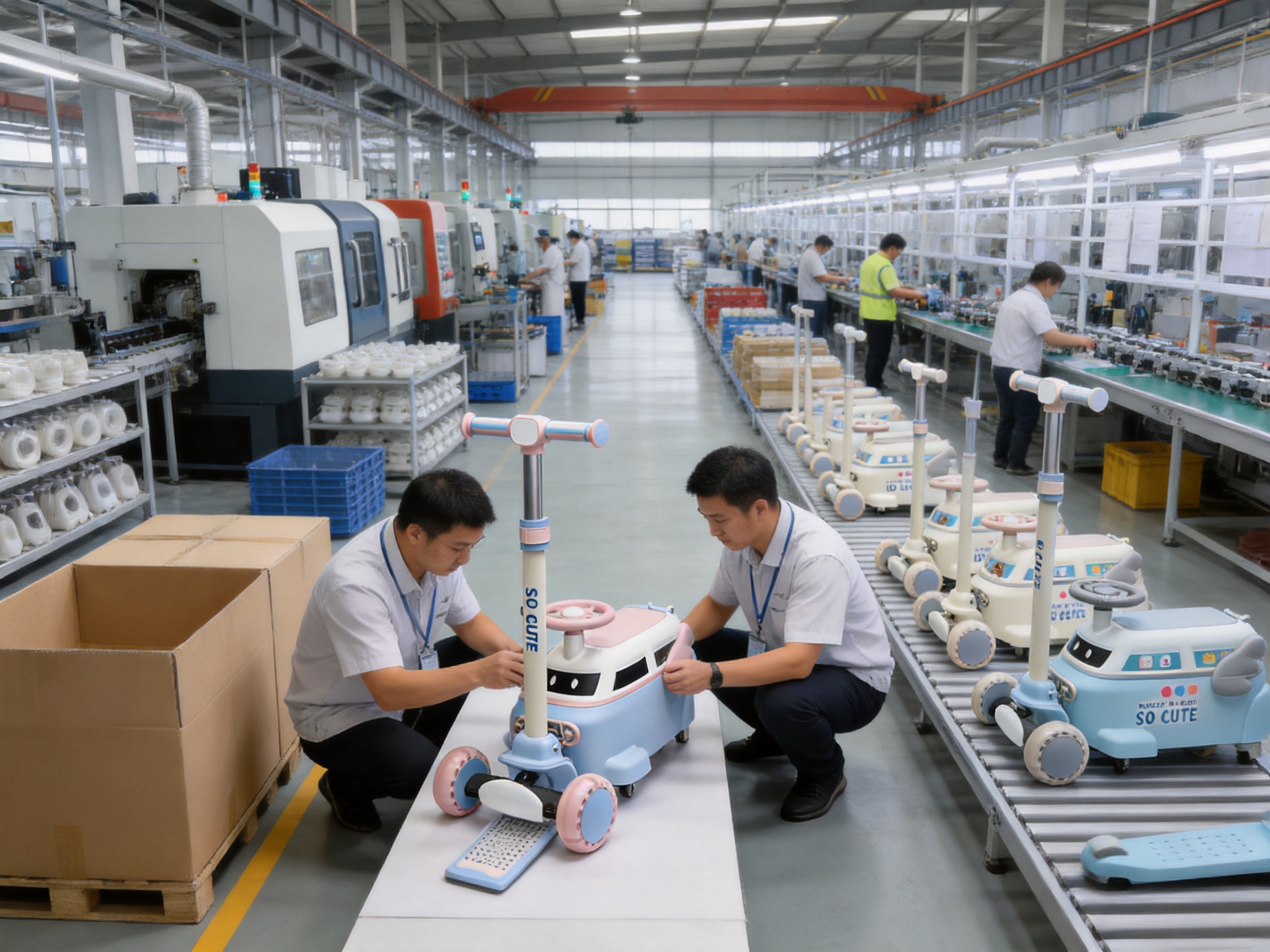
The product is manufactured by Ningbo Feile Sporting Goods Co., Ltd., a specialist producer of children’s scooters, inline skates, roller skates, ice skates, and related sports equipment. With more than a decade of industry experience, an extensive production facility, automatic production lines, internal workshops, and professional research and development capabilities, the company is positioned to support both product innovation and dependable large-scale manufacturing.
This article examines the design advantages of the FL-1200, its practical applications, the engineering ideas behind its safety features, and the manufacturing strengths that make it suitable for international sourcing, retail, and distribution.
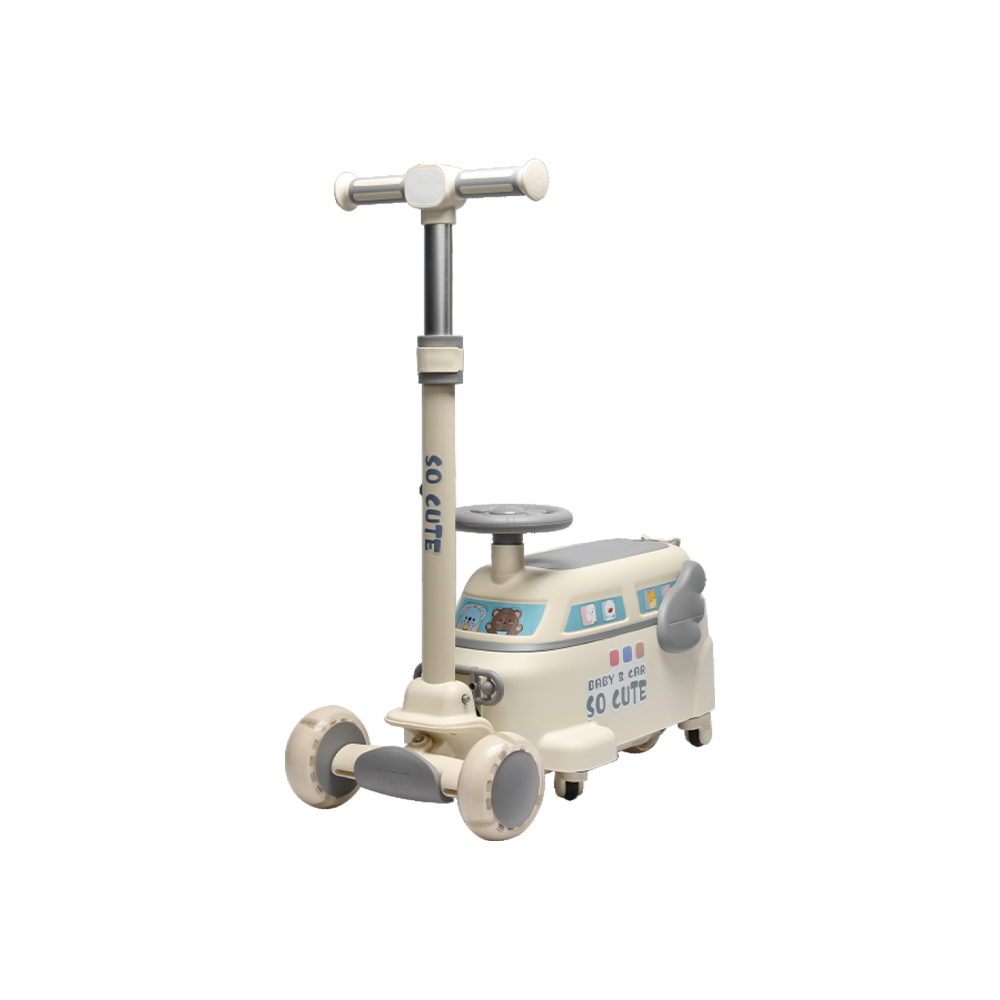
FL-1200 Cartoon Children Scooter
1. A Product Designed Around Two Ways to Play
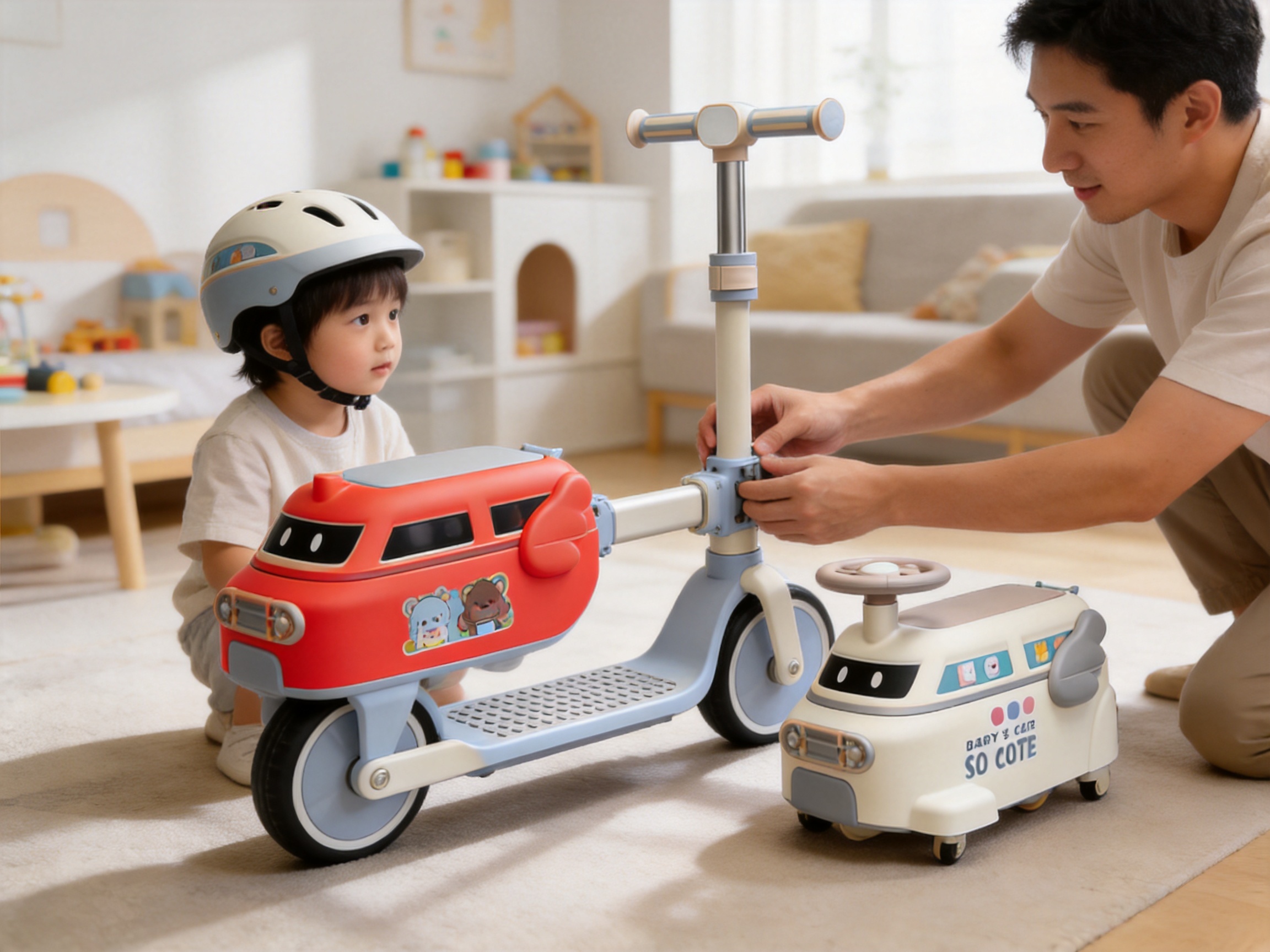
The central feature of the FL-1200 is its modular construction. The cartoon car module and the scooter body can be combined or separated according to the child’s activity. When connected, the product becomes a distinctive cartoon-themed scooter that encourages gliding and active movement. When separated, the car module can be used independently as a toy, while the scooter body remains available as a separate play structure.
This design is more versatile than a conventional scooter that provides only one type of experience. A standard scooter generally requires the child to stand on the deck, hold the handlebar, and move by pushing against the ground. Although this activity is valuable, it may not meet the needs of every child at every stage of development. Some children may prefer imaginative play before they are ready for sustained gliding, while others may enjoy alternating between riding and role-playing.
The FL-1200 supports both preferences. The cartoon vehicle shape can encourage storytelling, pretend driving, and creative interaction. Once the child becomes interested in active movement, the scooter configuration offers a way to practice balance and coordination. This transition from toy play to physical play is one of the product’s strongest advantages.
For retailers, modularity can also provide a clear point of differentiation. Many children’s ride-on products compete mainly through color, graphics, or minor changes to conventional forms. A separable car-and-scooter system offers a more meaningful product story. It can be presented as a multifunctional toy, a preschool mobility product, or an entry-level balance and coordination tool.
For families, the dual-use structure may improve perceived value. One purchase can support several forms of play instead of being limited to a single activity. The product can be used during outdoor trips, indoor leisure time, family recreation, and short-distance movement in suitable areas. This broadens its practical usefulness while reducing the likelihood that the toy will be quickly abandoned.
Imaginative play and physical activity in one product
Imaginative play is an important part of early childhood development. Children often learn through imitation, storytelling, and role-playing. A cartoon car form can become a racing vehicle, emergency vehicle, travel car, or character in an invented game. The child controls the story and can involve siblings, parents, or other toys.
Physical activity adds another developmental dimension. Gliding requires the child to coordinate both hands, maintain a stable posture, observe the surrounding space, and adjust movement according to speed and direction. These actions may help children develop confidence in their body control. The FL-1200 therefore connects imaginative engagement with active recreation instead of treating them as separate experiences.
A practical alternative to single-purpose products
Single-purpose ride-on toys can be enjoyable, but their usefulness may decline as the child’s interests change. A product that combines two functions has a better opportunity to remain relevant. Younger or less confident children can begin with casual toy play, while more active children can use the scooter configuration for outdoor gliding.
This flexibility is also valuable in households with limited storage space. Rather than purchasing and storing a separate toy car and scooter, families can use one modular product for both purposes. The lightweight construction further supports this advantage by making the product easier to move between rooms, vehicles, playgrounds, and storage areas.
2. The FL-1200 Design Explained
The FL-1200 is built around a cartoon car-shaped front module, a scooter body, a handlebar system, a widened anti-slip pedal, and wheels designed for smooth movement. The dimensions listed for the product are approximately 565 by 320 by 870 millimeters. This overall format provides a compact footprint while giving the child a recognizable riding structure.
Its visual identity is especially suitable for the children’s product market. The cartoon car appearance creates an immediate emotional appeal, while the scooter base provides a practical function. This combination allows the product to be marketed not only as sports equipment but also as a character-inspired play item.
Modular separation and combination
The ability to separate the car module from the scooter body is the defining structural feature. In combined mode, the car-shaped module gives the scooter a distinctive appearance and contributes to the product’s playful character. In separated mode, each part can support a different activity, subject to appropriate adult supervision and proper assembly.
A modular design must balance convenience with connection stability. The joining structure should be simple enough for efficient assembly but secure enough to resist unwanted movement during ordinary use. This requirement places importance on accurate molding, consistent component dimensions, reliable fastening points, and careful assembly inspection.
The production capabilities of the manufacturer are relevant here. The company operates mold, injection molding, sewing, and assembly workshops. These internal capabilities can help coordinate the production of connected components and improve control over fit, surface quality, and assembly consistency.
Cartoon styling with functional proportions
Children are often attracted to friendly shapes, bright visual themes, and products that resemble familiar objects. A cartoon car-shaped scooter can make the first interaction more inviting than a purely functional scooter. The child may feel that the product is a personal vehicle or a character companion rather than ordinary exercise equipment.
At the same time, the FL-1200 is designed around practical proportions. The low-profile structure helps keep the center of gravity close to the ground. The widened pedal gives the child a more substantial standing area. The handle supports steering and body positioning, while the two-wheel balance frame is intended to provide stability during basic gliding.
Lightweight construction
Portability is an important consideration for children’s ride-on products. A scooter that is difficult for adults to lift or transport may be left at home, even if children enjoy using it. The FL-1200 is designed to be lightweight and not bulky, making it easier to assemble, disassemble, carry, and store.
Lightweight construction also makes the product easier to manage in changing environments. Parents can take it to a community square, park, playground, or family gathering without requiring excessive vehicle space. At home, the product can be moved into a storage room or placed in a suitable indoor area when children want to play.
Weight reduction must not compromise structural reliability. For this reason, material selection, component geometry, molding quality, and assembly control are all important. A professional manufacturer can use its engineering and production experience to balance portability with durability.
3. Stability and Safety-Oriented Features
Safety is one of the most important purchasing factors in children’s scooters. Young riders are still learning to control their bodies and may not yet understand how speed, uneven surfaces, steering, and stopping interact. The FL-1200 includes several design features intended to support stable and controlled play.
Low center of gravity
The low-profile structure helps place the child’s riding position closer to the ground. A lower center of gravity can make the product feel more stable and can reduce the effect of small shifts in body weight. This is especially useful for preschool children who are developing balance and may make sudden movements while learning.
A low center of gravity does not eliminate all risks. Children should still use the product in suitable spaces, avoid steep slopes and traffic areas, and remain under adult supervision. However, the structural approach can make initial riding more manageable than a taller or less stable design.
Two-wheel balance frame
The two-wheel balance frame is intended to support predictable movement and reduce the chance of unnecessary tipping during ordinary gliding. A stable wheel arrangement can help children focus on steering and forward movement instead of constantly correcting the entire product.
Wheel alignment is essential to this function. If wheels are not positioned accurately, the scooter may pull to one side, create uneven resistance, or produce an inconsistent riding experience. This is why mold precision, assembly fixtures, and final inspection are important parts of professional scooter manufacturing.
Widened anti-slip pedal
The pedal is the main platform supporting the child’s feet. A widened pedal gives the rider more room to position both feet and can provide greater confidence during early use. The anti-slip surface is intended to help reduce foot movement, particularly when the child is wearing ordinary footwear or when the surface is slightly dusty.
Deck texture, material selection, edge finishing, and dimensional consistency all influence the user experience. The surface should provide practical grip without creating uncomfortable sharpness or difficult-to-clean recesses. A well-designed pedal can make the product feel more secure while encouraging the child to maintain a balanced posture.
Silent and smooth-moving wheels
Wheel performance affects both safety and comfort. Smooth-moving wheels can reduce sudden jerks and make the product easier for children to control. Quieter wheels are also beneficial in residential communities, indoor recreational areas, and shared public spaces where excessive noise may disturb others.
The wheel design should be matched to suitable surfaces. The product is intended for appropriate flat areas such as community squares, parks, playgrounds, and spacious indoor environments. It is not a substitute for a road vehicle and should not be used near traffic, on dangerous slopes, or on surfaces that are damaged, slippery, or unsuitable for children’s wheeled toys.
Adjustable anti-slip handle
The handle supports steering, posture, and balance. The FL-1200 uses multiple height levels so the handle can be adjusted as children grow or as different children use the product. This feature can reduce the need for frequent replacement and may help the child maintain a more natural gliding position.
An adjustable handle is more valuable when its locking mechanism is easy for adults to operate but resistant to accidental movement during use. The handle should be checked before every riding session to ensure that it is properly secured. Parents should also adjust the height according to the child’s size and riding posture rather than simply selecting the highest or lowest setting.
4. Growing With the Child
Children change rapidly during the preschool years. Their height, strength, confidence, and coordination can develop noticeably within a relatively short period. Products that cannot adapt may become uncomfortable or unsuitable, requiring families to purchase replacements more frequently.
The multiple height levels of the FL-1200 address this challenge. As the child grows, the handle can be repositioned to maintain a useful relationship between the child’s hands, shoulders, feet, and riding surface. This allows the product to remain practical for a longer period than a fixed-height scooter.
Economic value for families
Durability and adjustability influence the total value of a children’s product. A low initial price is not necessarily economical if the product is quickly outgrown, damaged, or abandoned. A modular scooter that supports multiple activities and adjustable use can provide stronger long-term value.
The FL-1200 can be positioned as a cost-effective choice because it combines a toy car and scooter experience, adapts through multiple handle height settings, and can be used in different environments. Its value is not limited to the number of parts included; it also comes from the variety of play opportunities and the potential for extended use.
Different riding postures
Children do not all learn in exactly the same way. Some may begin cautiously, holding the handle firmly and moving slowly. Others may be eager to glide and quickly develop confidence. Adjustable height enables the product to accommodate different postures and comfort preferences within a practical range.
Parents should still choose the product according to the child’s age, physical development, and ability to follow instructions. Adjustability supports a better fit, but it does not replace supervision or safe riding habits.
5. Outdoor and Indoor Applications
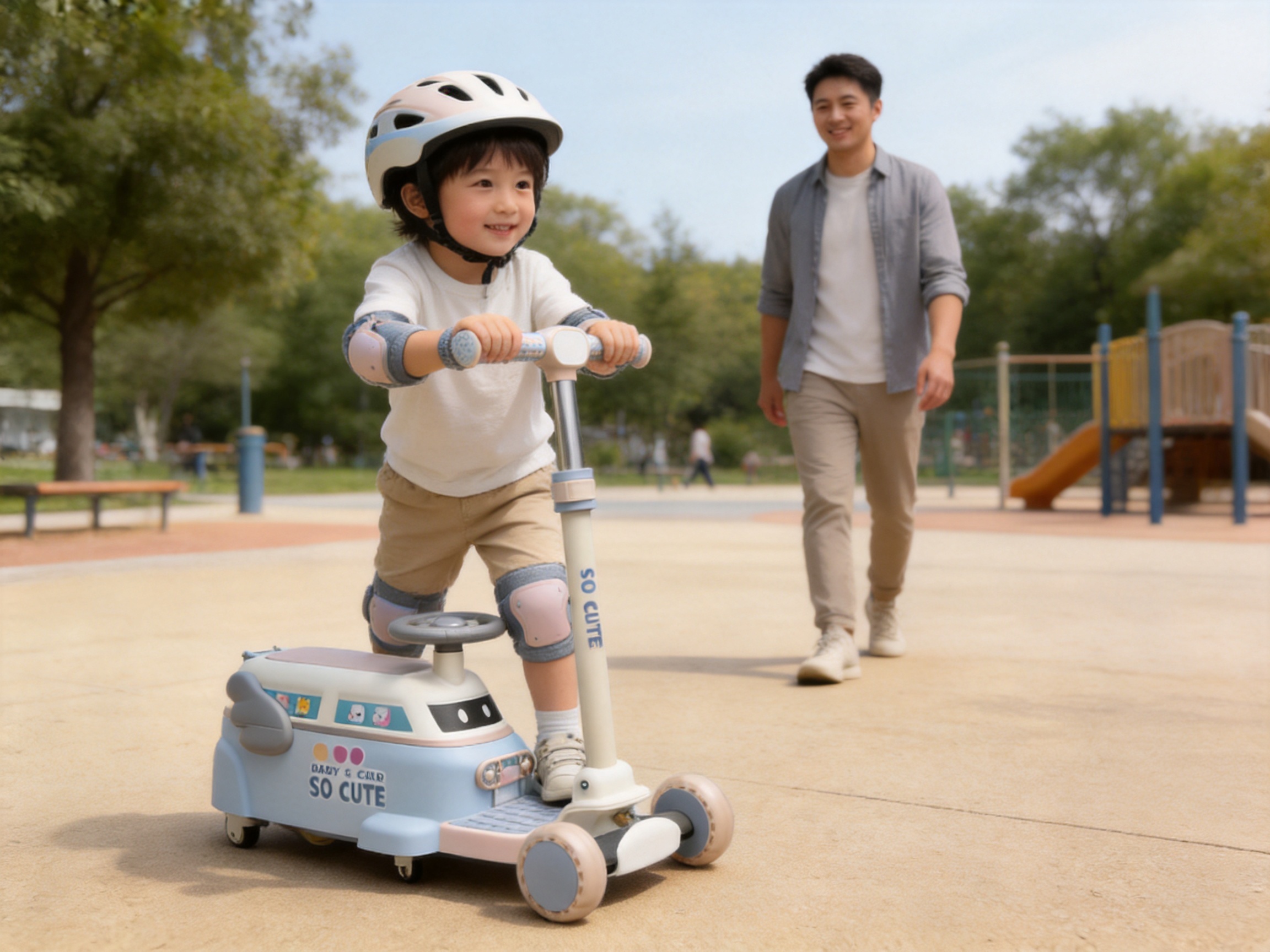
The FL-1200 is suitable for a variety of play environments when used responsibly. Outdoor applications include community squares, parks, playgrounds, and other open areas with smooth, level surfaces. These locations give children room to practice movement, steering, and coordination while enjoying fresh air and active recreation.
Community squares and residential areas
Community squares often provide accessible spaces for children to play close to home. The product’s quiet wheels can be an advantage in shared residential environments. Its compact size makes it easier to manage around benches, walkways, and family seating areas, although children should always avoid interfering with pedestrians.
Parks and playgrounds
Parks and playgrounds offer opportunities for longer periods of active movement. Children can alternate between riding and other physical activities. The cartoon design may also help the product fit naturally into imaginative games involving playground equipment, toy figures, or other ride-on products.
Adults should inspect the surface before use. Gravel, loose sand, puddles, broken pavement, steep slopes, and crowded paths can reduce control. A clear, flat area is more appropriate for early practice.
Short preschool commutes
In suitable private or pedestrian-only settings, the scooter may provide a convenient alternative to walking for short daily trips. It can make routine movement more engaging and encourage children to participate actively in getting from one place to another.
This application requires careful judgment. The product should not be used on public roads or in areas with vehicle traffic. Adults should remain close enough to guide the child, and the journey should take place on a safe, smooth route.
Indoor recreational use
Spacious indoor areas can provide an alternative when weather conditions prevent outdoor play. A gymnasium, large playroom, or other unobstructed space may allow children to use the scooter under supervision. The lightweight design makes it practical to move between indoor and outdoor settings.
Indoor use requires attention to furniture, walls, stairs, fragile objects, and other people. Families should establish clear play boundaries and avoid using the scooter on polished or slippery floors if traction is inadequate.
6. Developmental Benefits of Active Riding
A children’s scooter is not only a recreational product. It can also create opportunities for physical and cognitive development. The FL-1200 supports several basic skills through repeated, enjoyable movement.
Balance
Riding requires the child to maintain a stable relationship between the body and the moving product. The child learns to keep the torso controlled, place the feet securely, and make small corrections while moving. A stable low-profile design can make this learning process less intimidating.
Coordination
Children must coordinate the hands, arms, eyes, feet, and body position. Steering requires visual attention, while gliding requires controlled movement of the lower body. These actions encourage children to connect what they see with how they move.
Spatial awareness
When children ride in an open area, they learn to observe distance, direction, obstacles, and other people. They gradually understand that speed and steering must be adjusted according to the environment. Adults can support this learning by teaching children to slow down near others and stop when instructed.
Confidence and independence
Successfully learning to glide can give a child a sense of achievement. The adjustable handle, stable frame, and familiar cartoon form may help make the first experience less challenging. As children become more capable, they can participate more independently while still following safety rules.
The car-shaped module encourages pretend play. Children can create stories, assign roles, and cooperate with siblings or friends. This social dimension adds value beyond physical exercise and allows the product to remain interesting even when the child is not actively riding.
7. Advantages Over Conventional Children’s Scooters
The FL-1200 should not be evaluated only by its appearance. Its competitive advantages come from the combination of modularity, adjustability, stability, portability, and multiple play modes.
| Feature | FL-1200 Benefit | Typical Value for Families |
|---|---|---|
| Modular car and scooter structure | Supports combined riding and separated toy play | More varied activities from one product |
| Multiple handle height levels | Adapts to changing child height and posture | Potentially longer useful service period |
| Low center of gravity | Helps create a stable riding experience | Greater confidence for preschool users |
| Widened anti-slip pedal | Provides a broader, more secure standing area | Improved comfort and foot stability |
| Silent wheels | Supports smoother and quieter movement | Better suitability for shared spaces |
| Lightweight construction | Makes transport, storage, and assembly easier | More convenient everyday use |
| Cartoon car styling | Combines functional riding with imaginative play | Stronger emotional appeal for children |
More than a visual upgrade
Some children’s scooters differ from one another mainly through colors or decorative graphics. While visual appeal is important, it may not create a substantial functional difference. The FL-1200 introduces a structural distinction through its separable modules. The product is not simply decorated to look like a car; it is designed to support both a car-themed toy experience and scooter movement.
Better use of household space
Families often face storage limitations, especially in apartments and smaller homes. A multifunctional product can be more practical than purchasing separate ride-on toys. The ability to disassemble the product also supports more efficient transport and storage.
Greater suitability for varied retail channels
The product can appeal to several sales channels, including children’s toy retailers, sports equipment distributors, preschool activity suppliers, family lifestyle stores, online marketplaces, and gift-oriented businesses. Its multifunctional story gives sales teams several ways to explain its value to consumers.
8. Manufacturing Strengths Behind the Product
Product design is only one part of successful children’s equipment. Consistent manufacturing is equally important. The producer of the FL-1200 has specialized in children’s scooters and skating products since its establishment in 2010. This focused experience supports familiarity with child-oriented structures, molded components, moving parts, comfort requirements, and international market expectations.
Dedicated production facility
The company operates a workshop covering approximately 20,000 square meters and employs more than 200 people. This scale provides a foundation for organized production, quality management, product development, assembly coordination, and customer order support.
A larger facility can also help separate different production stages. Material preparation, molding, sewing, assembly, inspection, and packaging can be managed through defined processes. This is especially valuable for products containing several connected components.
Five advanced automatic production lines
Automatic production lines can improve repeatability and production efficiency. In children’s scooters, repeatability is important because components such as wheels, handles, decks, connectors, and decorative shells must work together accurately. Consistent processing can help reduce variation between production batches.
Automation does not remove the need for human expertise. Skilled workers and quality personnel remain important for equipment operation, process adjustment, visual inspection, functional testing, packing, and continuous improvement. The combination of automated production and professional management can support both capacity and quality.
Internal mold and injection molding capabilities
Mold development is central to products that use shaped plastic shells, decks, connectors, and structural parts. An internal mold workshop can improve communication between product engineers and manufacturing specialists. It may also shorten the feedback cycle when a design needs adjustment for strength, appearance, assembly, or production efficiency.
Injection molding quality affects surface finish, dimensional accuracy, component strength, and the consistency of connection points. Accurate molds and controlled molding conditions are especially important for a modular product because separate parts must fit correctly when assembled.
Sewing and assembly workshops
Although the FL-1200 is primarily a molded scooter product, the company’s sewing and assembly workshops demonstrate broader manufacturing capability. Internal assembly resources can support systematic installation of wheels, handles, modules, fasteners, and other parts. Proper assembly is essential for stability and user safety.
Professional research and development team
The company maintains a professional research and development engineering team. Product development in the children’s sports category requires attention to ergonomics, appearance, structural design, play value, ease of use, and market trends. An experienced engineering group can help transform consumer expectations into practical products.
The company launches new products each year to respond to changing market and customer requirements. This ongoing development approach is relevant to buyers seeking a supplier that can support product updates, new designs, customized programs, and long-term category growth.
9. Quality Systems and Certification Awareness
International buyers of children’s products need confidence that a supplier understands quality management and product compliance. The manufacturer has passed ISO9001, BSCI, and Kmart factory certification systems. These qualifications indicate attention to management procedures, social responsibility expectations, and factory assessment requirements.
The company also reports product certifications and compliance achievements including 3C, CE, EN71, EN62115, ASTM, EMC, and EN13843:2009. The specific applicability of each standard depends on the product configuration, destination market, sales channel, and current regulatory requirements. Importers should confirm the relevant documentation for each order and market before commercial distribution.
Why certification matters for children’s products
Children’s products require careful attention to material safety, mechanical performance, flammability where applicable, electrical safety where applicable, labeling, packaging, and user instructions. Certification and testing processes help buyers evaluate whether a product has been assessed against recognized requirements.
Testing should be considered part of a continuing quality program rather than a one-time marketing statement. Production materials, suppliers, molds, colors, components, and packaging can change over time. Responsible sourcing therefore includes document review, sample approval, batch inspection, and communication with the manufacturer regarding any changes.
Quality control for modular products
A modular scooter requires several additional checks. The connection between the car module and scooter body should be inspected for fit and stability. The adjustable handle should be checked at each height setting. Wheels should rotate correctly and remain aligned. The anti-slip pedal should be cleanly formed and free from defects. Decorative elements should be securely attached and suitable for the intended age group.
Packaging inspection is also important because components can be damaged during transportation. Effective packaging should protect molded surfaces, keep small assembly parts organized, and include clear instructions for adult assembly and use.
10. OEM and Sourcing Potential
The manufacturer’s product range and production infrastructure make it suitable for OEM and international sourcing discussions. Buyers may be interested in private-label programs, custom color combinations, packaging development, market-specific documentation, or coordinated product collections involving scooters, inline skates, roller skates, ice skates, and protective equipment.
One-stop category sourcing
A supplier offering several related categories can simplify procurement. Instead of coordinating separate factories for children’s scooters, skates, and protective gear, a buyer may be able to discuss multiple product lines with one experienced manufacturer. This can reduce communication complexity and support a more consistent quality and packaging strategy.
The company’s focus on skating and scooter equipment also makes it relevant to distributors seeking a coherent sports product portfolio. A retailer can present scooters for younger children, skates for developing users, and protective gear for safer participation in active recreation.
Design and packaging coordination
Cartoon products often depend on coordinated visual presentation. The product colors, printed materials, packaging graphics, instruction sheets, and retail displays should communicate the same age-appropriate identity. A manufacturer with internal engineering, production, and assembly experience can help buyers coordinate these requirements more efficiently.
International customer support
For overseas buyers, manufacturing capability must be supported by clear communication. Product specifications, minimum order quantities, sample procedures, packaging requirements, inspection standards, delivery schedules, and documentation should be agreed in writing. The company’s experience with international exhibitions and global customers provides a foundation for these business discussions.
11. Responsible Use and Maintenance
Even a stable and well-manufactured scooter requires responsible use. Adults should read the product instructions, complete assembly carefully, and inspect the scooter before each session. Any loose, cracked, deformed, or damaged component should be repaired or replaced before the child rides again.
Recommended riding environment
The scooter should be used on flat, dry, and unobstructed surfaces. Suitable locations may include private courtyards, community squares, parks, playgrounds, and spacious indoor areas where wheeled play is allowed. Children should avoid roads, vehicle driveways, steep hills, stairs, escalators, wet surfaces, loose gravel, and crowded areas.
Protective equipment
A properly fitted helmet is strongly recommended for scooter use. Depending on the child’s ability, speed, environment, and local safety guidance, knee pads, elbow pads, and wrist protection may also be appropriate. Protective gear should fit correctly and should not restrict the child’s ability to hold the handle or maintain balance.
Adult supervision
Young children should remain under direct adult supervision. Adults can teach the child how to start slowly, steer, stop, maintain distance from others, and respond to instructions. Supervision is especially important during the first uses, after adjusting the handle height, and when the product is used in a new environment.
Cleaning and storage
The product should be kept clean and dry. Dirt or small stones should be removed from the wheels and deck. The handle and connection points should be checked regularly. When not in use, the scooter should be stored in a dry location away from extreme heat, prolonged sunlight, and moisture. Proper storage can help preserve materials, graphics, and moving components.
12. Why the Product Appeals to Different Buyers
The FL-1200 has relevance for several buyer groups because its advantages extend beyond a single use case.
For parents
Parents may appreciate the combination of toy value, physical activity, adjustability, and portability. The product can support play at home and outdoors without demanding the storage space of several separate toys. Its cartoon form can also make active movement more attractive to children who are reluctant to use conventional sports equipment.
For retailers
Retailers can position the product as a multifunctional preschool gift, a beginner scooter, an imaginative play item, or a family outdoor product. Its modular design provides clear talking points for sales staff and online product descriptions. Visual demonstrations showing the separation and combination process may help customers understand its value quickly.
For distributors
Distributors can include the product in a broader children’s sports equipment program. Its combination of play and mobility can complement protective gear, skating products, and other active lifestyle categories. The manufacturer’s broad product expertise may also support consolidated sourcing.
For educational and recreational organizations
Preschools, indoor play centers, community recreation programs, and family activity venues may consider products that encourage basic balance and coordination. Any institutional use should be based on appropriate risk assessment, supervision levels, floor conditions, cleaning procedures, and age suitability.
13. Frequently Asked Questions
What is the main difference between the FL-1200 and a conventional children’s scooter?
The main difference is its modular dual-use structure. The cartoon car module and scooter body can be combined for gliding or separated for individual toy play. A conventional scooter generally focuses only on riding.
Can the car module and scooter body be separated?
Yes. The product is designed so that the cartoon car module and scooter body can be separated and combined. Adults should follow the assembly instructions and verify that all connections are secure before riding.
Is the product suitable for preschool children?
The product is designed for children’s use and is particularly suitable for preschool-style play environments. Parents and buyers should confirm the recommended age, weight, and use requirements shown in the official product documentation before purchase.
Does the handlebar height adjust?
Yes. The anti-slip handle supports multiple height levels. This feature allows the product to accommodate changes in the child’s height and different riding postures within the product’s intended range.
What helps make the scooter stable?
The low-profile structure, low center of gravity, two-wheel balance frame, widened anti-slip pedal, and smooth wheels are designed to support stable movement. These features do not eliminate the need for supervision or safe riding conditions.
Where can children use the scooter?
Suitable locations may include flat areas in community squares, parks, playgrounds, private spaces, and spacious indoor environments. Children should not use it on public roads, near traffic, on steep slopes, or on wet and dangerous surfaces.
Is the scooter easy to transport?
The product is designed to be lightweight and not bulky. Its separable structure can make assembly, disassembly, carrying, and storage more convenient for families and retailers.
Are the wheels noisy?
The product uses silent wheels intended to support quieter movement. Actual sound levels may vary according to the floor material, surface condition, speed, and maintenance.
Does the manufacturer provide other sports products?
Yes. The manufacturer specializes in children’s scooters, inline skates, roller skates, ice skates, and sports protective gear. This broader range may support one-stop sourcing for related children’s sports categories.
What manufacturing capabilities does the supplier have?
The company has a 20,000-square-meter workshop, more than 200 employees, five advanced automatic production lines, internal mold, injection molding, sewing, and assembly workshops, and a professional research and development engineering team.
What certifications and standards are associated with the company’s products?
The company reports certifications and compliance achievements including 3C, CE, EN71, EN62115, ASTM, EMC, and EN13843:2009. Buyers should confirm the exact documentation and applicable requirements for the specific product, market, and order.
Can international buyers discuss OEM programs?
The company is presented as an OEM manufacturer and supports international sourcing discussions. Buyers should communicate their requirements for branding, colors, packaging, testing, quantities, delivery, and documentation during the quotation and sample stages.
14. Final Assessment
The FL-1200 offers a strong combination of play value and practical function. Its cartoon car-shaped appearance creates an immediate emotional connection, while its modular construction gives children more than one way to interact with the product. The combined mode supports gliding, and the separated mode encourages independent toy play.
Its low center of gravity, two-wheel balance frame, widened anti-slip pedal, silent wheels, and adjustable handle are designed to support a stable and comfortable experience for young riders. The lightweight structure adds convenience for parents, retailers, and distributors who need a product that is easy to move, assemble, disassemble, and store.
Compared with a single-purpose scooter, the FL-1200 provides a broader play proposition and potentially stronger long-term value. It can support imaginative play, balance development, coordination, outdoor recreation, and short-distance movement in appropriate settings. Its adaptable handle and dual-use format may help the product remain relevant as the child’s abilities and interests change.
The manufacturing background behind the product is equally important. The producer has operated since 2010, maintains a sizable facility and workforce, runs five automatic production lines, and combines mold, injection molding, sewing, assembly, and engineering resources. Its experience across scooters, skates, and protective equipment supports a comprehensive understanding of children’s sports products.
For families, the FL-1200 is a multifunctional children’s scooter designed to make movement more enjoyable. For retailers and distributors, it is a differentiated product with a clear selling story. For OEM buyers, it represents an opportunity to work with an experienced sports equipment factory capable of supporting product development, manufacturing, compliance coordination, and broader category sourcing.
References
1. Product information supplied for the FL-1200 cartoon children’s scooter, including structure, features, applications, dimensions, and product imagery specifications.
2. Company information supplied for Ningbo Feile Sporting Goods Co., Ltd., including establishment history, facilities, workforce, manufacturing lines, workshops, certifications, and product categories.
3. ISO 9001 quality management system principles and manufacturing process guidance.
4. General product safety principles for children’s toys, wheeled products, and recreational equipment.
5. General guidance on children’s balance development, coordination, active play, and supervised physical recreation.
6. General international compliance references associated with CE, EN71, EN62115, ASTM, EMC, and EN13843:2009 requirements.
7. General sourcing and quality-control practices for OEM children’s sports equipment.
Product: FL-1200 Cartoon Children Scooter

Recommended Articles
-
BW-127BD Kids Ice Skate05/09

Get in Touch
Your email address will not be published. Required fields are marked *
Have a project in mind? Contact with us!
We are happy to answer your questions. Please fill out this form
and one of our professional team will get back to you as soon as possible.

We specialize in producing various types of children's toy cars, children's skateboards, and ice skates.
