
 En
 Español
 русский
 عربى

Why Adjustable High-Top Ice Skates Are a Smart Choice for Young Skaters
Date:Oct 17, 2026
Content
- 1 Product Overview
- 2 Designed Around the Needs of Children
- 3 High-Top Construction and Beginner Support
- 4 Adjustable Sizing for Longer Product Use
- 5 Materials and Functional Construction
- 6 Seasonal Maintenance and Ownership Guidance
- 7 Manufacturing Strengths Behind the Product
- 8 Quality Systems and Certification Awareness
- 9 Carton Specifications and Warehouse Efficiency
- 10 Advantages for OEM and Wholesale Buyers
- 11 Applications in Retail, Rentals, and Events
- 12 Manufacturing and Customization Opportunities
- 13 Responsible Product Communication
- 14 Why the Manufacturer Is a Strong Sourcing Partner
- 15 Conclusion
- 16 Questions and Answers
- 16.1 What type of product is the BW-2302?
- 16.2 What colors and patterns are available?
- 16.3 Why is the high-top design useful for children?
- 16.4 How does the adjustable sizing benefit families?
- 16.5 Are the stainless steel blades maintenance-free?
- 16.6 Is the product suitable for beginners?
- 16.7 What materials are used in the skate?
- 16.8 What are the approximate carton dimensions?
- 16.9 Can OEM buyers request customized designs?
- 16.10 What manufacturing capabilities does the supplier have?
- 16.11 Which certifications and quality systems are associated with the company?
- 16.12 Where can this model be used commercially?
- 17 References
- 18 Product: BW-2302 Kids Adjustable Ice Skates
Children’s ice skates need to do more than look attractive. They must support growing feet, provide a stable connection between the child and the ice, remain comfortable during practice, and withstand repeated use in a demanding seasonal environment. At the same time, parents, retailers, skating schools, and sports-equipment buyers increasingly expect products to offer practical value, reliable construction, manageable maintenance, and appealing designs.
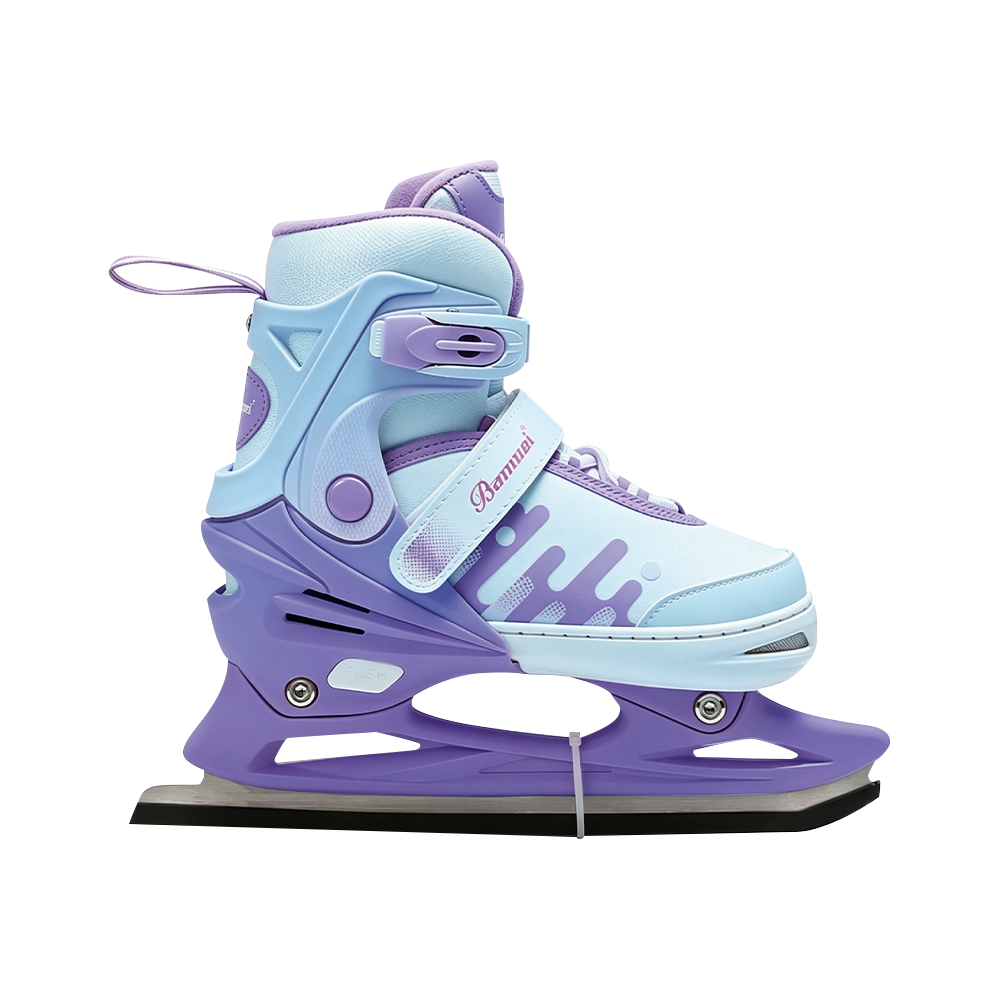
The BW-2302 Kids Adjustable Ice Skates are designed around these requirements. This model combines a high-top boot structure, a PVC shell, a breathable MESH upper, stainless steel blades, adjustable sizing from 32 to 42, and several child-oriented pattern options. Rather than treating children’s ice skates as a smaller version of adult equipment, the design addresses the specific needs of young users: developing balance, changing foot size, sensitivity to appearance, limited maintenance knowledge, and the need for parents to supervise equipment safely and efficiently.
Available in Pink, Blue, and Patterned visual options, the model uses full-print graphics rather than relying only on solid colors or small decorative details. This gives the product a playful identity while preserving its function as genuine skating equipment. The high-top profile also creates a distinctive ice-boot appearance and increases the amount of support around the ankle area.
For buyers seeking OEM skating and scooter equipment, the model also demonstrates how product design, manufacturing capability, material selection, and market positioning can work together. It is suitable for children’s sporting-goods retailers, skating venues, gift-oriented purchasing programs, seasonal promotions, and distributors looking for a differentiated adjustable skate.
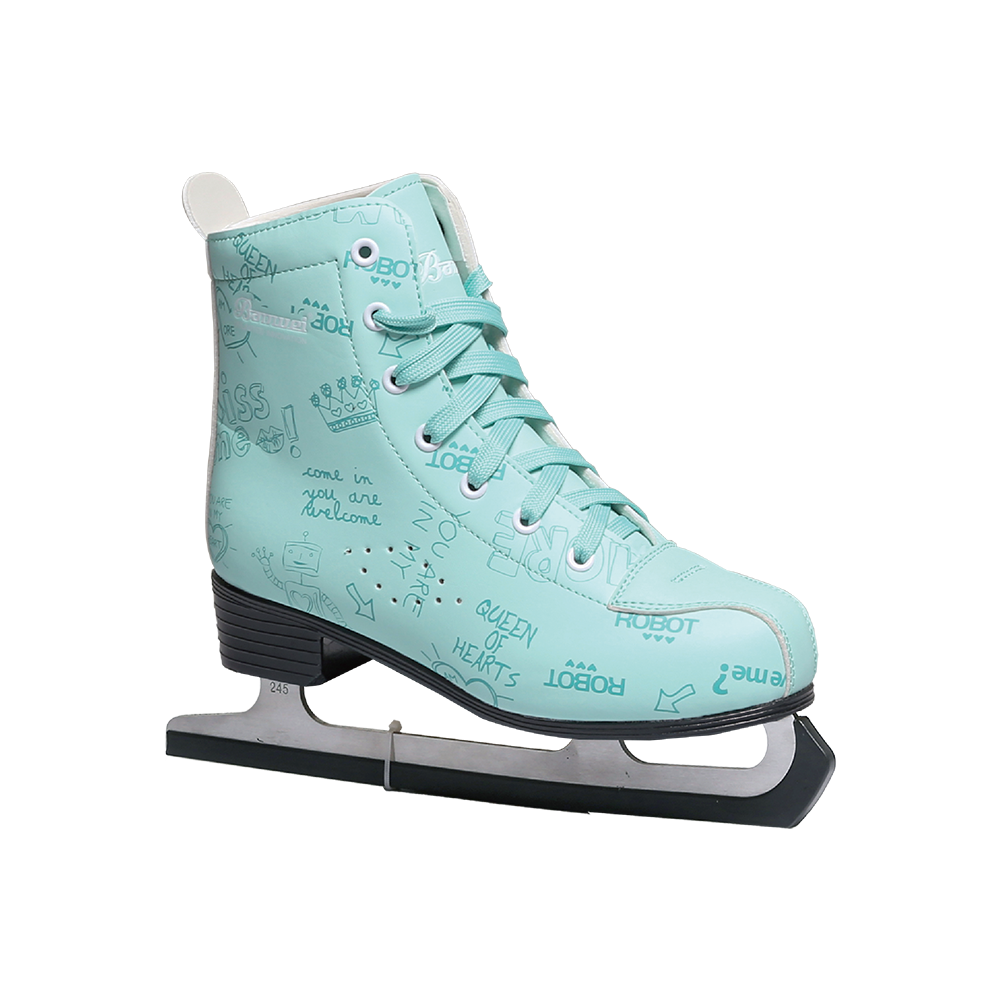
BW-2302 Kids Adjustable Ice Skates
Product Overview
The BW-2302 is an adjustable ice skate developed for children. Its size coverage extends from 32 to 42, allowing the product to serve several stages of childhood growth instead of being limited to a single short-term foot size. The adjustable construction is especially valuable for families whose children are still growing or for businesses that need equipment with broader user flexibility.
The skate uses a high-top boot design. Compared with a low-top profile, the upper rises higher around the ankle, increasing lateral coverage and creating a more secure visual and structural connection between the foot and the boot. Young children are still developing balance and skating posture, so additional ankle coverage can be helpful during the early learning period.
The shell is made of PVC, a material commonly used in sports products that require a balance of structure, manufacturability, and cost control. The upper uses breathable MESH fabric, which supports airflow and gives the boot a softer textile-like appearance. Stainless steel blades complete the functional structure and provide improved corrosion resistance compared with ordinary carbon-steel alternatives.
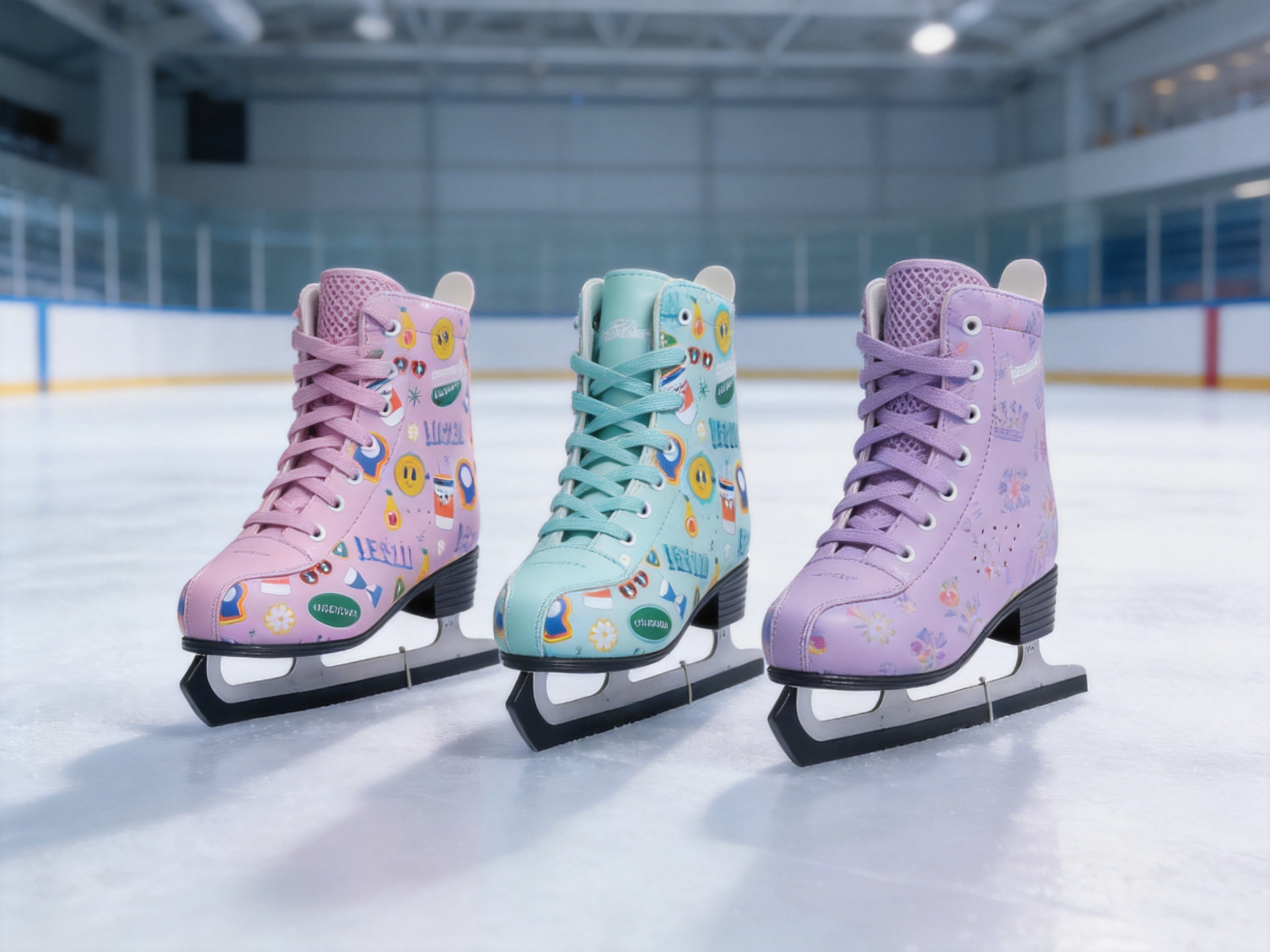
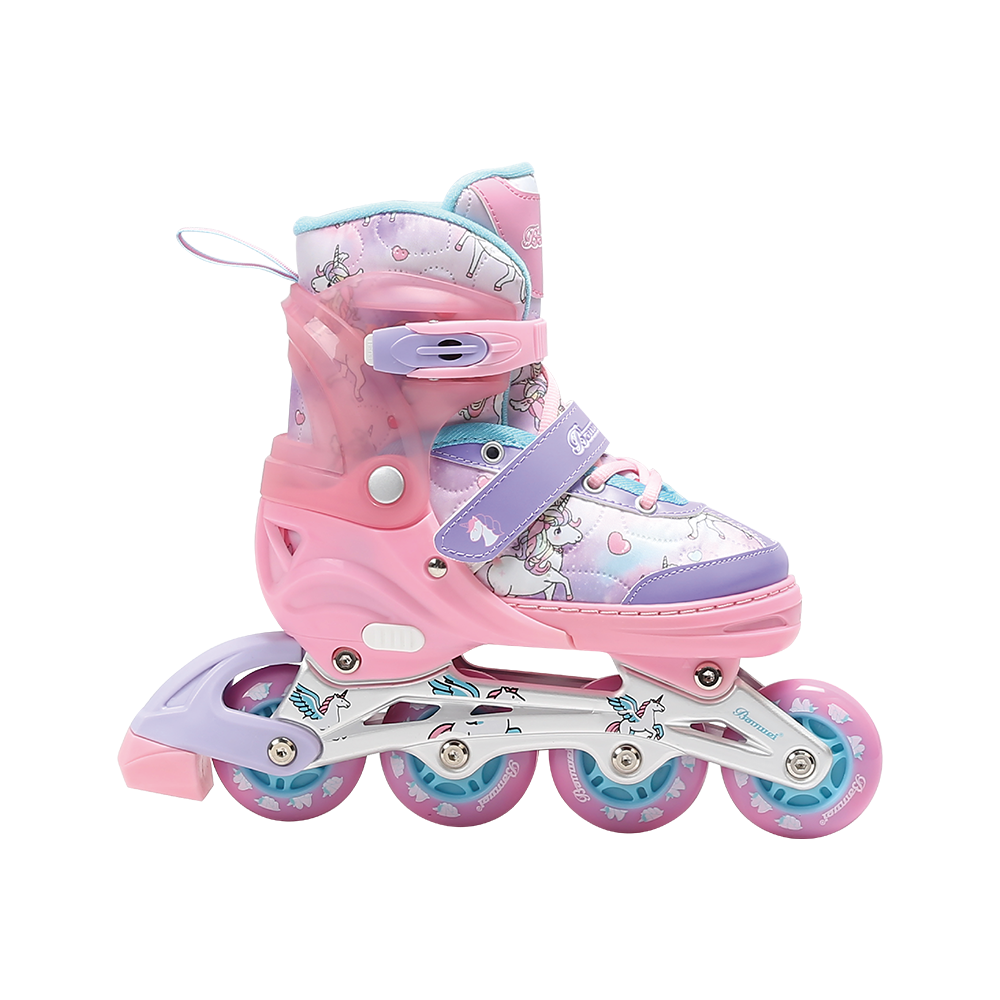
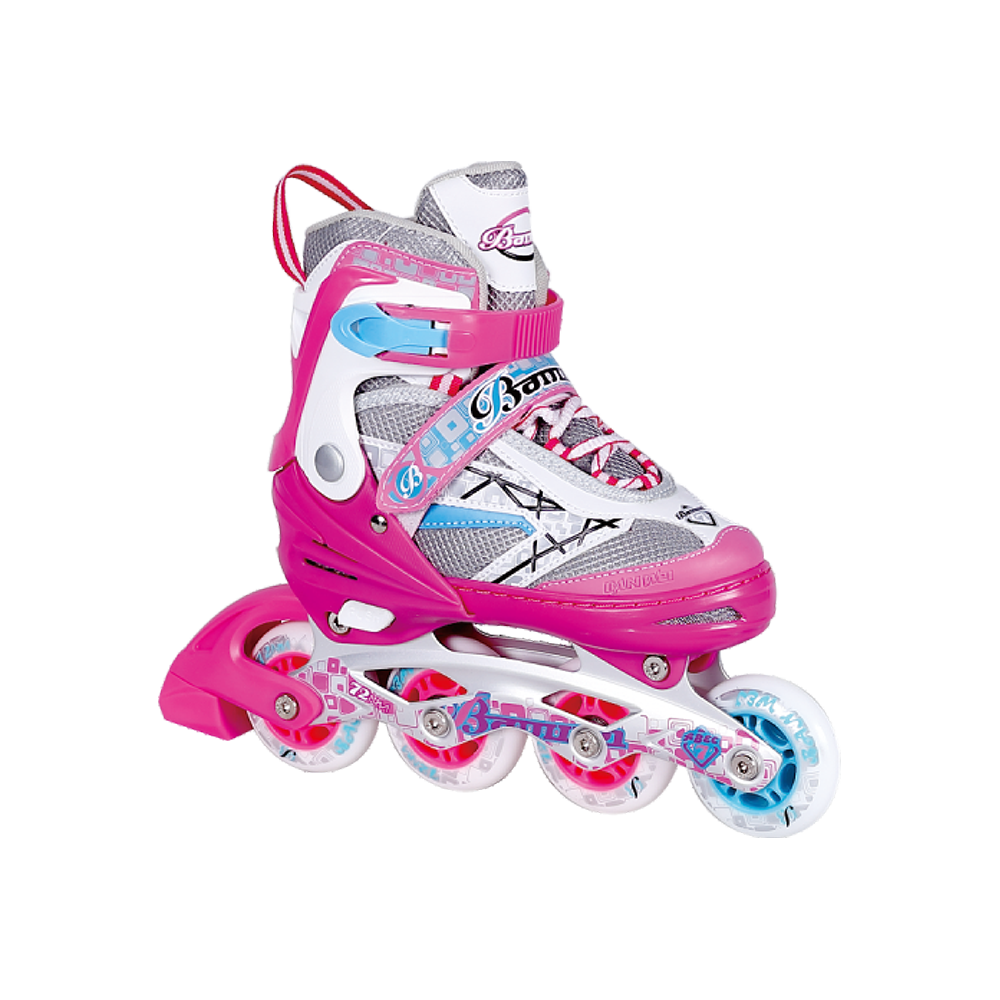
Three primary visual directions are available. The Pink version uses a full cartoon-style print. The Blue version features an all-over fun pattern. The Patterned version uses a light purple foundation with floral elements and varied visual density. These designs create a product family that can appeal to different preferences while maintaining a consistent underlying construction.
| Feature | Specification or Design Direction | Practical Value |
|---|---|---|
| Product type | Children’s adjustable ice skates | Supports beginner and developing skaters |
| Size range | 32–42 | Allows longer use as children grow |
| Boot structure | High-top design | Provides increased ankle coverage and lateral support |
| Shell material | PVC | Creates a structured and durable boot foundation |
| Upper material | Breathable MESH fabric | Improves ventilation and offers a comfortable textile-like finish |
| Blade material | Stainless steel | Helps reduce corrosion and seasonal maintenance demands |
| Color and pattern options | Pink, Blue, and Patterned | Supports varied customer preferences and merchandising plans |
| Carton tiers | S, M, and L specifications | Makes storage and size-group identification easier |
Designed Around the Needs of Children
Children interact with sports equipment differently from adults. An adult may select an ice skate primarily according to technical performance, fit, and durability. A child often makes an initial emotional judgment based on color, graphics, and whether the product feels personally appealing. If the product looks intimidating or overly institutional, the child may be less enthusiastic about trying it.
The BW-2302 addresses this reality through a child-focused pattern language. The Pink, Blue, and Patterned options use strong visual identities that make the skates appear familiar, expressive, and suitable for children. Cartoon graphics, playful all-over prints, and floral elements transform the upper into more than a plain protective shell. The skate becomes part of the child’s outfit and personal identity.
This emotional appeal can be important during a child’s first skating experience. Ice surfaces are unfamiliar, slippery, and sometimes intimidating. Attractive equipment can reduce the psychological distance between the child and the activity. Instead of seeing the skates only as technical sporting equipment, the child may view them as a favorite pair of boots or a special gift.
The high-top profile reinforces this effect. Its boot-like appearance resembles everyday footwear more closely than some narrow, highly technical skate silhouettes. This may make the transition from ordinary shoes to ice skates feel less unfamiliar, particularly for preschool children and lower-primary-school users.
For retailers, the visual variety also creates merchandising opportunities. The model can be displayed as a coordinated product family with different patterns, rather than as one generic item. Stores can organize the options around age groups, color preferences, seasonal themes, gift occasions, or skating-school enrollment campaigns.
Pattern Design as a Commercial Advantage
Many children’s sports products compete for attention through bright colors, but simple color blocking can become predictable. The BW-2302 uses full-print graphics and decorative surfaces to create a stronger shelf presence. Full-print coverage allows the design to remain visible across more of the boot, including areas that may be overlooked when decoration is limited to a logo or small stripe.
The Pink version is suited to customers who prefer cartoon-inspired styling. The Blue version provides a lively alternative with fun patterns. The Patterned option uses a light purple base and floral elements, offering a softer visual direction that can appeal to customers looking for a less conventional color combination.
From a product-development perspective, the same basic skate platform can support multiple visual markets. This reduces the need to create a completely separate construction for every consumer segment. Buyers can select prints according to regional preferences, seasonal campaigns, or retail positioning while preserving the central advantages of the model.
High-Top Construction and Beginner Support
Balance is one of the main challenges for a child learning to skate. Young users must coordinate body position, knee flexion, foot direction, and movement across a low-friction surface. Equipment cannot replace instruction or good technique, but a stable boot structure can help the child feel more secure while learning.
The BW-2302 extends above the ankle, creating a high-top boot profile with increased lateral coverage. This structure can help limit unnecessary side-to-side movement between the foot and the boot. For children whose ankle control is still developing, the additional coverage may make it easier to maintain a consistent stance during early practice.
The high-top design also offers a practical benefit for parents and instructors. When the boot provides a more enclosed ankle area, adults may find it easier to check whether the child is properly positioned before entering the ice. A supportive boot does not eliminate the need for correct fitting, fastening, or supervision, but it can contribute to a more reassuring learning setup.
Compared with lower-profile recreational skates, a high-top skate presents a more substantial upper around the ankle. This creates a recognizable visual distinction and supports the product’s positioning as a child-oriented ice boot rather than a basic shoe with a blade attached.
Importance of Correct Fit
Adjustability is valuable only when the skate is correctly set for the child’s foot. Parents and staff should follow the product’s fitting instructions, make sure the foot is positioned naturally, and check that the heel is seated securely. The child should be able to flex the knee without excessive movement inside the boot.
A skate that is too loose can reduce control, while a skate that is too tight can create discomfort. The adjustable range from size 32 to size 42 provides flexibility, but it does not mean that every setting is suitable for every child at every stage. The internal adjustment should be positioned according to the actual foot length and the manufacturer’s instructions.
Retail staff can add value by explaining how the adjustment works, how to check the fit, and how to retighten the skate after a child has worn it for several minutes. This type of guidance can improve customer confidence and reduce avoidable returns.
Adjustable Sizing for Longer Product Use
Children’s feet grow quickly, which creates a common problem for parents purchasing seasonal sports equipment. A fixed-size skate may fit well at the beginning of the season but become unsuitable before the child has had enough opportunities to use it. Replacing equipment frequently raises the cost of participation and can discourage families from continuing with the activity.
The BW-2302 addresses this issue through an adjustable structure covering sizes 32 to 42. This range spans several stages, from middle kindergarten and preschool-age use through lower primary school and into later childhood, depending on the child’s actual foot development. The ability to adapt the internal fit can extend the practical service period of the product.
For families, the benefit is straightforward: one pair of skates may remain useful through more than one growth stage. The equipment can become a better-value purchase when compared with buying several pairs of fixed-size skates over a similar period.
For skating schools, rental operators, shopping-mall rinks, and theme parks, broad adjustability can simplify inventory management. A product that fits a wider range of users may reduce the number of individual size categories required for short-term rental or supervised activity programs. Staff can focus on selecting and adjusting the correct setting instead of handling an excessive number of narrowly separated sizes.
Adjustable products also support gifting. Family members purchasing skates for birthdays or holidays may feel more comfortable choosing a model that can accommodate growth. The colorful appearance encourages emotional acceptance, while the adjustable construction provides a practical reason for parents to approve the purchase.
Value Across the Product Life Cycle
The value of adjustable sizing should be assessed across the entire period of ownership rather than only at the point of purchase. A fixed-size product may have a lower initial price but become less economical if it must be replaced after a short period. An adjustable skate can provide more usable months or years when properly maintained and when the child’s foot remains within the product’s intended range.
This is particularly relevant in markets where families carefully evaluate sports spending. Ice skating may be an occasional activity, a school-related program, a holiday experience, or a developing hobby. A flexible skate can make it easier for families to participate without immediately committing to a new product at every growth stage.
Materials and Functional Construction
PVC Shell
The PVC shell forms the structured foundation of the skate. It helps maintain the boot’s shape and provides a stable platform for the upper, internal components, and blade assembly. PVC is also well suited to mass production because it can be processed with consistent dimensions through controlled molding operations.
For a children’s product, dimensional consistency is important. The left and right skates must be produced with dependable repeatability, and the shell must integrate effectively with other components during assembly. A stable shell also supports the high-top silhouette that defines the product’s identity.
The use of PVC allows manufacturers to balance product structure with cost efficiency. This is valuable for OEM buyers who need dependable performance at a price suitable for children’s sporting-goods markets. The shell is not intended to replace proper fitting, responsible skating behavior, or protective supervision, but it contributes to the product’s overall functional foundation.
Breathable MESH Upper
The upper uses breathable MESH fabric, providing a softer and more textile-like surface than a fully rigid exterior. Ventilation is an important consideration for children because active movement can lead to heat and moisture inside the boot. A breathable upper can help improve wearing comfort during practice and recreational use.
MESH also provides a suitable surface for full-print decoration. The printed Pink, Blue, and Patterned options can achieve a richer visual effect than a plain molded surface. The upper therefore contributes to both comfort and appearance.
The textile-like finish helps distinguish the BW-2302 from basic hard-surface ice skates. It creates a more approachable visual character and supports the positioning of the product as a children’s lifestyle-oriented sports item. This combination may be especially useful in retail environments where consumers compare equipment according to both function and style.
Stainless Steel Blades
Ice-skate blades operate in a cold and wet environment, and they can be exposed to moisture during use, transport, and storage. Stainless steel offers improved corrosion resistance compared with conventional carbon steel, helping reduce the maintenance burden for household users.
This does not mean that the blades require no care. Users should still dry the blades after skating, avoid leaving them wet in closed bags, and store the skates in a suitable dry location. However, stainless steel reduces the concern that ordinary seasonal moisture will quickly create corrosion if the product is handled responsibly.
The low-maintenance character is particularly useful for families who may use the skates only during winter or during occasional trips to an ice rink. Non-professional owners are less likely to have specialized blade-care routines, so material selection that improves corrosion resistance can make ownership simpler.
For rental venues and event operators, stainless steel can also support more manageable equipment-care procedures. Staff still need to inspect, dry, and maintain the blades, but the material choice can reduce the risk associated with inconsistent seasonal storage.
Seasonal Maintenance and Ownership Guidance
Proper maintenance helps preserve the performance and appearance of any ice skate. After use, the blades should be wiped dry with a clean cloth. Soft blade guards may be used during transport, but they should not be left on wet blades for extended periods because trapped moisture can encourage corrosion.
The upper and shell should be checked for dirt, moisture, loose components, or visible damage. The skates should be allowed to air-dry in a ventilated area rather than being placed directly against a heater or exposed to excessive heat. High heat may affect synthetic materials, printed surfaces, adhesives, or component fit.
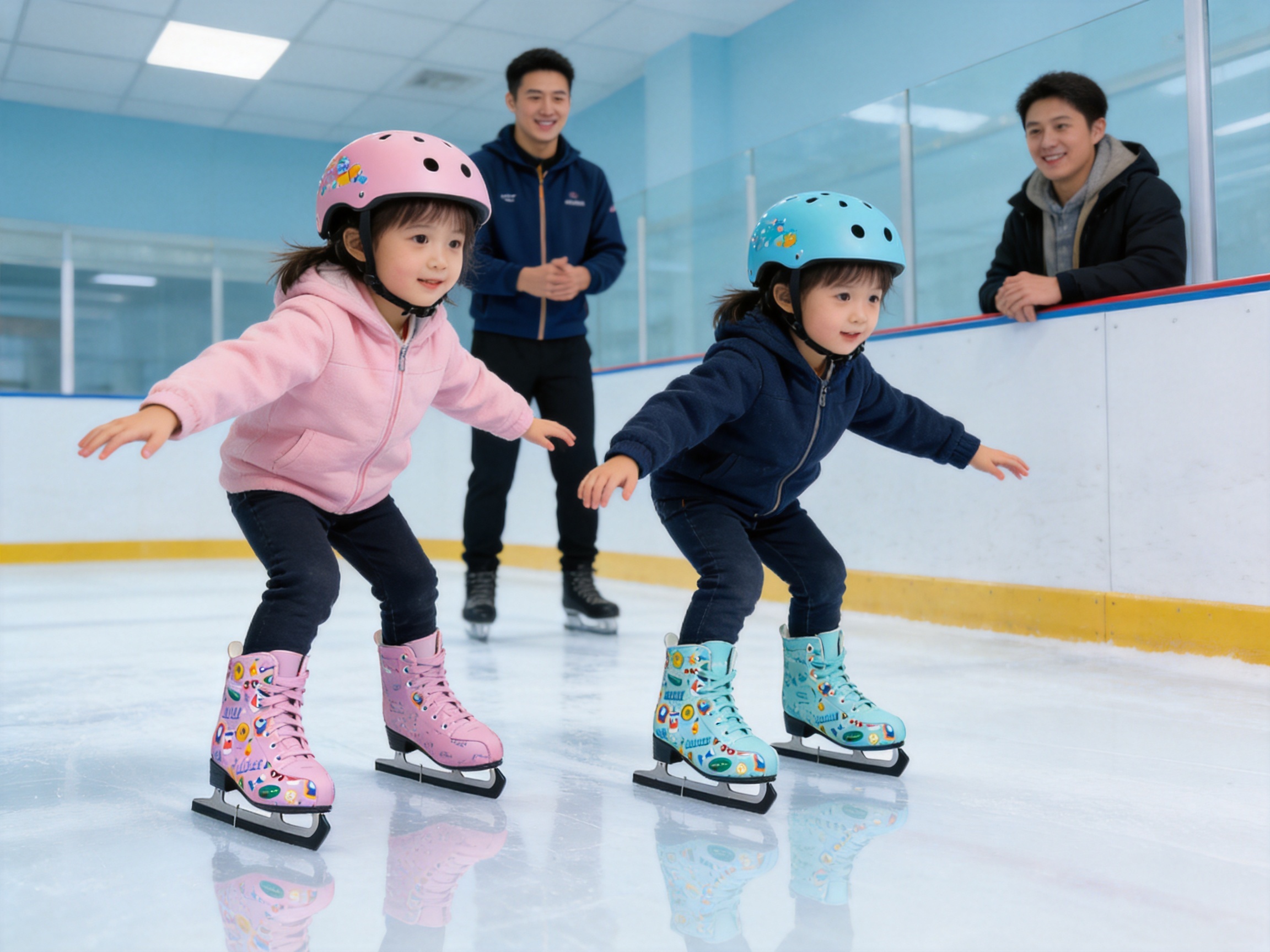
Before each use, adults should inspect the blade assembly and confirm that the boot remains secure. The adjustment mechanism should be checked as the child grows, and the fit should be reassessed at regular intervals. Children should use appropriate protective equipment and skate under suitable supervision, particularly when they are beginners.
At the end of the skating season, the skates should be cleaned, dried completely, and stored in a dry environment. Stainless steel makes seasonal ownership easier, but basic maintenance remains essential for extending service life.
Manufacturing Strengths Behind the Product
The product’s performance and consistency depend not only on its visible design but also on the manufacturing system used to produce it. Ningbo Feile Sporting Goods Co., Ltd. was established in 2010 and specializes in children’s scooters, inline skates, roller skates, and ice skates. This product specialization gives the company experience across related categories that share requirements for molded components, soft goods, wheels or blades, assembly accuracy, and child-oriented design.
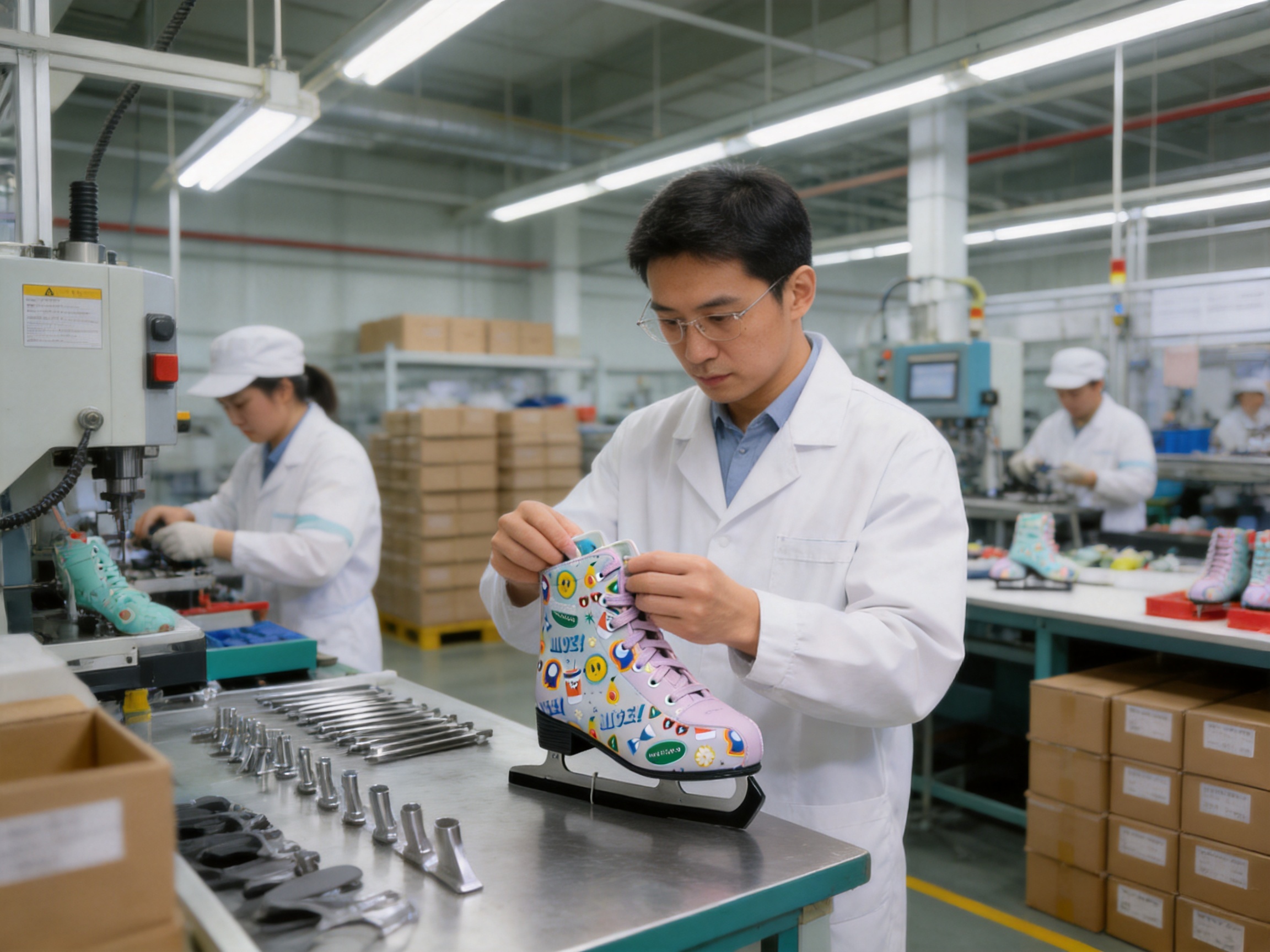
The company operates a workshop of approximately 20,000 square meters and employs more than 200 people. Its facilities include five advanced automatic production lines, as well as mold, injection molding, sewing, and assembly workshops. This combination allows important stages of product development and manufacturing to be managed within a coordinated production system.
For OEM customers, integrated manufacturing can reduce communication gaps between separate suppliers. Mold development, plastic component production, textile sewing, printing, and final assembly can be aligned more efficiently when they are supported by a single experienced production organization.
Mold and Injection-Molding Capability
The PVC shell and other molded components require reliable tooling and controlled injection-molding processes. Accurate molds help maintain dimensional consistency, repeatable fit, and stable appearance across production batches. This is particularly important for adjustable products because the shell, adjustment components, upper, and blade assembly must work together correctly.
In-house or closely coordinated mold capability also supports product customization. OEM buyers may request changes to colors, printed patterns, component details, packaging, or market-specific design features. A manufacturing partner with mold and engineering resources can assess these requests more efficiently than a trading organization with no direct production infrastructure.
Injection molding also supports scale. Once tooling has been validated, the production process can deliver repeated components with consistent geometry. This helps the final product maintain a recognizable appearance across multiple size settings and color options.
Sewing and Textile Assembly
The MESH upper requires cutting, sewing, shaping, and attachment processes that differ from rigid plastic production. A dedicated sewing workshop provides the foundation for handling textile components with appropriate quality control. Stitching consistency, panel alignment, edge finishing, and attachment to the shell all influence the final appearance and durability of the skate.
Because the product uses full-print graphics, textile handling is also important for visual consistency. Pattern placement and panel assembly should be managed carefully so that the finished pair presents a coherent appearance. For buyers selling multiple colors or patterns, repeatable sewing and printing processes help reduce variation between samples and mass production.
Assembly and Production Coordination
Final assembly brings together the molded shell, MESH upper, adjustment mechanism, internal components, and stainless steel blade. Each stage must be coordinated so that the finished skate is comfortable, structurally sound, visually attractive, and ready for retail packaging.
A professional assembly process should include checks for component alignment, closure or adjustment function, left-right pairing, surface quality, and blade attachment. These checks are especially important for children’s products because the end user may not be able to identify a manufacturing issue before use.
The company’s professional R&D engineering team supports product development and production improvement. More than 30 college-educated management staff contribute to organizational and operational coordination. This combination of engineering and management resources can help OEM customers move from concept discussions to practical manufacturing decisions.
Quality Systems and Certification Awareness
International buyers often require more than attractive product samples. They need confidence that a supplier can maintain stable production, manage documentation, and meet applicable market requirements. Feile has passed ISO9001 and BSCI systems and has participated in Kmart factory certification systems, according to the supplied company information.
The company also reports product certifications and compliance experience including 3C, CE, EN71, EN62115, ASTM, EMC, and EN13843:2009. The precise requirements applicable to an order depend on the destination market, product configuration, age classification, and sales channel. Buyers should confirm current documentation, testing scope, and certificate validity for the exact model and production version before placing an order.
Quality systems are valuable because they create repeatable processes rather than relying only on final inspection. Documented procedures can cover incoming materials, production control, equipment maintenance, worker responsibilities, inspection records, corrective actions, and shipment release. Such systems help reduce the risk of inconsistent batches.
For an OEM customer, this process orientation is a competitive advantage. A supplier that understands both product construction and compliance expectations can provide more useful support during development, testing, packaging preparation, and market entry.
Carton Specifications and Warehouse Efficiency
The product information includes three carton specifications: approximately 50 × 40 × 29 centimeters for the S tier, 57 × 42 × 30 centimeters for the M tier, and 61 × 44 × 32 centimeters for the L tier. The supplied information also lists carton dimensions of 570 × 420 × 300 millimeters and 610 × 440 × 320 millimeters. Buyers should confirm the final carton matrix, inner-pack quantities, and packing configuration during order confirmation.
| Carton tier | Approximate dimensions | Operational significance |
|---|---|---|
| S | 50 × 40 × 29 cm | Compact format for smaller size groups |
| M | 57 × 42 × 30 cm | Intermediate volume for mid-range size settings |
| L | 61 × 44 × 32 cm | Larger format for higher size tiers |
The gradual difference between the carton tiers provides a practical storage signal. Warehouse staff can identify size groups more quickly when carton dimensions follow a clear progression. This may reduce sorting errors during receiving, replenishment, and shipment preparation.
Carton differentiation is also useful for retail distribution. When an order includes multiple size ranges, clearly organized packaging can help staff match cartons to purchase orders and store allocations. For rental operators, it can support faster inventory counting and seasonal deployment.
Packaging should also protect the printed upper, blade, and adjustment components during transport. OEM buyers may request additional carton markings, barcode labels, language-specific warnings, instruction sheets, or customized retail packaging. These details should be discussed early because they can affect artwork approval, packing operations, and lead time.
Advantages for OEM and Wholesale Buyers
The BW-2302 offers several advantages to buyers developing a children’s ice-skating range. First, it combines functional features that are easy to communicate: adjustable sizing, a high-top boot, breathable MESH, PVC construction, and stainless steel blades. These benefits can be translated into packaging copy, retailer training material, product listings, and sales presentations.
Second, the visual system provides multiple merchandising directions without requiring entirely different product platforms. Pink, Blue, and Patterned versions can target different preferences while retaining consistent core specifications. Buyers can build a broader collection with manageable product complexity.
Third, the size range supports longer product use. This is attractive to family consumers and may help retailers position the model as a value-oriented purchase rather than a short-term novelty item.
Fourth, the product can serve multiple channels. It may be appropriate for sporting-goods stores, children’s department stores, online marketplaces, skating schools, recreational venues, holiday gift catalogs, and seasonal promotional programs. The product’s balance of appearance and function allows it to move beyond a strictly technical sports-equipment category.
Fifth, the manufacturer’s broader product experience creates potential for category expansion. A buyer sourcing ice skates may also need inline skates, roller skates, children’s scooters, or protective gear. A supplier with experience across these categories can support more consistent sourcing and product development.
Positioning Against Basic Fixed-Size Skates
Compared with basic fixed-size children’s skates, the BW-2302 provides a stronger answer to the problem of growth. The adjustable mechanism can extend the period during which the product remains usable, while the high-top structure and patterned upper give it a more developed product identity.
A basic fixed-size skate may be suitable for a single short-term activity, but it can become less economical when a child’s foot grows quickly. The BW-2302 is designed to support repeated use across a broader size range, subject to correct adjustment and normal care.
Positioning Against Plain Recreational Designs
Plain recreational designs may offer basic function but can be less emotionally engaging for children. The BW-2302 uses full-print graphics and floral styling to create a more distinctive shelf presence. This can help retailers attract attention and can make the product more suitable for gifting or themed skating events.
Positioning Against High-Maintenance Blade Materials
Stainless steel blades provide a practical maintenance advantage over less corrosion-resistant blade materials. Families and seasonal operators still need to dry and inspect the blades, but stainless steel can reduce the burden associated with storage between skating periods.
Applications in Retail, Rentals, and Events
Retail Stores
Retailers can present the BW-2302 as an adjustable children’s ice skate with a playful design collection. Product displays may group the models by color, pattern, or age-oriented size range. Clear signs should explain the adjustment feature and encourage parents to request fitting assistance.
The product’s visual identity is useful for online retail as well. High-quality images should show the full boot, blade, adjustment area, pattern details, and available color options. Product descriptions should explain that sizing must be adjusted according to the child’s actual foot length and that the product is intended for supervised skating.
Skating Schools
Skating schools can use adjustable skates for beginner programs, introductory lessons, and family activity sessions. A broader size range may help schools organize shared equipment. The high-top design can also provide a reassuring structure for students who are still learning basic stance and movement.
School staff should maintain a fitting record or inspection routine. Since several children may use the equipment, each pair should be checked for cleanliness, blade condition, adjustment function, and structural integrity between sessions.
Shopping-Mall Rinks and Theme Parks
Short-term skating venues often need products that combine visual appeal with operational practicality. The Patterned option may function as both equipment and a thematic prop for seasonal campaigns, children’s activity zones, or photo-oriented events. Colorful skates can make the activity more memorable and can contribute to family photographs and social sharing.
Venue operators should establish cleaning, drying, and storage procedures. Stainless steel blades can simplify seasonal maintenance, but frequent-use environments require consistent inspection and staff training.
Gift and Holiday Programs
The product is naturally suited to gift-oriented procurement. Full-print cartoons, bright colors, and floral details give children an immediate emotional reason to engage with the product. The adjustable range gives parents and gift buyers a practical reason to select it as well.
Retailers may promote the skates during winter holidays, birthdays, school breaks, and family travel periods. Packaging can reinforce the gift experience while still communicating fit, safety, and care information clearly.
Manufacturing and Customization Opportunities
OEM customers may approach the manufacturer with requirements for color changes, new surface graphics, packaging adjustments, market-specific labeling, or coordinated product families. The company’s experience with molds, injection molding, sewing, assembly, and R&D provides a foundation for evaluating such projects.
Customization should begin with a clear product brief. The brief should identify the target age group, sales market, required size range, preferred materials, pattern direction, packaging format, testing expectations, order quantity, and delivery schedule. Clear documentation helps prevent misunderstandings between design approval and production.
Artwork development requires attention to panel shapes and sewing lines. A pattern that looks effective on a flat drawing may require adjustment when wrapped around a three-dimensional boot. Sampling allows the buyer and factory to review scale, color balance, print alignment, and overall appearance before bulk production.
Packaging customization may include printed cartons, color boxes, instruction manuals, hangtags, barcode labels, and warning information. These materials should be checked for language accuracy and market requirements before mass printing.
Product customization should not compromise the core functional structure. Any change to the shell, adjustment mechanism, blade attachment, or load-bearing area should be evaluated by the engineering team and, where appropriate, followed by additional testing.
Responsible Product Communication
When selling children’s ice skates, product descriptions should make benefits clear without exaggerating them. The high-top design can be described as providing increased ankle coverage and lateral support, but it should not be presented as a guarantee against injury. Stainless steel can be described as corrosion-resistant and lower-maintenance, but users should still be told to dry and inspect the blades.
Adjustable sizing can be presented as a way to accommodate growth within the intended range. It should not be described as a universal fit for every child. Correct fitting remains necessary, and the product should be selected according to the actual foot measurement and manufacturer’s guidance.
Responsible communication builds trust with parents, retailers, and institutional buyers. It also helps ensure that the product is used as intended. Clear instructions about fitting, supervision, maintenance, and protective equipment should accompany the product wherever required.
Why the Manufacturer Is a Strong Sourcing Partner
Ningbo Feile Sporting Goods Co., Ltd. brings more than fifteen years of experience since its establishment in 2010. Its focus on children’s scooters, inline skates, roller skates, and ice skates indicates a concentrated understanding of products used in active youth markets.
The company’s location in Yuyao, Ningbo, Zhejiang Province, provides access to a region known for plastics manufacturing and to transportation connections associated with Ningbo and Shanghai. This location can support sourcing of materials, manufacturing coordination, and export logistics.
The company reports more than 200 employees, a 20,000-square-meter workshop, five automatic production lines, and specialized mold, injection-molding, sewing, and assembly areas. These resources support both production scale and process specialization.
A professional R&D engineering team allows the company to work on new products and design improvements. The company launches new products each year to respond to market and customer needs. For buyers, this suggests an ability to participate in product development rather than merely reproduce an existing item.
Its reported quality and social-compliance systems, along with product certification experience, provide additional support for international sourcing. Buyers should still conduct their own due diligence and confirm current documentation for every specific order, but the available company profile indicates a supplier with established export-oriented capabilities.
Conclusion
The BW-2302 Kids Adjustable Ice Skates combine child-focused styling with practical features for growing users. The high-top boot provides increased ankle coverage and a distinctive ice-boot appearance. The PVC shell creates a structured foundation, while the breathable MESH upper supports ventilation and gives the product a softer textile-like finish. Stainless steel blades reduce corrosion concerns and simplify seasonal ownership when combined with proper care.
The adjustable 32–42 size range is one of the model’s strongest commercial advantages. It can help families reduce replacement costs, assist skating schools in managing shared equipment, and provide retailers with a value-oriented product for children at different growth stages.
The Pink, Blue, and Patterned versions further strengthen the model’s market appeal. Full-print cartoons, lively patterns, and floral elements give the skates an emotional and visual identity that plain equipment may lack. This makes the model suitable for ordinary retail, gifts, themed events, and recreational venues.
Behind the product is a manufacturer with capabilities covering mold development, injection molding, sewing, assembly, engineering, and quality management. The company’s experience in related skating and scooter categories supports OEM development and coordinated product sourcing.
For buyers seeking children’s skating equipment that balances appearance, adjustability, support, material selection, and manufacturing capability, the BW-2302 represents a flexible platform for retail and institutional applications. Its strongest advantage is not one isolated feature, but the way multiple features work together to address the practical and emotional needs of young skaters and the adults who purchase, manage, and supervise their equipment.
Questions and Answers
What type of product is the BW-2302?
The BW-2302 is an adjustable ice skate designed for children. It combines a high-top boot structure, PVC shell, breathable MESH upper, stainless steel blades, and a size range from 32 to 42.
What colors and patterns are available?
The model is available in Pink, Blue, and Patterned options. The Pink version uses cartoon-style graphics, the Blue version uses fun all-over patterns, and the Patterned version uses a light purple foundation with floral elements.
Why is the high-top design useful for children?
The high-top design increases coverage around the ankle and may provide additional lateral support for children who are still developing balance and skating control. Correct fitting and adult supervision remain essential.
How does the adjustable sizing benefit families?
The 32–42 range allows the skate to accommodate foot growth within the intended adjustment range. This may extend the period of use and reduce the need to purchase a new fixed-size skate after a short period.
Are the stainless steel blades maintenance-free?
No. Stainless steel improves corrosion resistance and reduces maintenance demands, but users should still dry the blades after skating, use suitable blade guards during transport, and store the skates in a dry, ventilated place.
Is the product suitable for beginners?
The model is designed for children and includes features that can support early skating experiences, including a high-top structure and adjustable fit. Beginners should skate under appropriate adult or instructor supervision and use suitable protective equipment.
What materials are used in the skate?
The shell is made of PVC, the upper uses breathable MESH fabric, and the blades are made of stainless steel.
What are the approximate carton dimensions?
The supplied specifications identify S, M, and L carton tiers of approximately 50 × 40 × 29 centimeters, 57 × 42 × 30 centimeters, and 61 × 44 × 32 centimeters. Final packing details should be confirmed with the manufacturer before ordering.
Can OEM buyers request customized designs?
OEM buyers can discuss color, pattern, packaging, labeling, and product-development requirements with the manufacturer. Customization should be reviewed by the engineering and production teams to confirm feasibility, testing needs, and minimum order conditions.
What manufacturing capabilities does the supplier have?
The company reports mold, injection-molding, sewing, and assembly workshops, five automatic production lines, a professional R&D engineering team, and experience producing children’s scooters, inline skates, roller skates, and ice skates.
Which certifications and quality systems are associated with the company?
The supplied company information reports ISO9001, BSCI, and Kmart factory certification systems, along with product certification experience including 3C, CE, EN71, EN62115, ASTM, EMC, and EN13843:2009. Buyers should verify current documentation for the exact product and destination market.
Where can this model be used commercially?
The model may be suitable for sporting-goods retail, online sales, skating schools, shopping-mall rinks, theme parks, holiday programs, gift channels, and other supervised recreational applications.
References
1. Product specification and marketing materials for BW-2302 Kids Adjustable Ice Skates, supplied for article preparation.
2. Company profile and manufacturing capability information for Ningbo Feile Sporting Goods Co., Ltd., supplied for article preparation.
3. General principles of children’s skating equipment fitting, inspection, supervision, and seasonal maintenance.
4. General manufacturing practices for PVC injection molding, textile sewing, product assembly, and OEM sports-equipment production.
5. General quality-management and product-compliance considerations for children’s sporting goods and recreational equipment.
Product: BW-2302 Kids Adjustable Ice Skates

Recommended Articles
-
BW-127BD Kids Ice Skate05/09

Get in Touch
Your email address will not be published. Required fields are marked *
Have a project in mind? Contact with us!
We are happy to answer your questions. Please fill out this form
and one of our professional team will get back to you as soon as possible.

We specialize in producing various types of children's toy cars, children's skateboards, and ice skates.
