
 En
 Español
 русский
 عربى

Why Adjustable Youth Ice Skates Are Becoming a Smarter Choice for Growing Skaters
Date:Oct 03, 2026
Content
- 1 Product Positioning for Teenagers and Growing Beginners
- 2 Key Product Specifications
- 3 Adjustability and Growth Management
- 4 High-Top Construction and Beginner Stability
- 5 Minimalist White and Black Styling
- 6 Material Selection: PVC Shell and Breathable MESH Upper
- 7 Stainless Steel Blades for Seasonal Use
- 8 Packaging and Inventory Efficiency
- 9 Advantages Compared with Common Competitor Types
- 10 Applications in Schools and Training Centers
- 11 Applications in Ice Rink Rental Operations
- 12 Applications for Families and Long-Term Household Use
- 13 Applications in Performances and Events
- 14 Manufacturing Strengths and Production Capability
- 15 Quality Systems, Certifications, and Compliance Awareness
- 16 Research, Development, and OEM Cooperation
- 17 How Buyers Can Evaluate the Product
- 18 Care and Maintenance Recommendations
- 19 Q&A: Common Questions About Youth Adjustable Ice Skates
- 19.1 Who is the BW-2301 designed for?
- 19.2 What sizes are available?
- 19.3 What colors are offered?
- 19.4 Why is the high-top design useful?
- 19.5 What materials are used?
- 19.6 Are stainless steel blades maintenance-free?
- 19.7 Is the product suitable for school programs?
- 19.8 Can ice rinks use the model for rental inventory?
- 19.9 Is the White version suitable for performances?
- 19.10 Does adjustability guarantee several years of use?
- 19.11 What should importers request before ordering?
- 20 Conclusion
- 21 References
- 22 Product: BW-2301 Youth Adjustable Ice Skates
Choosing ice skates for teenagers involves more than selecting an attractive pair from a catalog. A suitable skate must balance stability, comfort, appearance, durability, maintenance requirements, sizing flexibility, and purchase cost. Young skaters are still developing physically and technically, so their equipment must support changing foot dimensions while providing a secure platform for learning. At the same time, parents, schools, training centers, rental operators, and distributors need products that are practical to stock, easy to identify, and reliable during repeated seasonal use.
The BW-2301 Youth Adjustable Ice Skates are designed around these requirements. They combine an adjustable youth-oriented structure with a traditional high-top boot, a PVC shell, breathable MESH upper material, and stainless steel blades. The model is available in pure White and pure Black, with gold logos as the primary visual accent. Its size range extends from 32 to 42 and is organized into three four-size combination cartons: 31–34, 35–38, and 39–42.
This combination gives the product a clearly defined position between basic children’s skates and more specialized adult-looking equipment. It is intended for teenagers and developing skaters who want a mature appearance without immediately moving to a full adult product. It also serves institutional buyers that need a manageable inventory system for schools, ice rinks, training programs, and family sports retailers.
Rather than relying on bright prints, cartoon graphics, or complicated decoration, the BW-2301 uses a restrained design language. The White version presents a fully white high-top boot with gold logos, while the Black version presents a fully black boot with gold logos. This minimalist approach can help teenagers feel that they are using serious sporting equipment instead of a product designed for very young children.
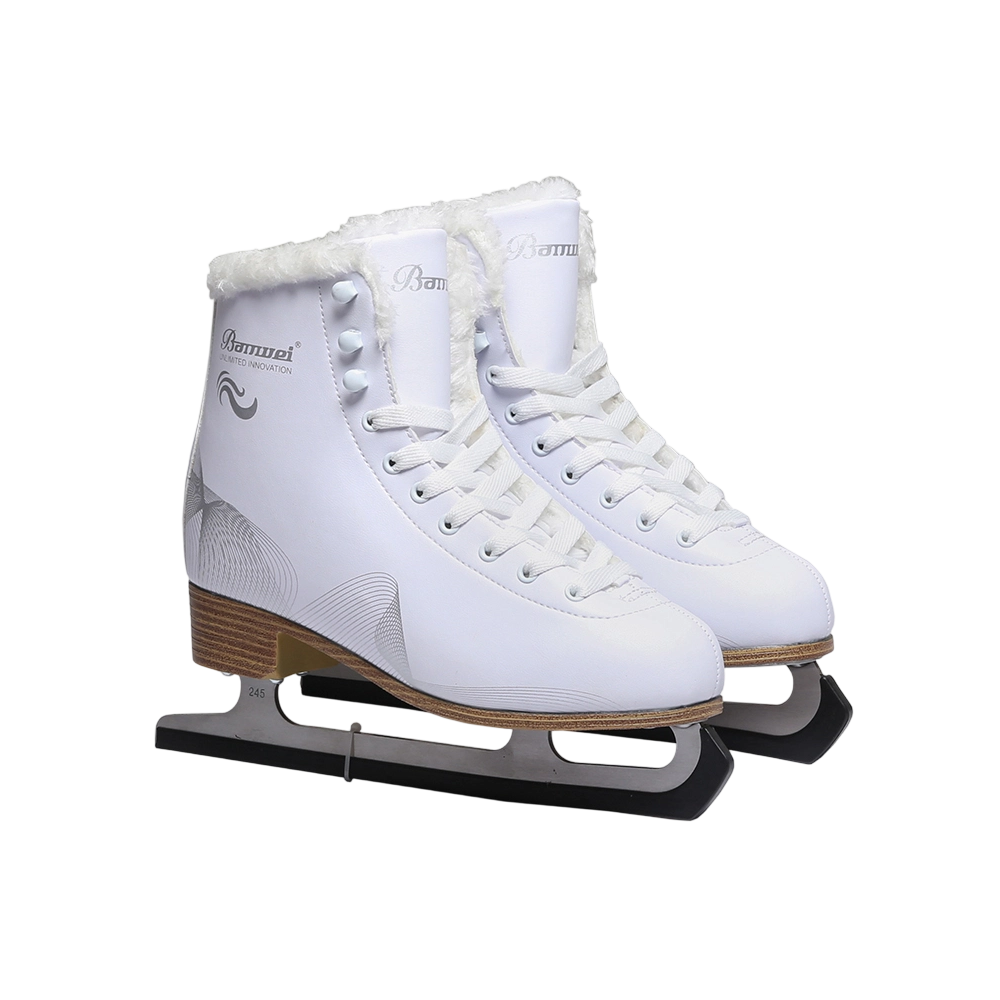
BW-2301 Youth Adjustable Ice Skates
Product Positioning for Teenagers and Growing Beginners
Youth ice skate buyers often face a gap in the market. Children’s skates may use playful colors, printed characters, and highly decorative styling. Adult skates, on the other hand, may be too large, too rigid, or insufficiently adapted to the physical and skill-development needs of younger users. A youth-specific skate can address this gap by combining age-appropriate sizing with a more mature visual identity.
The BW-2301 name directly communicates its intended user group. The inclusion of “Youth” makes the target market easy to understand for distributors, schools, rental facilities, and online shoppers. It signals that the product is not simply a reduced version of an adult skate or an oversized children’s model. Instead, it is positioned for teenagers who are developing balance, coordination, and basic skating confidence.
This positioning is especially useful for families with children who are moving rapidly through different stages of physical growth. A teenager may need a skate that feels secure during early training but does not look childish in a school, club, or public rink environment. The BW-2301 responds to that requirement through its high-top construction, limited color palette, and adjustable youth format.
For beginners, confidence is an important part of sports participation. Equipment that looks appropriate for the user’s age can reduce self-consciousness and encourage regular practice. A mature-looking skate may also make the transition from casual skating to structured lessons feel more natural. While appearance cannot replace technical instruction, it can influence whether a young user feels comfortable returning to the rink.
The product is also suitable for teenagers who are moving from basic recreational skating toward introductory technical training. Its traditional contour visually connects with familiar figure-skating and hockey-inspired equipment without adding unnecessary decoration. This gives the skate a professional visual identity while retaining the practical characteristics expected of a youth model.
Key Product Specifications
| Product Feature | BW-2301 Specification | Practical Value |
|---|---|---|
| Product type | Youth adjustable ice skates | Supports developing users and reduces the need for immediate replacement |
| Target group | Teenagers and growing beginner skaters | Bridges the gap between children’s and adult-looking equipment |
| Color options | White and Black | Provides a mature, easy-to-coordinate appearance |
| Boot structure | Traditional high-top design | Offers increased ankle coverage and a stable visual profile |
| Shell material | PVC | Provides a practical molded structure for regular recreational use |
| Upper material | Breathable MESH fabric | Supports airflow and helps improve wearing comfort |
| Blade material | Stainless steel | Reduces corrosion concerns during seasonal storage |
| Overall size coverage | 32–42 | Fits a broad youth and early adolescent range |
| Carton grouping | 31–34, 35–38, and 39–42 | Simplifies bulk purchasing and inventory organization |
The specifications show that the product is not built around one isolated feature. Its value comes from the relationship between the adjustable format, youth-focused size coverage, mature design, high-top structure, breathable upper, and stainless steel blade. Together, these elements address the needs of users who may skate seasonally, grow quickly, or share equipment within an organized program.
Adjustability and Growth Management
Growth is one of the most important factors affecting youth sports equipment. A child or teenager may change shoe size several times during school years. When fixed-size skates are purchased too early, they may become uncomfortable before they are significantly worn. When families buy oversized skates to anticipate growth, the fit may be unstable and difficult to control. An adjustable design offers a practical middle path when used correctly and fitted according to the manufacturer’s instructions.
The BW-2301 covers sizes from 32 to 42, creating a broad product range for growing skaters. The model is particularly suitable for families seeking longer service life from one purchase. The stated design concept allows a skate to accommodate changes over time rather than being limited to one narrow foot dimension.
The product information also describes a four-size combination structure. Cartons are organized as 31–34, 35–38, and 39–42. This arrangement is useful for wholesalers and institutional purchasers because it connects product packaging with the natural progression of youth sizes. A school, club, or training center can plan procurement by size group instead of managing a completely separate carton for every individual size.
For families, growth flexibility may reduce the frequency of replacement decisions. The exact service period depends on the user’s growth rate, frequency of skating, fitting practices, and maintenance. Nevertheless, a size range extending across several youth stages can provide a more economical ownership model than repeatedly buying single-size skates.
Adjustability should always be paired with proper fitting. The skate should hold the foot securely, the heel should not lift excessively, and the user should be able to flex naturally without pressure points. Parents, coaches, and rink staff should inspect the fit regularly, particularly after periods of rapid growth. The benefit of adjustability is maximized when the skate is correctly set for the wearer rather than simply left at the largest possible position.
Compared with fixed-size entry-level competitors, an adjustable youth skate can offer a stronger value proposition for buyers who prioritize service life. It can also make product selection easier for retailers because one model can serve several adjacent stages of development. This is especially useful when customers are uncertain about which size to purchase for a growing child.
High-Top Construction and Beginner Stability
The BW-2301 uses a traditional high-top boot design. The boot extends above the ankle, creating a familiar skating profile and providing additional coverage around the lower leg. For developing skaters, this structure can contribute to a more secure feeling when learning basic stance, gliding, stopping, and turning.
Teenagers may experience changes in height, weight distribution, muscle strength, and coordination over a relatively short period. These changes can affect balance and movement control. A high-top skate does not eliminate the need for instruction or proper technique, but it can provide a supportive structure that helps the user feel more stable during early practice.
Compared with low-cut recreational footwear, a high-top skate can create a stronger sense of ankle enclosure. This is particularly valuable for beginners who are still learning how to keep the knees flexed and align the body over the blades. The visual height of the boot also reinforces the impression that the product is designed for serious ice activity rather than casual costume use.
The high-top format can be attractive to schools and rental facilities as well. Beginners often require equipment that feels intuitive and secure. A traditional boot contour can help instructors identify whether the skate is being worn and laced correctly. It also gives the product a consistent appearance when multiple pairs are used in a class or team setting.
At the same time, support must not be confused with stiffness or guaranteed injury prevention. Safe skating depends on correct sizing, blade condition, lacing, surface conditions, supervision, and the user’s skill level. The BW-2301’s high-top structure should be viewed as one part of a complete equipment and training system.
Minimalist White and Black Styling
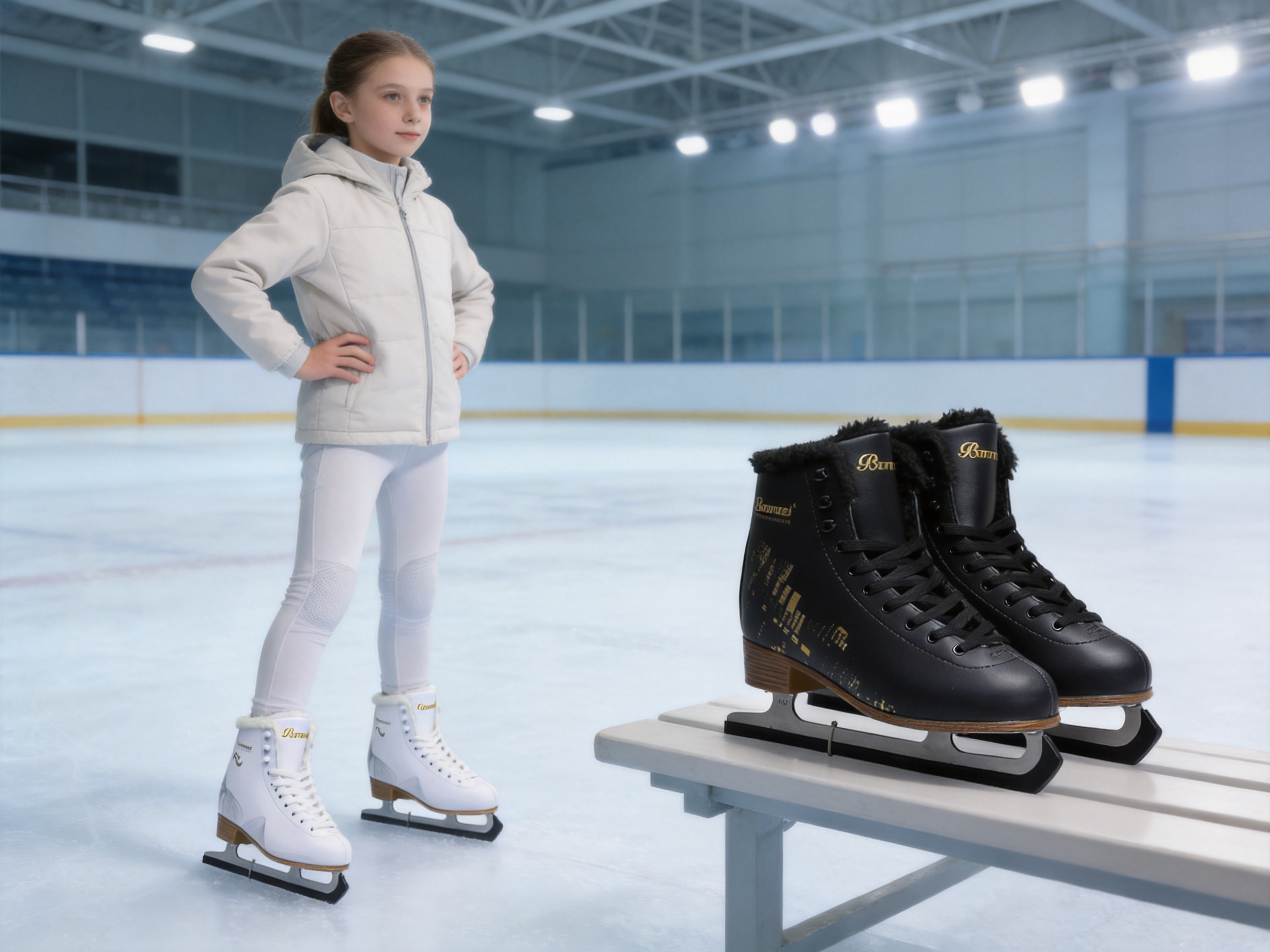
The visual design of the BW-2301 is one of its clearest differences from many children’s and youth competitors. The model is offered in two solid colors: White and Black. Each version uses gold logos as the principal decorative detail. There are no cartoon characters, printed patterns, or complex color blocks.
This restrained appearance has several commercial advantages. First, it appeals to teenagers who may prefer equipment that resembles adult sporting gear. As users become more aware of personal style and social presentation, they may reject products that look too young. A clean White or Black skate can feel more appropriate for school programs, club training, and public rink use.
Second, simple colors make the product easier to coordinate with clothing, uniforms, protective gear, and team apparel. A school can select one color for a group or use both colors to identify different classes. A rental facility can also recognize its inventory quickly without managing many decorative variations.
Third, minimalist products can remain visually acceptable for longer periods. Fashion-led patterns may become outdated or may appeal only to a narrow age group. White and Black are less dependent on seasonal graphics or gendered color preferences. This can help distributors maintain inventory across different selling periods.
The White version is particularly suitable for performances, school showcases, figure-skating demonstrations, and ice-themed events where a clean boot appearance is desirable. The Black version offers a practical alternative for everyday training, rental inventory, or users who prefer a less visibly delicate color.
Compared with highly decorated competitors, the BW-2301 may also be easier to position across multiple markets. It can be presented as a youth product, a school sports item, a rental skate, or a beginner training model without its appearance limiting the audience. The gold logo adds a small visual accent while preserving the overall purist design.
Material Selection: PVC Shell and Breathable MESH Upper
The boot shell is made of PVC, a widely used material for molded sporting-goods components. In an ice skate, the shell contributes to the external form and structural support of the boot. PVC can be processed into consistent shapes and is suitable for products that require repeatable dimensions across large production runs.
For manufacturers, molded PVC also supports efficient production. Once the appropriate tooling is prepared, shells can be produced with consistent contours and integrated design features. This consistency is important for wholesale buyers because it helps reduce variation between pairs and supports more predictable assembly.
For users, the value of the PVC shell lies in its practical balance of structure, manufacturability, and cost. The material helps the product remain accessible to families, schools, and rental operators that may need to purchase multiple pairs. It also supports the clean exterior appearance required by the White and Black design strategy.
The upper uses breathable MESH fabric. Compared with a completely closed synthetic upper, MESH can support air movement around the foot. Ice skating involves repeated movement and physical exertion, so ventilation can influence perceived comfort during lessons and longer sessions.
Breathability is especially relevant for teenagers who may use the skates during training sessions, school activities, or extended recreational visits. A breathable upper may help reduce the feeling of heat and moisture accumulation inside the boot. However, users should still wear suitable socks and allow the skates to dry after use.
The combination of a structured PVC shell and a MESH upper gives the skate a balanced material profile. The shell supplies form and support, while the fabric introduces a softer and more ventilated element near the foot. This combination can be more versatile than a design that relies entirely on rigid molded material or entirely on soft textile construction.
Stainless Steel Blades for Seasonal Use
The BW-2301 is paired with stainless steel blades. This material choice is especially relevant to youth and family skating because many users do not skate every day. Equipment may be stored for weeks or months between winter sessions, school courses, holidays, or occasional rink visits.
Stainless steel offers corrosion resistance compared with ordinary steel when the product is cleaned and stored properly. It does not remove the need for drying or maintenance, but it can reduce the burden associated with long periods of storage. This is an important advantage for households that may not have specialized skate-maintenance knowledge.
After skating, users should wipe moisture from the blades and allow the skates to dry in a ventilated place. Blades should not be left wet inside a closed bag. Protective guards used for walking off the ice should also be removed during storage unless they are specifically intended for drying or long-term protection. These basic practices help preserve the blade condition regardless of material.
For rental facilities, stainless steel blades can simplify routine inventory management. Rental skates may move between users, remain in storage during quiet periods, and experience different levels of maintenance attention. A corrosion-resistant blade material provides an additional margin of practicality, although regular inspection and sharpening remain necessary.
Blade condition directly affects performance and safety. Buyers should work with qualified rink personnel or skate technicians to assess sharpening requirements, edge condition, and alignment. Stainless steel is a material benefit, not a substitute for maintenance. The strongest advantage comes when the blade material is combined with a clear care procedure.
Compared with low-cost skates using less corrosion-resistant blade materials, the BW-2301 can be better suited to seasonal or intermittent use. This makes it relevant not only to private households but also to schools, event organizers, rental businesses, and community sports programs.
Packaging and Inventory Efficiency
The four-size carton system is a distinctive commercial feature of the product. The available carton groups are 31–34, 35–38, and 39–42. Their listed carton dimensions are 500 × 400 × 290 millimeters, 570 × 420 × 300 millimeters, and 610 × 440 × 320 millimeters respectively.
For a distributor, this structure makes planning easier. Instead of treating every size as an isolated stock-keeping unit, the buyer can organize inventory by developmental size group. This is valuable when supplying schools, sports centers, and retailers that serve many young users with overlapping requirements.
The carton dimensions also help buyers estimate warehouse capacity, shipping requirements, and shelf allocation. Product planning can be carried out at the carton level, which may reduce unnecessary repacking and simplify receiving procedures. When products are ordered for a class or training group, the four-size structure can correspond more closely to the real mix of students than a single-size purchasing method.
In school environments, equipment allocation can be time-consuming. Staff may need to sort skates, identify sizes, and distribute pairs before a lesson begins. A clear carton system does not eliminate fitting work, but it can reduce the complexity of the initial stock arrangement. It can also help administrators forecast how many cartons are required for different age groups.
Rental facilities can use the three carton categories to create a dedicated youth inventory. The two solid color options make it easier to identify the youth range visually, while the size groups support organized storage. A well-labeled inventory can shorten service time and reduce the likelihood of misplaced pairs.
For online and offline retailers, the carton structure may support more efficient wholesale presentation. Buyers can be offered a product family with a clear progression from 31–34 to 39–42 rather than a confusing collection of unrelated size listings. This improves communication between manufacturers, distributors, and final customers.
Advantages Compared with Common Competitor Types
Compared with Decorative Children’s Skates
Decorative children’s skates may attract younger buyers through bright graphics and character designs. However, those features can become less appealing as a child approaches adolescence. A teenager may prefer equipment that looks more mature and less associated with early childhood.
The BW-2301 offers a different value proposition. Its pure White and Black finishes, combined with gold logos, are visually simple and broadly acceptable. This makes the product easier to sell to teenagers who want a serious sporting appearance. It also supports school or club environments where a coordinated visual standard is preferred.
Compared with Fixed-Size Entry-Level Skates
Fixed-size skates may have a lower initial price, but they can become unsuitable when a young user’s feet grow. Families may need to replace them more frequently, particularly when the skates are used over several school years.
The adjustable structure and 32–42 coverage of the BW-2301 are designed to provide greater flexibility. The total cost advantage depends on the purchase price, growth pattern, usage frequency, and actual service life, but the product gives buyers a stronger opportunity to manage growth without immediate replacement.
Compared with Low-Cut Recreational Footwear
Low-cut products may feel familiar to users who are accustomed to casual shoes, but they may not provide the same high-top enclosure. Beginners often appreciate the feeling of a taller boot during early balance exercises and basic directional movement.
The BW-2301’s traditional high-top structure offers a more recognizable ice-skate profile and can provide additional ankle coverage. This makes it a more appropriate choice for structured lessons and users who need a supportive beginner platform.
Compared with Complex Color-Block Designs
Complex graphics can limit the market of a product to a specific age, season, or style preference. They may also make it more difficult for a school or rental operator to maintain a visually consistent inventory.
The BW-2301’s minimal color system is easier to coordinate, easier to classify, and less dependent on short-term fashion trends. White and Black can serve different user preferences while remaining within one consistent product family.
Compared with Skates Requiring More Intensive Storage Attention
All ice skates require drying and care, but stainless steel blades can offer a practical benefit for users who store equipment seasonally. The material is corrosion resistant and can reduce concerns during periods of inactivity when compared with ordinary steel alternatives.
This feature is useful for family storage, school equipment rooms, and rental facilities. It helps support a lower-maintenance ownership concept, provided that users still follow proper cleaning, drying, inspection, and sharpening procedures.
Applications in Schools and Training Centers
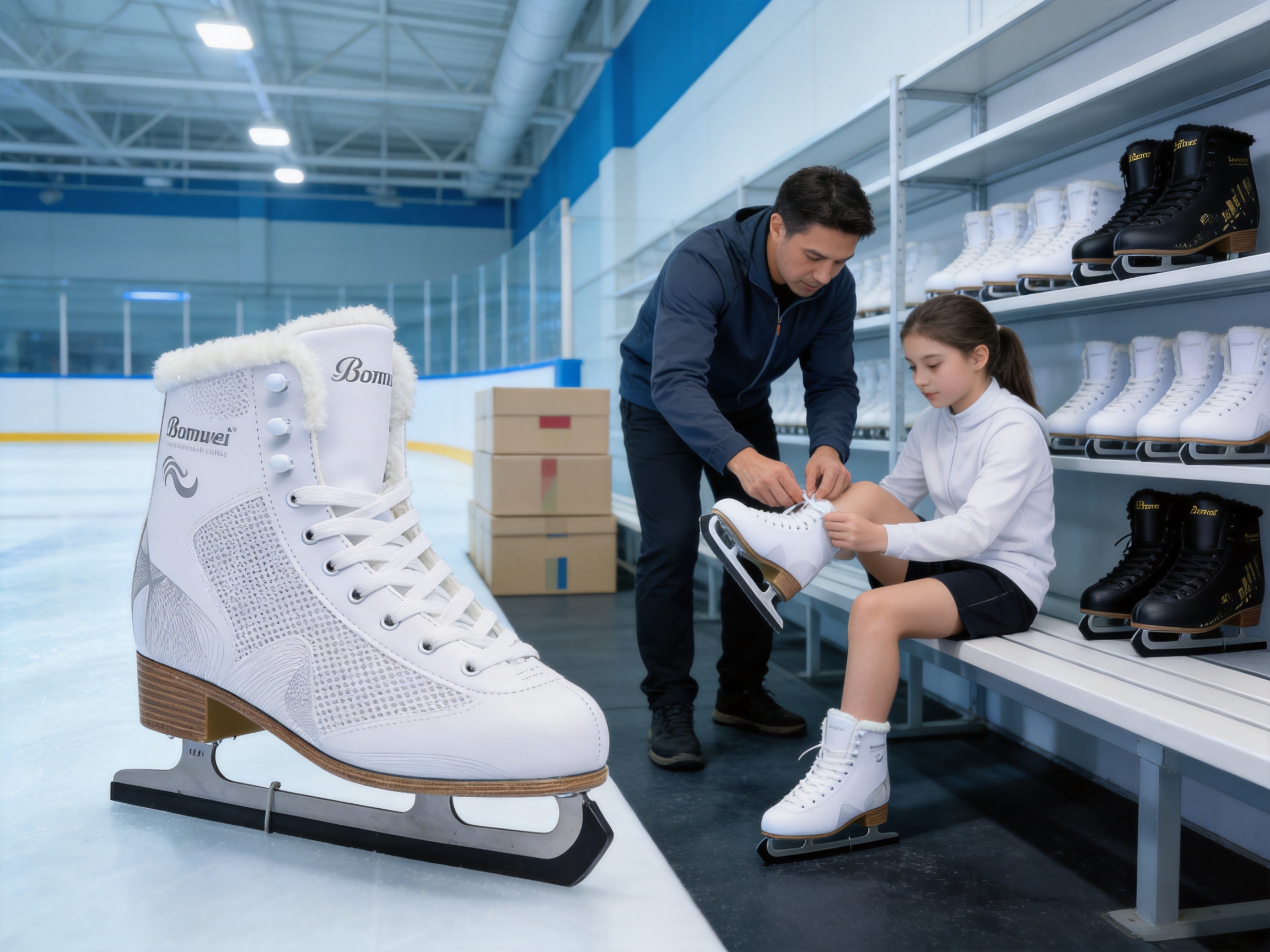
School sports programs need equipment that can serve many students with different foot sizes and experience levels. A youth skate with an organized four-size carton system can simplify procurement and classroom preparation. The BW-2301 is suitable for primary and secondary school ice courses, introductory skating programs, and school teams that require a consistent appearance.
The White and Black color options can be used to create a collective equipment standard. A school may select one color for all students or use different colors for class groups, skill levels, or activity types. The absence of cartoon graphics allows the equipment to look appropriate in educational and athletic settings.
Four-size groups can also reduce the need for extremely detailed initial purchasing calculations. Administrators can estimate student demand within the 31–34, 35–38, and 39–42 ranges. Actual fitting is still essential, but the packaging structure provides a useful starting point for stock planning.
Training centers may appreciate the adjustable design because students do not all progress at the same pace. Some may remain recreational users, while others advance into basic technical training. A flexible youth skate can serve multiple stages without requiring the center to maintain a completely different model for every level.
Coaches and staff should inspect each pair before use. Laces, boot condition, blade edges, fasteners, and fit should be checked regularly. The high-top structure can contribute to a stable feeling, but instruction in posture, knee flexion, stopping, and safe falling techniques remains essential.
Applications in Ice Rink Rental Operations
Ice rinks often need rental equipment that is recognizable, durable, easy to organize, and suitable for a wide range of first-time users. Teenagers are an important rental segment because they may visit with schools, families, friends, or youth groups. A dedicated youth model can help rinks serve this segment more effectively.
The BW-2301’s two solid colors make rental inventory easy to identify. Staff can distinguish the youth product family from other rental models without relying only on labels. This can reduce confusion during busy periods when many pairs are being issued and returned.
The size coverage from 32 to 42 is broad enough to support many school-age and teenage users. The adjustable concept may also help rental operators manage users who fall between conventional fixed sizes. Staff must still fit each customer carefully and make sure the skate is secure before the user enters the ice area.
Stainless steel blades are valuable in a rental environment because equipment may be stored between sessions and may be used by different customers. The material can help reduce corrosion concerns, while the simple exterior design makes cleaning and visual inspection more straightforward.
Rental operators should establish a maintenance schedule covering drying, sharpening, blade inspection, shell inspection, interior hygiene, and replacement of worn components. A product’s material advantages become more valuable when supported by consistent operational procedures.
Applications for Families and Long-Term Household Use
For families, sports equipment purchases often involve a balance between present needs and expected growth. Parents may hesitate to invest in specialized gear if they believe it will become unusable after one season. The BW-2301 is designed to address this concern through its adjustable format and broad youth size range.
The product can serve children who are beginning to skate and teenagers who want a more mature appearance. In a single-child household, the skate may remain useful across multiple developmental stages. In a family with more than one child, the simple White or Black design may also make transfer between siblings easier.
Families should store the skates in a dry, ventilated environment. The blades should be dried after every session, and the upper should be allowed to air out. The fit should be checked as the child grows. If the toes become compressed or the heel begins to move excessively, the skate should be adjusted or replaced according to the manufacturer’s guidance.
The minimalist appearance may also contribute to longer perceived product life. A child who outgrows cartoon styling may still accept a White or Black skate with a traditional high-top shape. This can reduce the risk that the product will be rejected simply because its design looks too young.
Applications in Performances and Events
Ice shows, school performances, winter festivals, and temporary skating events often require equipment that looks clean and coordinated. The White version of the BW-2301 is well suited to settings where a bright, traditional skating appearance is desirable.
The pure White boot can complement performance costumes and group choreography. Its gold logo provides a controlled accent without overwhelming the overall visual presentation. For schools and event organizers, this can create a more unified appearance than mixing multiple decorative skate designs.
The Black version can be useful for demonstrations, training performances, and events where a darker equipment style is preferred. Because both versions share the same basic model identity, organizers can create a consistent equipment program while offering users a color choice.
Event buyers should distinguish between equipment appearance and technical suitability. Performers still require correct fitting, appropriate sharpening, and adequate practice time. The product’s visual simplicity is an advantage for presentation, while safe performance depends on preparation and supervision.
Manufacturing Strengths and Production Capability
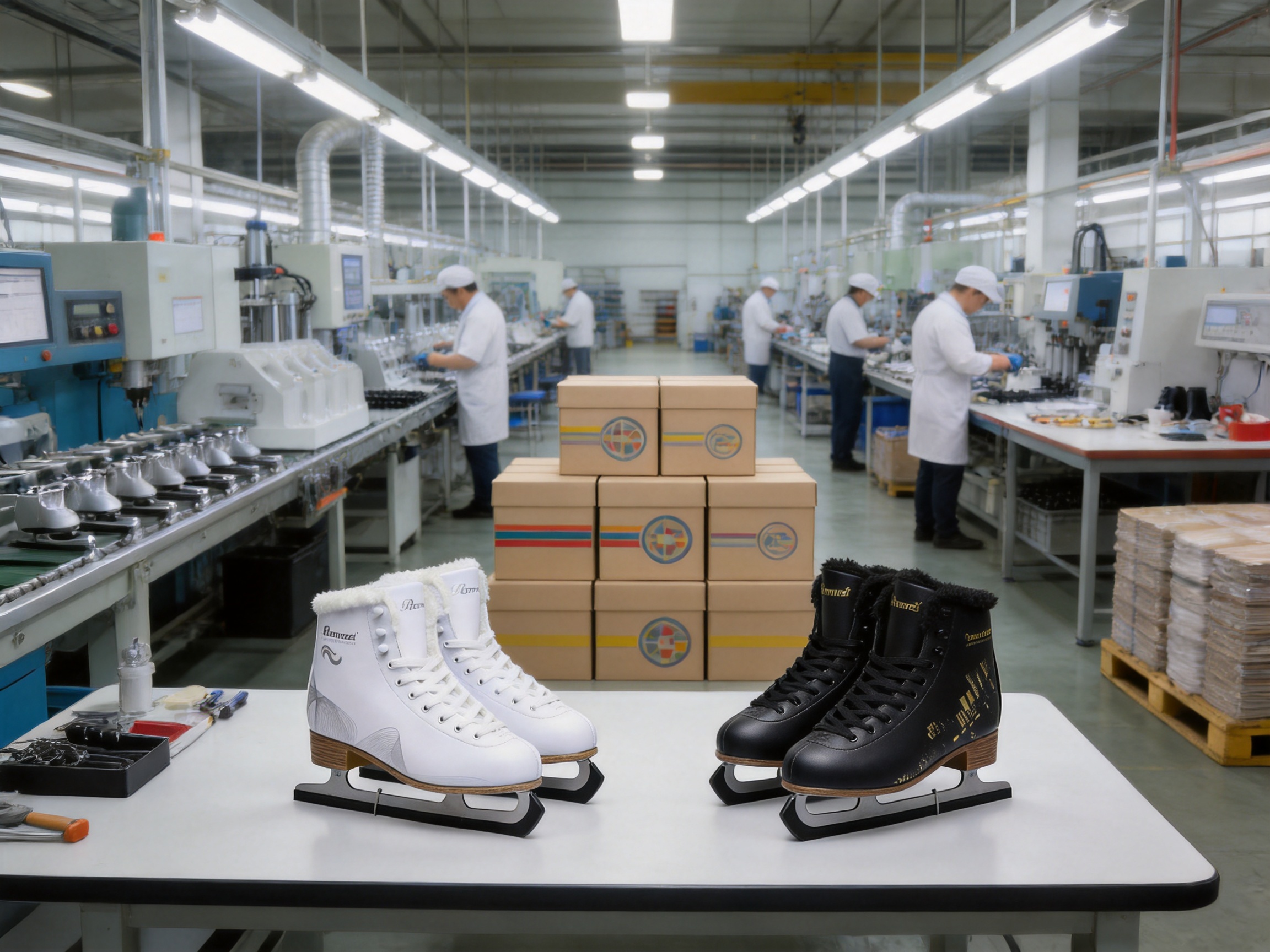
The manufacturer, Ningbo Feile Sporting Goods Co., Ltd., was established in 2010 and specializes in children’s scooters, inline skates, roller skates, and ice skates. This product focus gives the company experience across several related categories of wheeled and ice-based sporting equipment.
The company operates from Yuyao, Ningbo, Zhejiang Province, an area widely associated with plastics manufacturing. Its facilities include a 20,000-square-meter workshop, more than 200 employees, five advanced automatic production lines, and a professional research and development engineering team.
These resources are relevant to the BW-2301 because the product requires coordinated control over molded shell components, textile uppers, blade attachment, assembly, inspection, packaging, and product development. A manufacturer with in-house production capabilities can manage these processes more directly than a business that relies entirely on unrelated subcontractors.
The company’s facilities include mold, injection molding, sewing, and assembly workshops. This range of production areas is important for a product combining a PVC shell with a MESH upper and metal blade components. Mold and injection molding capabilities support consistent shell production. Sewing capacity supports textile upper construction. Assembly facilities bring the separate elements together into a finished skate.
Vertical coordination can improve communication between product development and manufacturing. When engineers, mold technicians, sewing teams, and assembly personnel work within an integrated production system, design adjustments can be evaluated more efficiently. It can also help the company respond to customer requirements involving colors, packaging, sizing, and private-label programs.
Mold and Injection Molding Capability
The PVC shell depends on accurately prepared tooling. Mold quality affects shape consistency, dimensional repeatability, surface finish, and the ability to produce multiple units with similar characteristics. The manufacturer’s mold and injection molding workshops provide a foundation for controlling these elements.
For OEM and bulk buyers, consistent molding is particularly important. Products supplied to schools, retailers, or rental facilities should maintain a uniform appearance across batches. Consistency also supports more predictable fitting and inventory management.
Sewing and Upper Construction
The MESH upper requires textile cutting, sewing, reinforcement, and attachment to the other boot components. Dedicated sewing capacity allows the manufacturer to manage these steps within its own production system. This can support better coordination between fabric selection, seam construction, and final assembly.
Breathable materials must be integrated carefully so that ventilation benefits are preserved while the upper remains suitable for regular use. Production inspection should verify stitching, panel alignment, reinforcement points, and overall appearance.
Assembly and Final Inspection
Assembly brings together the shell, upper, lining, blade assembly, and related components. Proper assembly is essential for product consistency and user confidence. Finished pairs should be checked for visual defects, component alignment, closure function, blade condition, and packaging accuracy.
A clear final-inspection process is especially important for adjustable products. The adjustment mechanism, size markings, and user instructions should correspond correctly with the intended size range. Bulk buyers benefit when the manufacturer provides consistent product identification and carton labeling.
Quality Systems, Certifications, and Compliance Awareness
The company reports having passed ISO9001, BSCI, and Kmart factory certification systems. These systems and assessments indicate attention to quality management, social responsibility, and customer-specific factory requirements. Their value is strongest when supported by documented procedures, internal audits, employee training, traceability, and continuous improvement.
The company also reports product certifications and testing related to 3C, CE, EN71, EN62115, ASTM, EMC, and EN13843:2009. The exact applicability of each standard depends on the product, market, configuration, and current regulatory requirements. Importers should confirm the relevant documentation for the intended destination country before placing an order.
For international buyers, compliance support is a significant part of supplier selection. A capable factory should be able to discuss material information, testing arrangements, labeling, packaging, technical files, and market-specific requirements. This is particularly important when products are sold to children, teenagers, schools, or public rental facilities.
Quality management is not limited to laboratory testing. It also includes incoming-material inspection, process control, production-line checks, finished-product inspection, carton verification, and complaint analysis. The manufacturer’s combination of production facilities, engineering personnel, and certification experience provides a useful foundation for these activities.
Research, Development, and OEM Cooperation
The company maintains a professional R&D engineering team and launches new products each year. In a competitive sporting-goods market, product development must respond to changes in consumer preferences, safety expectations, materials, packaging, and usage environments.
The BW-2301 demonstrates how product development can combine functional and emotional requirements. Functionally, it offers adjustability, youth size coverage, high-top construction, MESH ventilation, and stainless steel blades. Emotionally, it addresses a teenager’s desire for mature-looking equipment. Commercially, it includes a carton structure suitable for institutional purchasing.
OEM customers may also benefit from the manufacturer’s ability to coordinate product design and factory production. Possible areas of cooperation can include color selection, logo application, packaging design, size-group planning, market-specific labeling, and product-line extension. Any custom project should be confirmed through technical samples, approved specifications, testing, and written production standards.
A supplier with mold, injection molding, sewing, and assembly resources can be more flexible when adapting a product than a trading company that has limited control over production. This does not eliminate the need for buyer inspection, but it can improve communication and shorten the path between concept and production.
How Buyers Can Evaluate the Product
Wholesale buyers should begin by defining the intended market. A school program may prioritize size distribution, durability, and simple visual coordination. A rental rink may prioritize maintenance, identification, and repeated use. A family retailer may focus on adjustability, appearance, packaging, and consumer value.
The buyer should then confirm the exact adjustment range and fitting procedure. Product descriptions should be matched with physical samples, size charts, and user instructions. The four-size carton categories should be reviewed against the buyer’s expected customer distribution.
Material specifications should also be verified. Buyers should confirm the PVC shell construction, MESH upper composition, stainless steel blade specification, lining details, closure system, and any included accessories. If the product is intended for a regulated market, the relevant test reports and certificates should be requested.
Packaging should be checked for carton dimensions, gross and net weight, pair quantity, barcodes, size labels, color identification, and shipping marks. Clear carton information is essential when products are sent to multiple warehouses or distributed through school and rental channels.
Sample evaluation should include visual inspection, fitting, adjustment operation, seam review, shell examination, blade inspection, and basic skating assessment by an appropriate user or technician. A sample approval process helps ensure that mass production matches the buyer’s expectations.
Care and Maintenance Recommendations
Proper maintenance supports the performance and service life of any ice skate. After use, the blades should be wiped dry with a clean cloth. The skates should be removed from sealed bags and placed in a ventilated area so that moisture can evaporate.
The MESH upper should be kept clean and allowed to dry naturally. Excessive heat from radiators, heaters, or direct high-temperature air can damage synthetic materials or affect adhesives. The shell and upper should be inspected for cracks, loose seams, or other damage before the next session.
Blade guards should be used when walking off the ice, but hard guards should not be used as a substitute for drying. Blades should be sharpened when edges become dull or uneven. A qualified technician should evaluate sharpening requirements, especially for beginner users whose control depends on predictable edges.
The adjustment system should be checked as the user grows. A skate that is too tight can create discomfort, while a skate that is too loose can reduce control. The heel should remain positioned securely, and the toes should not be forced against the front of the boot.
Rental facilities and schools should create written procedures for issuing, cleaning, drying, inspecting, and storing each pair. Consistent procedures protect the equipment and make it easier to identify problems before they affect users.
Q&A: Common Questions About Youth Adjustable Ice Skates
Who is the BW-2301 designed for?
The BW-2301 is designed for teenagers and growing beginner skaters. Its appearance, size coverage, and high-top construction are intended to bridge the gap between children’s equipment and adult-looking skating gear.
What sizes are available?
The stated overall coverage is 32–42. The carton groups are listed as 31–34, 35–38, and 39–42. Buyers should confirm the precise adjustment range and fitting method through the current size chart and product documentation.
What colors are offered?
The model is available in White and Black. Both versions use a clean solid-color appearance with gold logos and no printed patterns or color-block decoration.
Why is the high-top design useful?
The high-top design extends above the ankle and provides a more enclosed, traditional boot structure. This can give beginners a stronger feeling of support during basic skating practice, although correct fitting and instruction remain essential.
What materials are used?
The shell is made of PVC, the upper uses breathable MESH fabric, and the blades are made of stainless steel. Each material contributes a different function: structure, airflow, and corrosion resistance.
Are stainless steel blades maintenance-free?
No. Stainless steel is corrosion resistant, but the blades should still be dried after use, stored properly, inspected regularly, and sharpened when necessary.
Is the product suitable for school programs?
Yes. The youth positioning, simple color options, size-group cartons, and adjustable format make it suitable for school ice courses, youth teams, and introductory training programs. Schools should establish fitting, inspection, and maintenance procedures.
Can ice rinks use the model for rental inventory?
Yes. The White and Black versions are easy to identify, while the broad youth size range and stainless steel blades are practical for seasonal rental operations. Rental staff should inspect every pair before issuing it.
Is the White version suitable for performances?
The fully White version has a clean traditional appearance that can work well for school performances, ice shows, demonstrations, and other visual presentation settings. Performance suitability still depends on correct fitting and technical preparation.
Does adjustability guarantee several years of use?
No guarantee should be assumed. Actual service life depends on growth, usage frequency, skating ability, maintenance, storage, and product condition. Adjustability is intended to provide additional size flexibility and may reduce replacement frequency when used correctly.
What should importers request before ordering?
Importers should request current technical specifications, size charts, adjustment instructions, test documents, packaging details, sample approval information, production lead times, and market-specific compliance documentation.
Conclusion
The BW-2301 Youth Adjustable Ice Skates offer a carefully defined solution for teenagers, growing beginners, schools, families, training centers, rental facilities, and event organizers. Their main strengths are not limited to one material or design detail. The product combines a mature White-and-Black appearance, gold logo accents, a traditional high-top boot, PVC shell construction, breathable MESH upper, stainless steel blades, and a size system covering 32–42.
Compared with highly decorative children’s skates, the model provides a more mature visual identity. Compared with fixed-size products, its adjustable concept offers greater flexibility for growing users. Compared with less structured recreational footwear, its high-top design presents a more traditional skating profile. Compared with products requiring greater corrosion attention during seasonal storage, its stainless steel blades offer a practical maintenance advantage.
The four-size carton structure adds a commercial benefit for wholesale buyers. The 31–34, 35–38, and 39–42 groupings can simplify purchasing, warehouse organization, school allocation, and rental inventory planning. This makes the model relevant not only to individual consumers but also to institutional and professional buyers.
The manufacturer’s experience, production facilities, automatic production lines, mold and injection molding workshops, sewing and assembly capabilities, R&D team, workforce, and reported certification background provide a solid basis for OEM and international cooperation. Buyers should still complete their own sample evaluation and compliance review, but the available manufacturing platform supports scalable and coordinated production.
For businesses looking for a youth ice skate that combines functional adaptability, understated design, manageable inventory, and practical seasonal usability, the BW-2301 presents a balanced option. Its strongest competitive position lies in treating teenage skating equipment as a distinct category—one that requires not only child-friendly functionality, but also mature appearance, growth flexibility, operational efficiency, and dependable manufacturing support.
References
1. Product specification materials for BW-2301 Youth Adjustable Ice Skates, including size range, materials, colors, blade construction, and carton dimensions.
2. Manufacturer company information for Ningbo Feile Sporting Goods Co., Ltd., including production facilities, workforce, manufacturing capabilities, and quality-system information.
3. General principles of youth sports-equipment fitting, maintenance, storage, and supervised use.
4. General product-development and quality-management practices for molded sporting goods, textile uppers, metal blade components, and OEM manufacturing.
Product: BW-2301 Youth Adjustable Ice Skates

Recommended Articles
-
BW-127BD Kids Ice Skate05/09

Get in Touch
Your email address will not be published. Required fields are marked *
Have a project in mind? Contact with us!
We are happy to answer your questions. Please fill out this form
and one of our professional team will get back to you as soon as possible.

We specialize in producing various types of children's toy cars, children's skateboards, and ice skates.
