
 En
 Español
 русский
 عربى

Why Modular Children’s Scooters Are Changing Everyday Outdoor Play
Date:Nov 06, 2026
Content
- 1 A Two-in-One Concept for Modern Children’s Play
- 2 Designed Around Children’s Changing Abilities
- 3 Low-Profile Stability and Anti-Slip Construction
- 4 Imaginative Play Through a Cartoon Car Design
- 5 Suitable Settings for Daily Use
- 6 Portability, Assembly, and Storage Advantages
- 7 Advantages Over Conventional Competitors
- 8 Manufacturing Strength Behind the Product
- 9 Research, Development, and Product Improvement
- 10 Quality Systems and International Market Readiness
- 11 OEM and Private-Label Potential
- 12 Maintenance and Long-Term Product Value
- 13 Why the FL-1200 Is a Strong Category Choice
- 14 Questions and Answers
- 14.1 What is the FL-1200?
- 14.2 How does the modular structure work?
- 14.3 What is the main advantage over a standard scooter?
- 14.4 Is the handle adjustable?
- 14.5 Why is a low center of gravity useful?
- 14.6 Does the scooter have an anti-slip deck?
- 14.7 Are the wheels quiet?
- 14.8 Where can children use the product?
- 14.9 Does the product require adult supervision?
- 14.10 Should children wear protective equipment?
- 14.11 Is the product easy to transport?
- 14.12 What are the listed product dimensions?
- 14.13 Can the product be customized for OEM orders?
- 14.14 What manufacturing resources support the product?
- 14.15 What certifications and systems are reported by the manufacturer?
- 14.16 Can the product be combined with protective gear?
- 15 References
- 16 Product: FL-1200 Cartoon Children Scooter
Children’s scooters have evolved from simple ride-on toys into thoughtfully engineered products that combine mobility, physical activity, imaginative play, and age-appropriate safety. Among the newest designs is the FL-1200 Cartoon Children Scooter, a modular model created around the idea that one product can support more than one type of play. It combines a cartoon car-shaped toy module with a stable scooter body, allowing children to enjoy both pretend play and active gliding.
This combination gives the FL-1200 a distinctive position in the children’s mobility market. Traditional scooters generally focus on riding alone, while ride-on car toys are usually intended for seated or stationary play. The FL-1200 bridges these two categories through a structure that can be separated and recombined. The result is a product that offers different experiences as a child’s mood, ability, or play environment changes.
For importers, distributors, retailers, and original equipment customers, the product also represents a practical opportunity. Its modular design supports a broader usage story, its adjustable handle can accommodate children as they grow, and its low-profile structure is designed to make early gliding more stable. These characteristics help distinguish it from basic fixed-height scooters and single-purpose ride-on toys.
A Two-in-One Concept for Modern Children’s Play
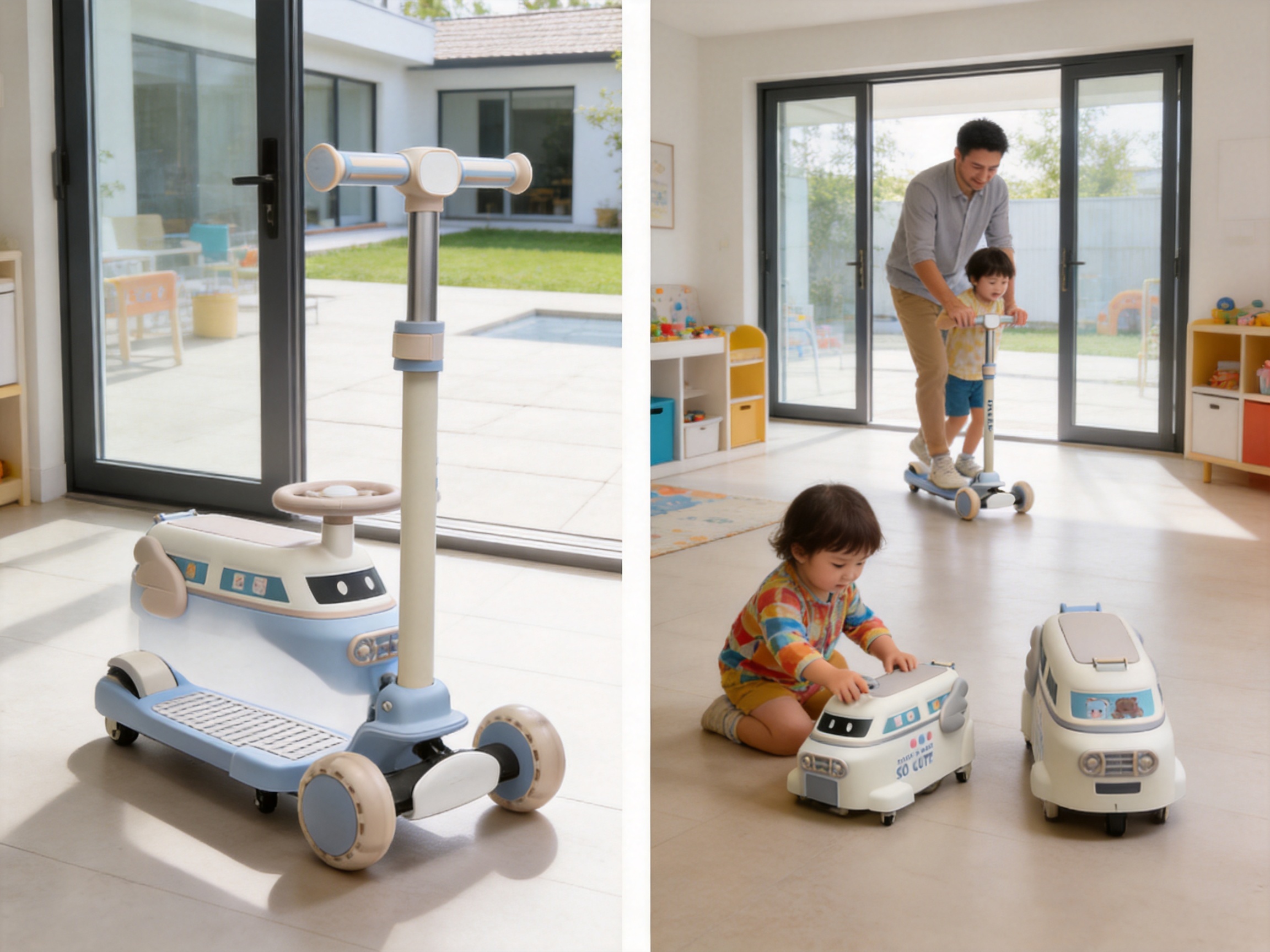
The central feature of the FL-1200 is its modular dual-use structure. The cartoon car module and the scooter body can be combined for riding or separated for individual play. In combined form, the product becomes an attractive children’s scooter with a playful automotive appearance. In separated form, the car module can function as a toy for imaginative activities, while the scooter body remains a separate mobility component.
This arrangement gives children more than one way to interact with the product. A child may begin by using the cartoon car as a pretend vehicle, imagining journeys, races, or rescue missions. Later, the scooter can be assembled for active outdoor play. This transition from stationary imagination to physical movement encourages a wider range of activities without requiring families to purchase multiple large toys.
The dual-use structure also adds value for families with limited storage space. A conventional ride-on car and a separate scooter can occupy considerable room in a home, garage, or retail package. A modular product can provide some of the functions of both while maintaining a more compact and flexible ownership experience. The ability to disassemble the product can also make transportation and seasonal storage more convenient.
From a product positioning perspective, this versatility is an important advantage over many competing entry-level scooters. A basic scooter may offer mobility but little imaginative play value. A ride-on toy may provide role-play value but limited support for balance development and active gliding. The FL-1200 brings these benefits into one coordinated concept.
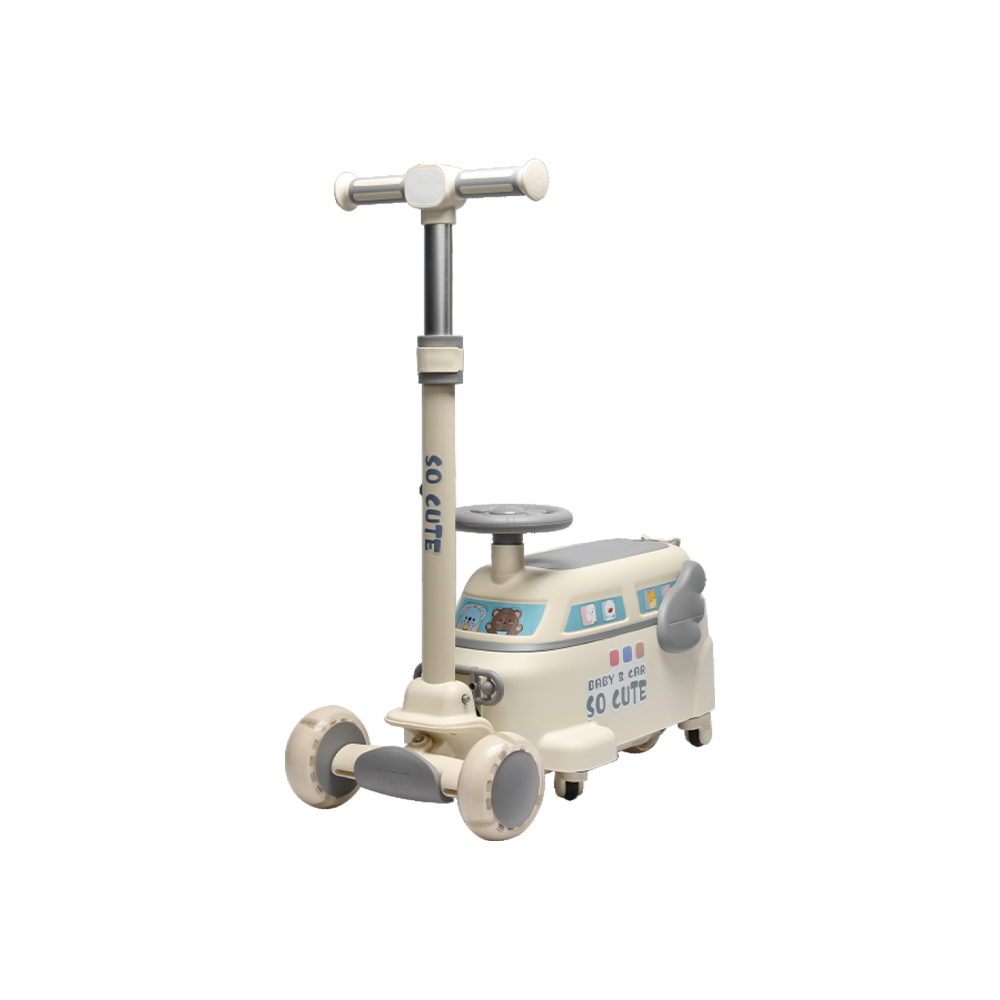
FL-1200 Cartoon Children Scooter
Designed Around Children’s Changing Abilities
Children grow quickly, and their height, balance, confidence, and riding posture can change significantly over a relatively short period. A fixed-size scooter may become uncomfortable or unsuitable as a child develops. The FL-1200 addresses this issue with an anti-slip handle that supports multiple height levels.
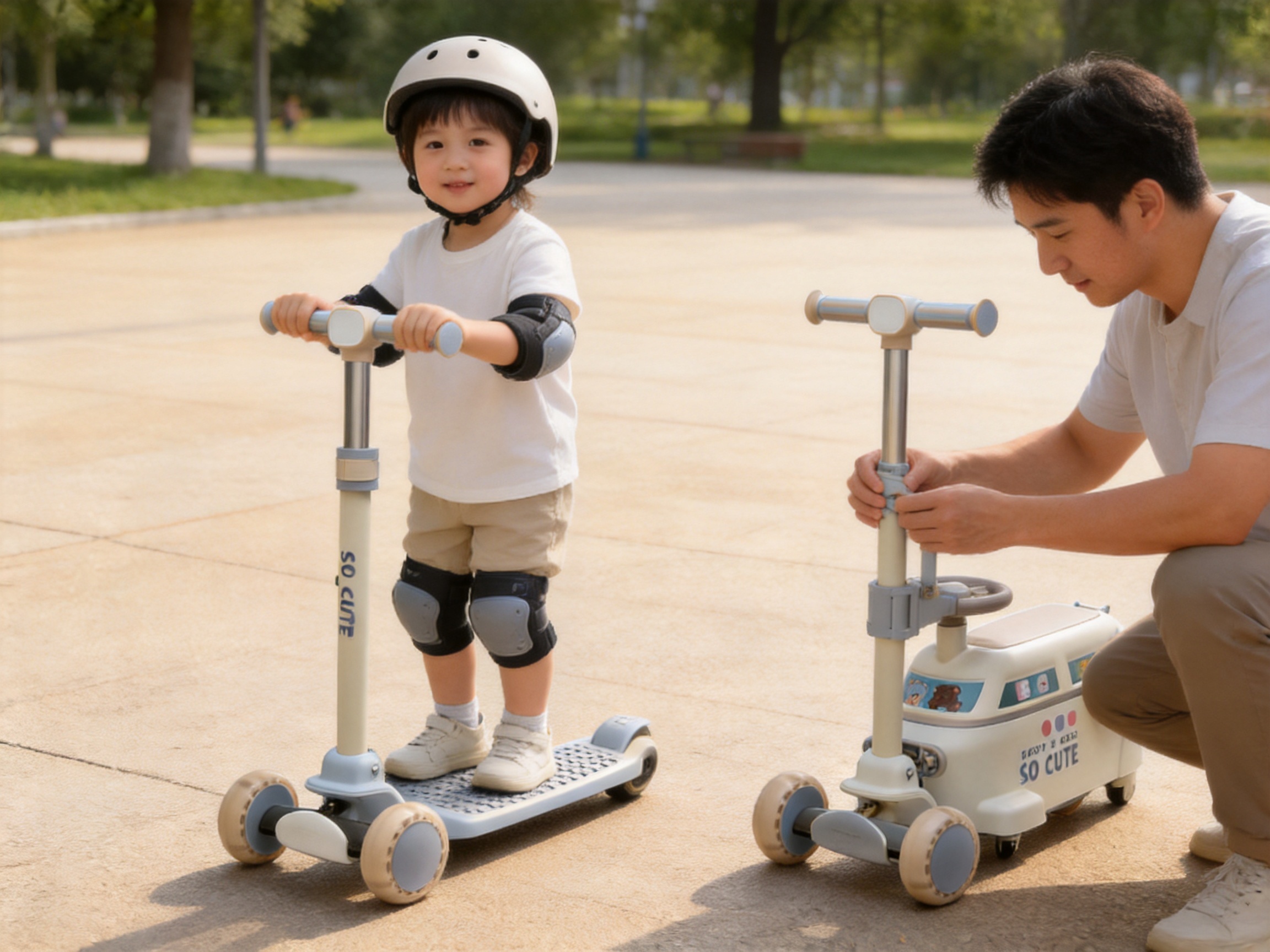
Adjustable handle positioning enables the scooter to accommodate different heights and riding postures. For a smaller child who is still learning, the handle can be positioned to support a comfortable and controlled stance. As the child grows, the handle can be raised to reduce bending and help maintain a more natural posture. This adaptability may extend the practical service period of the product and reduce the need for frequent replacement.
Height adjustment is valuable not only for children but also for parents and retailers. Parents often compare products according to expected usable life, especially when purchasing equipment for preschool children. Retailers can present an adjustable model as a longer-lasting choice than a fixed-height alternative. For OEM customers, the adjustable structure can also support broader market positioning across several early-childhood age segments, subject to appropriate age grading and safety evaluation.
The handle is described as anti-slip, an important detail for products used by young children. A secure grip can help children maintain control while pushing, gliding, turning, or slowing down. Grip design should always be considered together with supervision, surface conditions, and protective equipment, but an anti-slip contact surface is a useful part of an overall safety-oriented design.
Supporting Natural Learning Progress
Learning to use a scooter involves a gradual progression. Children first become familiar with standing on the deck and holding the handle. They then learn to shift their weight, push with one foot, maintain direction, and control speed. A product that can be adjusted as these abilities develop is better suited to this gradual learning process than a product that assumes every child has the same height and coordination.
The FL-1200’s two-wheel balance frame is intended to make this early stage easier. Its structure is designed around a low center of gravity, which can help reduce the sensation of instability. This is especially important for preschool-age riders who may still be developing balance and coordination. A stable platform can give children greater confidence while they learn basic movement skills.
Confidence is an important part of successful product use. If a child feels that a scooter is too tall, too narrow, or difficult to control, interest may decline quickly. A balanced, approachable design can encourage repeated practice. Frequent practice, in turn, can help children become more comfortable with steering, stopping, and moving across suitable surfaces.
Low-Profile Stability and Anti-Slip Construction
The FL-1200 uses a low-profile structure intended to keep the center of gravity closer to the ground. This design approach can contribute to a more stable riding experience and may reduce the likelihood of tipping during ordinary gliding. Stability is particularly important in children’s scooters because younger users are still learning how small changes in body position affect direction and balance.
The two-wheel balance frame works together with the broad anti-slip pedal. A wider deck provides more room for the child’s supporting foot and may make it easier to maintain a steady stance. The anti-slip surface is intended to help prevent the foot from sliding during movement, especially when the child is pushing off or adjusting position.
A stable deck can also support more consistent riding posture. When the foot remains securely positioned, the child can focus on looking ahead, holding the handle, and controlling direction instead of repeatedly correcting foot placement. For parents, this creates a clearer safety message: the product is designed to support basic stability, although adult supervision and suitable protective equipment remain essential.
The product also incorporates silent wheels. Reduced wheel noise can make the scooter more pleasant to use around residential communities, parks, indoor recreational areas, and other shared spaces. Quieter operation may be especially useful for families living in apartments or for indoor leisure areas where loud rolling sounds are undesirable.
Silent wheels can also contribute to a smoother impression during use. While wheel performance depends on the surface, load, assembly, and maintenance, a well-designed wheel system can help provide more comfortable movement on appropriate flat ground. Retailers can highlight the combination of low-profile stability, an anti-slip deck, and quiet wheels when comparing the model with simpler scooters.
Safety as a Complete Usage System
No scooter can eliminate every risk associated with movement. Product safety depends on design, correct assembly, suitable riding areas, child supervision, and responsible use. The FL-1200’s stability-oriented structure is therefore best understood as one component of a complete safety system.
Children should use the scooter on smooth, dry, and obstacle-free surfaces away from traffic, steep slopes, stairs, and bodies of water. They should wear properly fitted protective equipment, including a helmet and suitable knee and elbow protection. Adults should inspect the handle, deck, wheels, fasteners, and modular connection points before use. The product should be used according to its final certified instructions, age recommendations, and market-specific requirements.
For manufacturers and distributors, clear warnings and instructions are as important as physical construction. Packaging and manuals should explain assembly, separation of the modules, height adjustment, recommended surfaces, supervision requirements, and maintenance. A strong product experience depends on making correct use easy for families to understand.
Imaginative Play Through a Cartoon Car Design
The FL-1200 is not designed as a plain technical scooter. Its cartoon car-shaped appearance is intended to create an emotional connection with children. Bright, friendly, and vehicle-inspired styling can make the product more attractive before the child even begins to ride it.
Visual character plays a major role in the children’s product market. A scooter with a recognizable theme can stand out on a retail shelf, in an online product listing, or in promotional photography. The cartoon car form gives retailers a clear merchandising story: it is both a ride-on activity product and an imaginative toy.
Children often use objects in ways that extend beyond their original mechanical purpose. A scooter can become a race car, a space vehicle, a delivery truck, or a character’s transportation. The FL-1200’s car module supports this kind of open-ended play. Imaginative play allows children to create narratives, practice communication, and explore social interaction with siblings or friends.
The modular structure further strengthens this experience. Children can decide whether they want to glide, pretend, combine the two activities, or move from one type of play to another. This choice gives the product a degree of flexibility that is not normally available in a single-function scooter.
Suitable Settings for Daily Use
The product is intended for a range of appropriate indoor and outdoor environments. Outdoor use can include community squares, parks, playgrounds, and other controlled areas with smooth surfaces. These locations provide space for children to practice gliding, steering, and balance while remaining visible to supervising adults.
For preschool children, the scooter can also serve as a convenient alternative to walking during short daily journeys in suitable private or pedestrian areas. It should not be treated as a road vehicle, and it must never be used in traffic. However, for short trips within a residential compound, park, or other controlled environment, a scooter can make movement more engaging and active.
Indoor use is possible in spacious areas with appropriate flooring and sufficient clearance. A large playroom, indoor activity space, or open family area may allow children to use the product during poor weather. The quiet wheel design can be helpful in indoor settings, although users should still confirm that the floor is suitable and that furniture, steps, and other obstacles are removed.
These different usage scenarios improve the product’s year-round appeal. A basic outdoor toy may see limited use during rainy or cold seasons, while a modular model can continue to support imaginative play indoors. The product’s ability to be separated and moved also helps families adapt activities to available space.
Portability, Assembly, and Storage Advantages
The FL-1200 is designed to be lightweight and not bulky. This characteristic is valuable for families who need to carry the product between home, car, playground, and park. A portable scooter is more likely to be used regularly because parents can transport it without requiring excessive effort or a large amount of trunk space.
Its modular construction is also intended to simplify assembly and disassembly. A product that can be separated into manageable parts may be easier to move through doorways, place in storage, or pack for travel. For retailers and distributors, a modular structure can also offer packaging and warehouse advantages, depending on the final carton design and shipping configuration.
Storage is an often-overlooked part of a children’s product’s practical value. Homes may have limited closets, balconies, or garage space. The ability to separate the car module from the scooter body can help a family organize the product more efficiently when it is not in use. This can be a meaningful competitive advantage over large fixed ride-on toys that are difficult to store.
At the same time, easy assembly should never come at the expense of secure connection. The modular interface must be properly locked before riding, and the user manual should make the correct process clear. Parents should verify that all connection points are fully engaged before allowing a child to glide.
Product Specifications at a Glance
| Product Element | Key Characteristic | Practical Benefit |
|---|---|---|
| Product type | Modular cartoon children’s scooter | Combines active gliding with imaginative play |
| Structure | Separable cartoon car module and scooter body | Supports combined use, individual play, transport, and storage |
| Handle | Multiple height levels with anti-slip grip | Adapts to changing heights and riding postures |
| Frame | Two-wheel balance frame with low center of gravity | Designed to support stability for developing riders |
| Deck | Widened anti-slip pedal | Provides a more secure standing area |
| Wheels | Silent wheel design | Helps provide quieter operation in suitable environments |
| Portability | Lightweight, non-bulky construction | Easy to move, assemble, disassemble, and store |
| Listed dimensions | 565 × 320 × 870 | Final measurement unit and packaging details should be confirmed for the target market |
Advantages Over Conventional Competitors
Competition in the children’s scooter category includes fixed-height scooters, three-wheel scooters, ride-on cars, and low-cost plastic mobility toys. The FL-1200 does not compete only on the basic function of rolling forward. Its main advantage is the combination of functions and the product experience surrounding them.
Compared with a fixed-height scooter, the adjustable handle can offer a longer period of practical use. A fixed scooter may be suitable for only a narrow range of heights, while the FL-1200 is intended to accommodate growth through multiple handle positions. This can improve perceived value and reduce the frequency of replacement.
Compared with a single-purpose ride-on car, the FL-1200 encourages more active movement and balance practice. The scooter body gives children an opportunity to push, glide, steer, and coordinate their movements. The separate car module preserves imaginative play, creating a more varied ownership experience.
Compared with a basic lightweight scooter, the cartoon car design adds emotional appeal and merchandising differentiation. Retailers can promote the product to families looking for a gift that feels more distinctive than a standard scooter. Its appearance may also attract children who are more interested in vehicles and pretend play than in conventional sports equipment.
Compared with bulky ride-on toys, the modular construction can improve portability and storage. The ability to separate parts is particularly valuable in homes with limited space and for families who travel frequently by car.
Compared with noisy, rigid wheel systems, silent wheels may make the product better suited to shared residential areas and selected indoor environments. Quiet performance is not a replacement for wheel quality or surface suitability, but it can improve the user experience and reduce disturbance.
| Comparison Factor | Basic Fixed Scooter | Ride-On Car Toy | FL-1200 Modular Scooter |
|---|---|---|---|
| Primary activity | Gliding | Imaginative ride-on play | Gliding plus imaginative play |
| Handle adjustment | Often limited or unavailable | Usually not applicable | Multiple height levels |
| Storage flexibility | Generally compact | Often bulky | Separates into modular components |
| Growth adaptability | Depends on fixed dimensions | Often limited | Designed to adapt to changing heights |
| Imaginative play value | Usually limited | High | High through the cartoon car module |
| Active balance development | Available through riding | Usually limited | Available through scooter use |
| Retail positioning | Standard mobility product | Ride-on toy | Multi-function children’s activity product |
These comparisons should be understood as general category distinctions rather than absolute claims about every competing product. Final performance depends on materials, construction, testing, assembly quality, and intended use. Nevertheless, the FL-1200’s combination of modularity, adjustment, stability-oriented geometry, and playful styling gives it a clear value proposition.
Manufacturing Strength Behind the Product
The capabilities of the manufacturer are an important part of the product story. Ningbo Feile Sporting Goods Co., Ltd. was established in 2010 and specializes in children’s scooters, inline skates, roller skates, and ice skates. This focused experience provides a relevant foundation for developing products that combine plastic components, wheels, hardware, soft goods, ergonomic features, and children’s safety considerations.
The company operates from Yuyao City in Zhejiang Province, an area recognized for its plastics industry and convenient transportation connections to Ningbo Airport and Shanghai. This location can support access to material suppliers, component manufacturers, logistics services, and export infrastructure. For international customers, a strong manufacturing location can contribute to more efficient sourcing and communication throughout the production process.
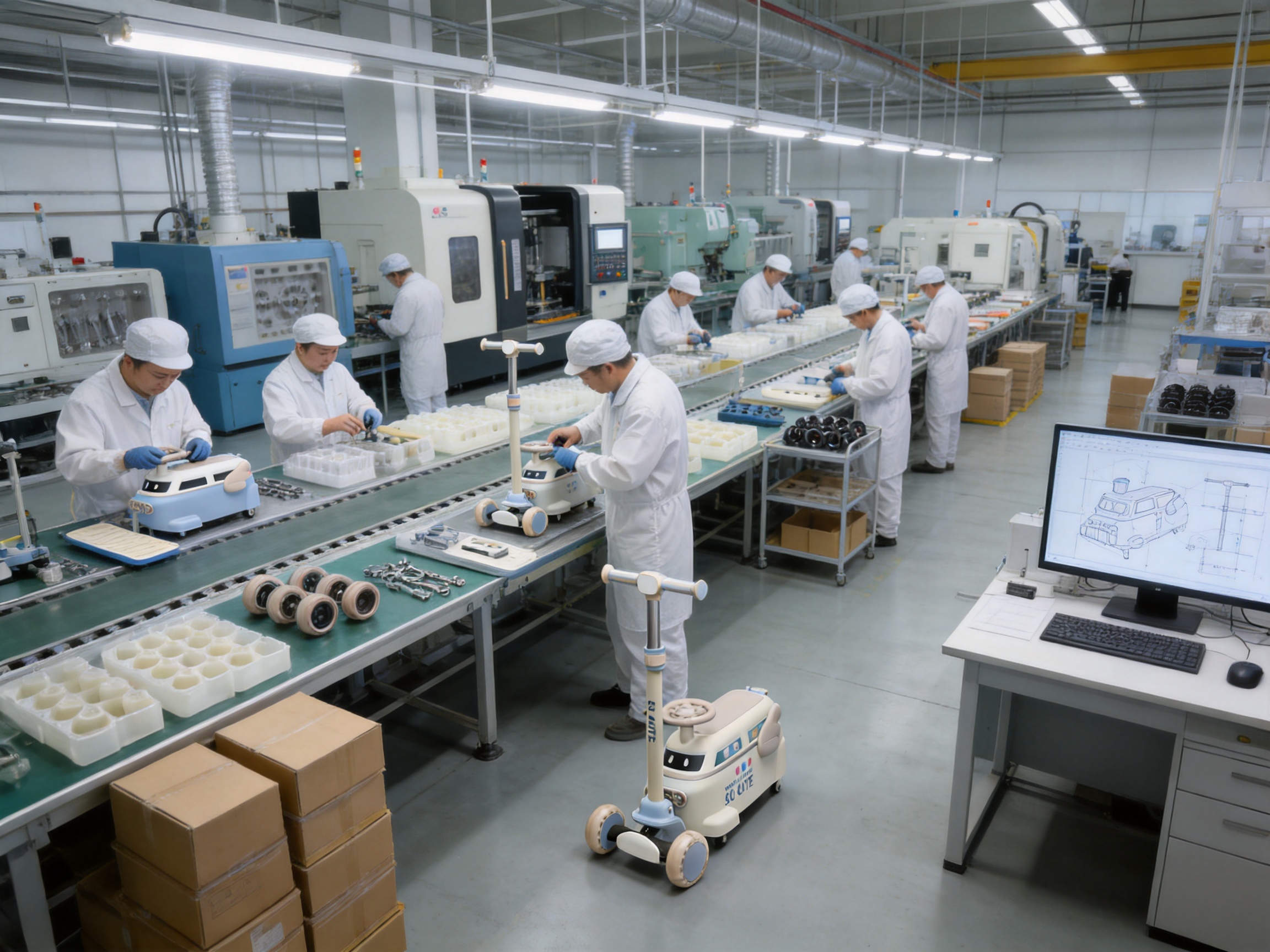
The company reports more than 200 employees and a 20,000-square-meter workshop. It also operates five advanced automatic production lines and maintains a professional research and development engineering team. These resources are significant for a product such as the FL-1200, which requires coordination between design, mold development, injection molding, assembly, quality inspection, and packaging.
Manufacturing scale can help improve production consistency when supported by appropriate process controls. Repeated production of components such as decks, handles, housings, wheel parts, and modular connection pieces requires stable molds, controlled material handling, and carefully defined assembly procedures. Automated production lines may help reduce variation in repetitive operations while allowing skilled personnel to focus on inspection and process management.
Integrated Production Facilities
The company’s facilities include mold, injection molding, sewing, and assembly workshops. An integrated factory structure can provide greater control over the product development cycle. Mold capability supports the creation and modification of plastic components. Injection molding is essential for producing consistent shapes and detailed cartoon styling. Assembly facilities bring together the frame, wheels, handle, deck, and modular car body. Sewing capability can support selected soft components and related product categories.
In-house or closely managed mold development is particularly valuable for distinctive children’s products. The FL-1200’s cartoon car appearance depends on recognizable shapes, smooth transitions, appropriate wall thickness, and reliable fit between components. A factory with mold and engineering resources can respond more effectively to design refinements than a supplier that relies entirely on external tooling.
Injection molding quality affects both appearance and function. Surface finish, color consistency, dimensional accuracy, and structural integrity all contribute to the final product. For modular products, dimensional control is especially important because the car module and scooter body must connect securely and repeatedly. Proper mold maintenance, material control, and inspection procedures are essential to maintaining this performance.
Assembly quality is equally important. A scooter may contain numerous small parts, including axles, wheels, fasteners, handle components, deck elements, and connection mechanisms. Correct assembly torque, alignment, and functional testing help ensure that the finished product performs as intended. A clear production workflow can reduce the possibility of missing or incorrectly installed components.
Research, Development, and Product Improvement
The company maintains a professional R&D engineering team and launches new products each year to respond to market and customer needs. This development approach is important in a competitive children’s sporting goods market, where consumers expect attractive designs, convenient functions, and improved comfort.
Product development for children’s mobility equipment requires more than visual design. Engineers must consider balance, center of gravity, steering behavior, handle height, deck dimensions, wheel placement, connection strength, material selection, and assembly convenience. These factors interact with one another. Changing the height of a handle, for example, may affect posture, steering leverage, and overall product balance.
The modular concept also requires careful engineering of the separation and connection system. The connection should be sufficiently secure during riding while remaining manageable for adults during assembly and disassembly. It must be designed to minimize unintended release and to withstand repeated use. These requirements make modular products more technically involved than simple one-piece toys.
Design refinement can also address the needs of different markets. International customers may request adjustments to colors, graphics, packaging, language, age grading, or accessory configurations. An experienced OEM manufacturer can use its engineering and production resources to evaluate these requests while maintaining the fundamental structure of the product.
Quality Systems and International Market Readiness
The manufacturer reports certification through ISO9001, BSCI, and Kmart factory certification systems. ISO9001 is associated with quality management processes, while BSCI relates to social compliance auditing. These systems can provide customers with greater insight into how manufacturing operations, documentation, labor practices, and quality processes are managed.
The company also reports certifications and compliance testing related to 3C, CE, EN71, EN62115, ASTM, EMC, and EN13843:2009. Requirements vary according to product type, market, age classification, electrical content, and destination country. Customers should always confirm which standards apply to the specific FL-1200 configuration and target market, and they should request current documentation before commercial launch.
For children’s products, compliance is not merely a marketing statement. It involves material safety, mechanical performance, labeling, warnings, small parts, sharp edges, flammability where applicable, and other technical considerations. A reliable supplier should be able to provide relevant test reports, certification records, inspection documentation, and product specifications for review.
International readiness is also supported by the company’s experience participating in exhibitions and working with overseas customers. International trade requires more than manufacturing capacity. It requires communication across languages and time zones, export documentation, packaging coordination, sample management, production scheduling, and responsiveness to customer feedback.
For distributors and brand owners, these capabilities can reduce sourcing complexity. A one-stop supplier that produces scooters, inline skates, roller skates, ice skates, and protective gear may be able to support a broader product program. This can create opportunities for coordinated collections, seasonal promotions, and category expansion.
OEM and Private-Label Potential
The FL-1200 can serve as a foundation for OEM and private-label development. Its cartoon car form, modular structure, adjustable handle, and stability-oriented platform provide a clear base product that can be adapted to different market identities. Potential customization areas may include colors, graphics, packaging, manuals, labels, and selected accessory combinations, subject to engineering review and minimum order requirements.
For a retailer, the product can be positioned as a developmental toy, an outdoor activity product, a preschool mobility aid, or a special gift item. For a sports equipment distributor, it can complement inline skates, roller skates, helmets, knee pads, and elbow pads. For a general toy importer, it can add an active-play product to a portfolio that might otherwise focus on stationary toys.
The product’s broad story can support several sales channels. In physical stores, the cartoon design and modular concept can attract attention. In e-commerce, the dual-use structure provides multiple points for product photography and demonstration. In catalog sales, the adjustable handle and compact storage advantages can be emphasized. In seasonal promotions, the product can be presented as a birthday, holiday, or outdoor-play gift.
Before placing an OEM order, customers should confirm the full technical specification. Important points include the target age range, maximum user weight, material composition, color options, wheel material, package dimensions, unit and carton weight, assembly instructions, test standards, spare parts, warranty terms, production lead time, and quality inspection procedure.
Maintenance and Long-Term Product Value
Regular maintenance helps preserve the performance of any children’s mobility product. Parents should periodically inspect the wheels for damage, check that fasteners remain secure, and examine the deck for cracks or deformation. The handle should be checked at each height setting, and the modular connection should be inspected before every riding session.
The product should be kept clean and dry. Dirt or grit can affect wheels and moving parts, while moisture may contribute to corrosion in metal components if the scooter is stored improperly. After outdoor use, families should remove visible debris and allow the product to dry before placing it in storage.
Because the FL-1200 can be separated, users should avoid carrying the assembled product by a component that is not intended to serve as a lifting handle. Adults should follow the manufacturer’s assembly instructions and avoid modifying the connection system. Replacement components should be sourced through the supplier whenever possible to preserve compatibility and safety.
For retailers, after-sales support can strengthen customer confidence. Providing clear manuals, assembly guidance, spare-part availability, and responsive service can reduce returns and improve product satisfaction. A modular product may require especially clear instructions because customers need to understand both the combined and separated configurations.
Why the FL-1200 Is a Strong Category Choice
The FL-1200 stands out because it responds to several common consumer concerns at the same time. Families want products that are fun, safe, durable, space-efficient, and useful for more than a short period. Retailers want distinctive products that are easy to explain and visually appealing. Distributors want reliable production and compliance support. The modular scooter concept addresses each of these needs in a single product story.
Its strongest advantage is versatility. Children can use the car module for pretend play, combine it with the scooter for gliding, or separate the components for different activities. The adjustable handle supports growth, while the low-profile frame, widened anti-slip deck, and quiet wheels contribute to a more stable and comfortable use experience.
The company’s manufacturing infrastructure adds further value. Experience in scooters and skates, integrated workshops, automated production lines, engineering resources, quality systems, reported international certifications, and OEM experience create a solid foundation for commercial supply.
Compared with a basic scooter, the FL-1200 offers more play value. Compared with a ride-on car, it offers more active mobility. Compared with a bulky toy, it offers improved portability and separation. These combined advantages give it a differentiated position in the children’s outdoor activity market.
For responsible use, the product should always be matched with appropriate supervision, protective equipment, suitable surfaces, and market-specific safety instructions. When these requirements are followed, the FL-1200 can become a valuable tool for encouraging movement, balance, coordination, imagination, and everyday outdoor play.
Questions and Answers
What is the FL-1200?
The FL-1200 is a cartoon children’s scooter with a modular dual-use structure. It includes a cartoon car module and a scooter body that can be combined or separated for different play activities.
How does the modular structure work?
The car module can be connected to the scooter body for a combined gliding experience. The components can also be separated so that the car module can be used as an individual toy and the scooter body can be stored or used separately according to the product instructions.
What is the main advantage over a standard scooter?
The main advantage is that the FL-1200 combines active scooter use with imaginative car play. It also includes multiple handle height levels, giving it greater adaptability than many fixed-height models.
Is the handle adjustable?
Yes. The anti-slip handle supports multiple height adjustments. This is intended to accommodate children as they grow and to support different riding postures.
Why is a low center of gravity useful?
A low center of gravity can help make a product feel more stable and may reduce the risk of tipping during ordinary use. It is particularly helpful for young children who are still developing balance and coordination.
Does the scooter have an anti-slip deck?
Yes. The product uses a widened anti-slip pedal designed to provide a more secure standing area during gliding.
Are the wheels quiet?
The product is designed with silent wheels to help reduce rolling noise in suitable outdoor and indoor environments. Actual sound levels may vary according to the floor or ground surface.
Where can children use the product?
Suitable locations include community squares, parks, playgrounds, and spacious indoor areas with smooth, safe surfaces. The scooter should not be used on roads, near traffic, on steep slopes, or in areas with significant obstacles.
Does the product require adult supervision?
Yes. Children should always be supervised while using the scooter. Adults should check the assembly, connection points, handle adjustment, wheels, and riding surface before use.
Should children wear protective equipment?
Yes. A properly fitted helmet and suitable knee and elbow protection are recommended. Protective equipment should be used together with supervision and safe riding practices.
Is the product easy to transport?
The product is designed to be lightweight and non-bulky. Its modular structure allows it to be assembled, disassembled, moved, and stored more conveniently than many large fixed ride-on toys.
What are the listed product dimensions?
The supplied product information lists the dimensions as 565 × 320 × 870. Customers should confirm the measurement unit, assembled configuration, carton dimensions, and packaging weight with the manufacturer before ordering.
Can the product be customized for OEM orders?
The product can serve as a basis for OEM and private-label development. Customers should discuss available colors, graphics, packaging, manuals, labels, accessories, minimum order quantities, tooling, and compliance requirements with the manufacturer.
What manufacturing resources support the product?
The manufacturer has more than 200 employees, a 20,000-square-meter workshop, five automatic production lines, mold and injection molding workshops, sewing and assembly facilities, and a professional R&D engineering team.
What certifications and systems are reported by the manufacturer?
The company reports ISO9001, BSCI, and Kmart factory certification systems, as well as product-related certifications or testing associated with 3C, CE, EN71, EN62115, ASTM, EMC, and EN13843:2009. Applicability should be confirmed for the exact product configuration and destination market.
Can the product be combined with protective gear?
Yes. The manufacturer specializes in sporting goods and can provide or discuss related protective equipment categories. Buyers should confirm compatible helmets, knee pads, elbow pads, packaging, and certification requirements for each market.
References
1. Product information supplied for the FL-1200 Cartoon Children Scooter, including structure, functions, dimensions, applications, and product features.
2. Company information supplied for Ningbo Feile Sporting Goods Co., Ltd., including manufacturing facilities, workforce, product categories, engineering resources, and quality systems.
3. General principles of children’s scooter design, including balance, center of gravity, deck stability, handle ergonomics, and supervised use.
4. General guidance for children’s wheeled toys, protective equipment, product labeling, assembly instructions, and age-appropriate safety communication.
5. General quality management and international product compliance concepts applicable to children’s sporting goods and recreational mobility products.
Product: FL-1200 Cartoon Children Scooter

Recommended Articles
-
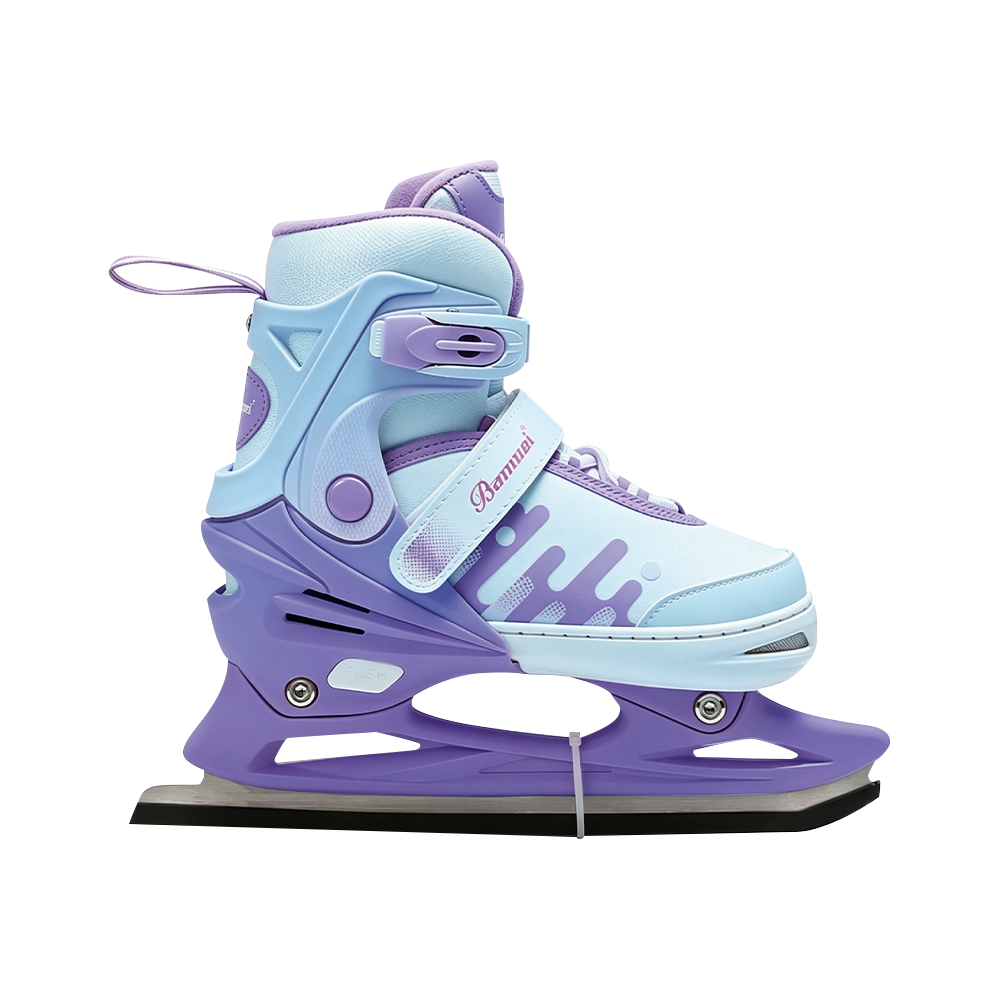
BW-127BD Kids Ice Skate05/09

Get in Touch
Your email address will not be published. Required fields are marked *
Have a project in mind? Contact with us!
We are happy to answer your questions. Please fill out this form
and one of our professional team will get back to you as soon as possible.

We specialize in producing various types of children's toy cars, children's skateboards, and ice skates.
