
 En
 Español
 русский
 عربى

Adjustable Kids Ice Skates: A Practical Guide to Comfort, Safety, Performance, and Long-Term Value
Date:Oct 05, 2026
Content
- 1 Why Adjustable Ice Skates Matter for Growing Children
- 2 Product Overview
- 3 Supportive Hard PVC Shell for Beginner Confidence
- 4 Breathable MESH for Extended Comfort
- 5 Carbon Steel Blades for Stable Ice Contact
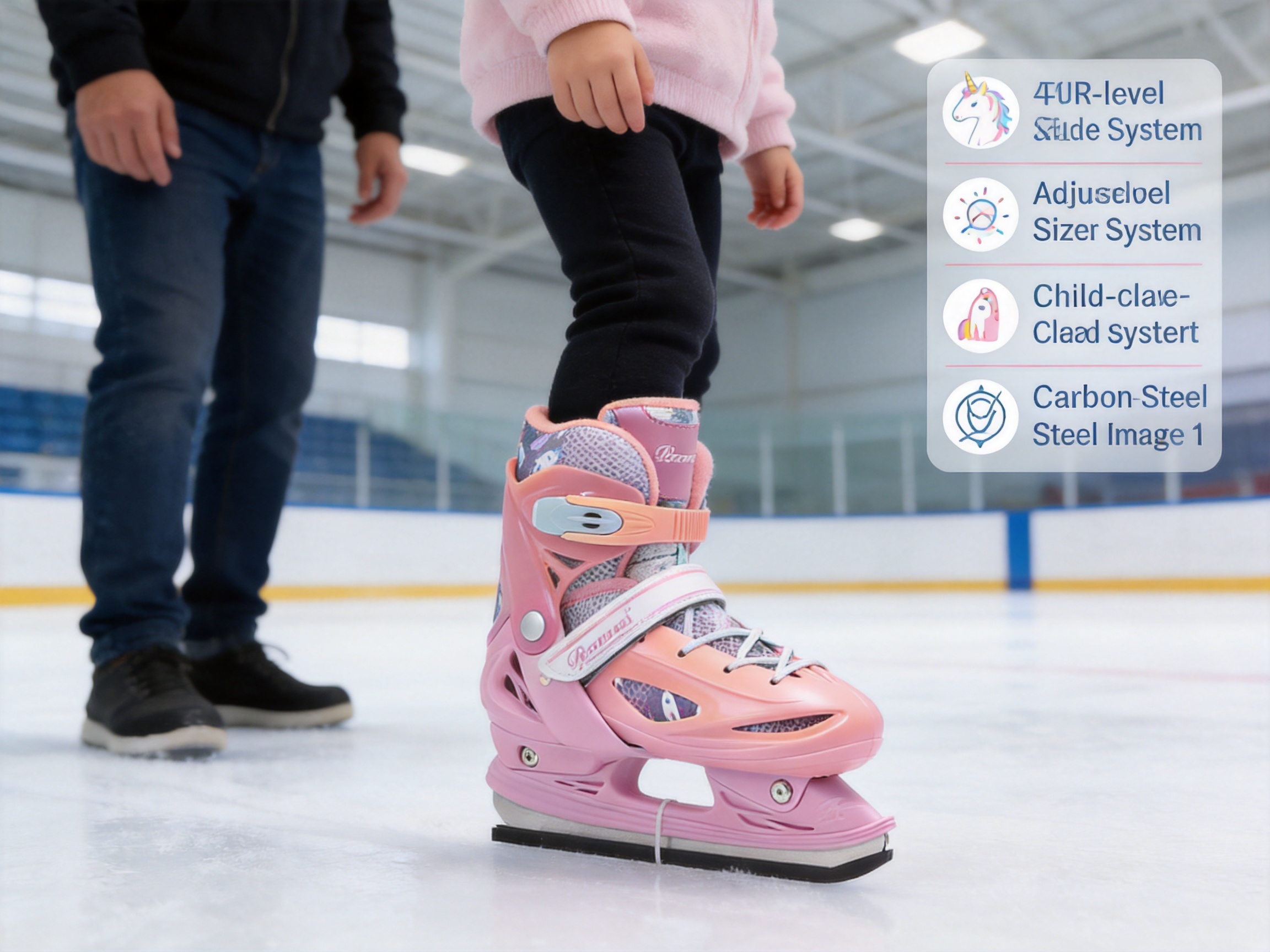
- 6 Four-Level Adjustment for Multiple Growth Stages
- 7 Child-Friendly Buckle System
- 8 Advantages Compared with Conventional Fixed-Size Children’s Skates
- 9 Applications for Families, Schools, and Sports Programs
- 10 Manufacturing Strengths Behind the Product
- 11 Research, Development, and Product Improvement
- 12 Quality Systems and Certifications
- 13 OEM and Wholesale Sourcing Potential
- 14 Packaging, Storage, and Logistics Considerations
- 15 How to Select the Correct Size and Adjust the Skates
- 16 Care and Maintenance Recommendations
- 17 Safety Guidance for Young Skaters
- 18 Frequently Asked Questions
- 18.1 What makes these ice skates adjustable?
- 18.2 Are the skates suitable for beginners?
- 18.3 What materials are used?
- 18.4 Which size should parents choose?
- 18.5 Are pink, blue, and red the available colors?
- 18.6 How should the carbon steel blades be maintained?
- 18.7 Can children put the skates on by themselves?
- 18.8 Are these skates suitable for competitive figure skating or hockey?
- 18.9 What are the benefits for schools or sports institutions?
- 18.10 Where is the product manufactured?
- 18.11 What certifications and systems does the manufacturer report?
- 19 Conclusion
- 20 References
- 21 Product: BW-905BD Adjustable Kids Ice Skates
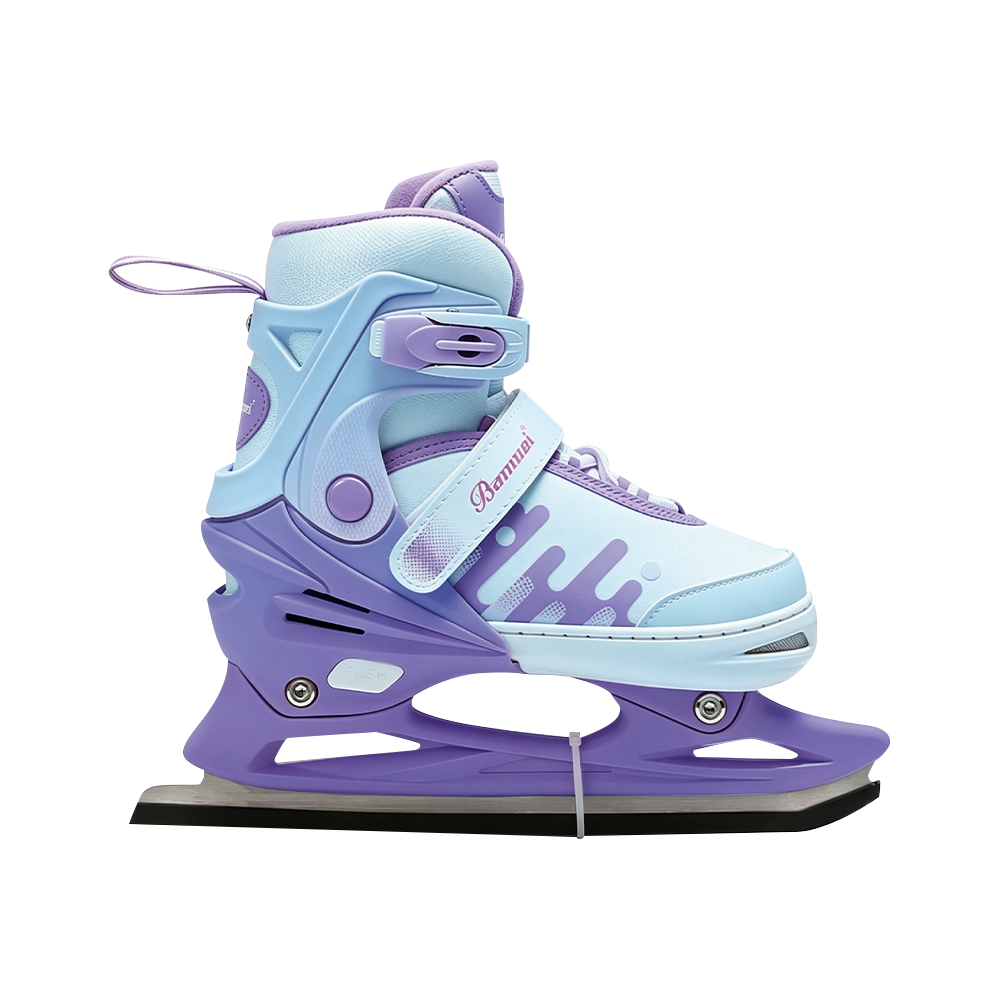
Choosing ice skates for children involves more than selecting an attractive color or the lowest available price. Children’s feet grow quickly, beginners require dependable support, and families often need equipment that can tolerate repeated use at skating rinks, training sessions, school programs, and weekend activities. The BW-905BD Adjustable Kids Ice Skates – Pink/Blue/Red are designed to address these practical requirements through a combination of adjustable sizing, a supportive hard shell, breathable materials, durable carbon steel blades, and a child-friendly fastening system.
These skates are intended for children who are beginning to explore ice sports as well as for young recreational skaters who need reliable equipment for regular use. Their four-level adjustment system covers sizes 27–30, 31–34, 35–38, and 39–42. Instead of replacing a complete pair whenever a child’s feet grow, parents can adjust the skate to accommodate several stages of development. This approach can reduce long-term equipment costs while also making the skates useful for families, schools, sports clubs, and rental programs.
The product combines a breathable MESH upper and lining with a hard PVC shell. The MESH material helps reduce heat and moisture accumulation during activity, while the PVC structure contributes ankle stability and exterior protection. Underneath, carbon steel blades provide a firm skating edge and dependable contact with the ice. A convenient buckle system allows children to put on and remove the skates with less assistance, supporting independence while helping parents prepare for skating sessions more efficiently.
Why Adjustable Ice Skates Matter for Growing Children
Children’s footwear requirements change quickly. A pair that fits correctly at the beginning of winter may become uncomfortable a few months later. In conventional fixed-size ice skates, this often means purchasing a new pair before the original product has reached the end of its useful life. The result is higher ownership cost, unnecessary storage of outgrown equipment, and more time spent searching for the next correct size.
An adjustable skate offers a different solution. The BW-905BD model is built around four size ranges, allowing the internal length to be modified as the child grows. The adjustment does not simply provide convenience; it changes the economic value of the product. One pair can accompany a child through several growth stages, making it particularly suitable for families who want to plan equipment purchases carefully.
Adjustability is also useful when several children in a household share equipment at different times. With suitable hygiene and fit checks, the skates can be adjusted for different users within the available size range. Schools and sports institutions may also benefit because adjustable products simplify inventory management. Instead of maintaining many individual sizes, an organization can allocate several adjustable pairs across broader age and foot-size groups.
Proper adjustment remains important. The skate should hold the foot securely without compressing the toes or creating painful pressure points. Parents should check that the heel is seated correctly, the ankle is supported, and the child can flex naturally while standing. Adjustment should be made before skating, and the fit should be reviewed periodically as the child grows.
Product Overview
The BW-905BD Adjustable Kids Ice Skates are available in pink, blue, and red. These color options provide visual variety and allow children to select a style that reflects their preferences. They can also help families, coaches, or rink operators identify different pairs more easily.
| Product Feature | Specification or Benefit |
|---|---|
| Product type | Adjustable children’s ice skates |
| Available colors | Pink, blue, and red |
| Adjustment ranges | 27–30, 31–34, 35–38, and 39–42 |
| Upper and lining material | Breathable MESH |
| Outer support structure | Hard PVC shell |
| Blade material | Carbon steel |
| Closure system | Child-friendly buckle system |
| Primary applications | Beginner skating, leisure skating, training, school sports, and family activities |
The product is designed around a balance of comfort, support, service life, and usability. Many children’s skates emphasize only one of these attributes. A soft product may be comfortable but provide insufficient ankle support, while an extremely rigid design may feel secure but be difficult for a beginner to wear. This model combines a firm PVC shell with padded and breathable components to create a more balanced equipment solution.
For purchasers, the main value lies in the way the individual features work together. The adjustable structure addresses growth, the shell addresses support, the MESH components address comfort, the carbon steel blade addresses ice contact, and the buckle addresses ease of use. The result is a product intended for real family use rather than occasional display or short-term novelty.
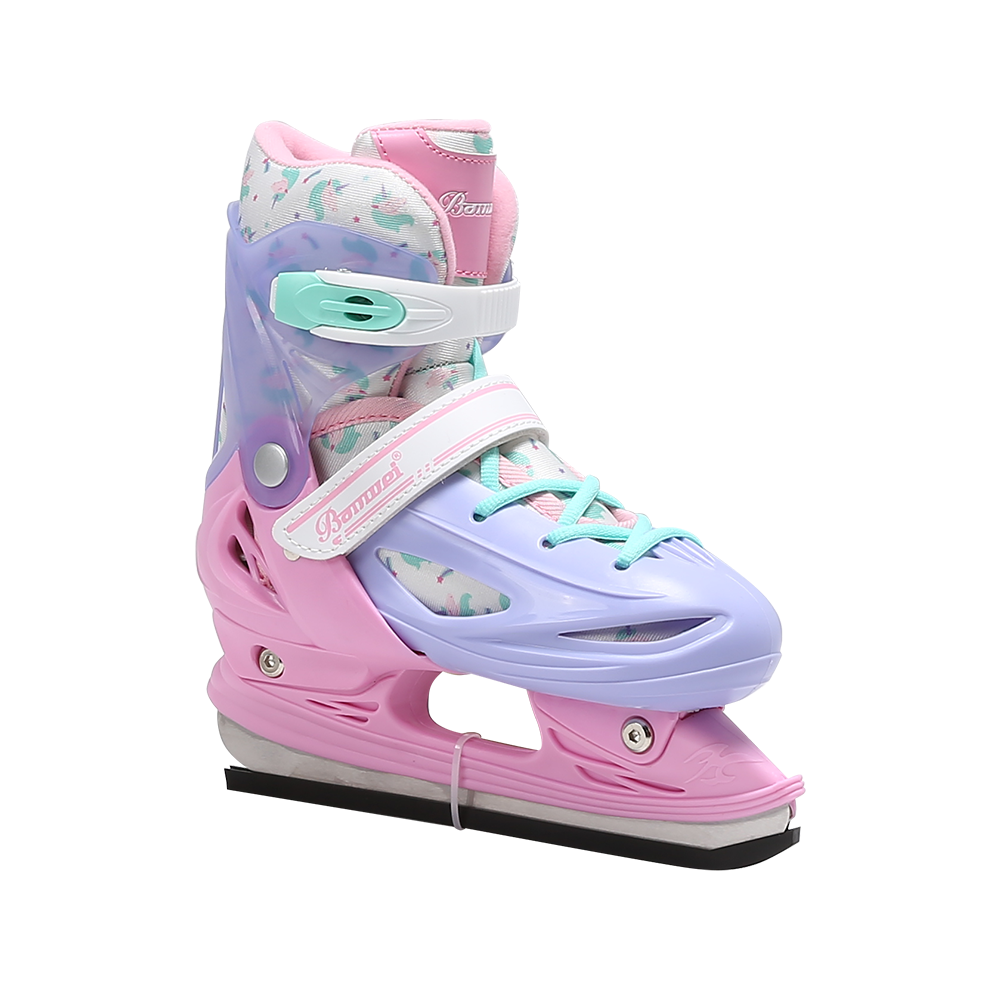
BW-905BD Adjustable Kids Ice Skates
Supportive Hard PVC Shell for Beginner Confidence
Beginning skaters often have difficulty maintaining ankle alignment. They may lean inward, lose balance while changing direction, or place uneven pressure on the boot. A stable outer shell can help the foot and ankle remain in a more controlled position as the child develops basic skills.
The BW-905BD uses a hard PVC shell to provide structure around the foot and ankle. PVC is widely used in sports equipment because it can be molded into consistent shapes, offers useful impact resistance, and supports efficient large-scale production. In this product, the shell helps create a protective barrier around the lower foot while giving the skate sufficient rigidity for recreational skating and introductory training.
The shell works together with a soft padded lining. This combination is important because rigid support without internal cushioning may feel uncomfortable, especially when a child spends a long period at the rink. The lining helps reduce direct contact between the foot and the hard outer structure, while the shell maintains the external form of the boot.
Support does not eliminate the need for supervision or correct technique. Children should skate in an environment appropriate to their skill level and should receive instruction when necessary. However, equipment that feels stable can help beginners concentrate on posture, balance, stopping, and controlled movement instead of constantly struggling with loose or unstable footwear.
Breathable MESH for Extended Comfort
Ice rinks are cold, but feet can still become warm and damp during physical activity. A child may spend considerable time walking in skates, practicing movements, waiting for a lesson, or skating continuously. Heat and moisture trapped inside the boot can reduce comfort and may contribute to unpleasant odors or irritation.
The MESH material used in the BW-905BD is intended to improve airflow around the foot. Its breathable construction helps prevent excessive heat buildup and supports a drier internal environment. This is particularly valuable for children, who may not always communicate discomfort immediately or may continue playing despite damp socks and overheated feet.
Breathability also contributes to the perceived weight and flexibility of the skate. A well-designed textile component can make the boot feel less restrictive than a completely enclosed rigid construction. The child can maintain a more comfortable fit during longer recreational sessions, while the hard shell continues to supply the necessary structural support.
Parents can further improve comfort by choosing moisture-managing socks that are neither too thick nor too thin. Extremely thick socks may make the skate tight and restrict circulation, while very thin socks may provide inadequate cushioning. After use, the skates should be opened and allowed to dry naturally in a ventilated area.
Carbon Steel Blades for Stable Ice Contact
The blade is the part of the skate that directly interacts with the ice, so material quality and maintenance have a significant effect on skating behavior. The BW-905BD uses carbon steel blades designed to provide a stable edge and smooth gliding performance for children’s recreational and beginner skating.
Carbon steel is valued for its hardness, strength, and ability to maintain a functional edge under normal use. For a child learning to glide and turn, consistent contact with the ice can make movements feel more predictable. A reliable blade also supports the development of basic skills such as forward motion, controlled stopping, and gentle changes in direction.
The phrase “durable” does not mean that the blade can be neglected. Blades should be kept clean and dry after every skating session. Moisture left on the metal can encourage corrosion, while contact with hard surfaces such as concrete or stone can damage the edge. Children should avoid walking on non-ice surfaces unless the product is specifically designed for that purpose.
Periodic inspection is recommended. Parents should look for visible rust, nicks, bent components, loose connections, or any unevenness in the edge. Sharpening should be performed by a qualified skate service provider when necessary. Correct maintenance helps extend the useful life of the blade and preserves a more consistent skating experience.
Four-Level Adjustment for Multiple Growth Stages
The four-level adjustment system is one of the product’s most important advantages. The available ranges are XS, 27–30; S, 31–34; M, 35–38; and L, 39–42. These ranges are designed to accommodate different stages of childhood and adolescence, from smaller-foot beginners to older children and teenagers.
| Adjustment Level | Foot Size Range | Typical Use |
|---|---|---|
| XS | 27–30 | Small-foot beginners and younger children |
| S | 31–34 | Preschool and lower elementary school users |
| M | 35–38 | Upper elementary school children |
| L | 39–42 | Older children and teenagers |
The exact age associated with each size should not be treated as a fixed rule because children’s foot dimensions vary. The correct selection should be based on the child’s actual foot size and the manufacturer’s fitting guidance. The skates should not be selected solely by age, height, or clothing size.
Adjustment is valuable not only because it delays replacement but also because it helps maintain a closer fit over time. An oversized fixed skate can allow the foot to move inside the boot, reducing control and increasing the risk of discomfort. An adjustable skate can be set nearer to the child’s current size, then expanded when required.
Parents should make small, deliberate adjustments and check both skates for symmetry. The left and right skate should be set to the same position unless a qualified professional recommends otherwise. After adjustment, the child should stand, bend the knees slightly, and move the feet to confirm that the heel remains secure and the toes are not compressed.
Child-Friendly Buckle System
Many children find traditional laces difficult to tie evenly. Loose laces may reduce support, while overly tight laces may create pressure across the top of the foot. A buckle system simplifies the process and allows children to participate in putting on and removing their own skates.
The BW-905BD uses a convenient buckle closure designed with children’s use in mind. The system can reduce preparation time at the rink and help parents avoid repeatedly retying footwear. More importantly, it encourages children to develop practical equipment habits. A child who learns to open, close, and check the buckle is more likely to take an active role in preparing safely for skating.
Adult supervision is still appropriate, particularly for younger children. Parents should confirm that the buckle is fully engaged, the strap is secure, and the foot is not shifting inside the boot. Children should also be taught not to force the buckle or stand on it while putting on the skate.
The buckle’s convenience is especially useful in group environments. In a class or school program, instructors often need to help several children prepare at the same time. A straightforward closure system makes the process more orderly and can reduce delays before the lesson begins.
Advantages Compared with Conventional Fixed-Size Children’s Skates
The most direct comparison is between adjustable skates and conventional fixed-size products. Fixed-size skates may offer a familiar construction and can be suitable when a child’s feet have stopped growing or when the skates will be used for a short, specific period. However, they generally offer less flexibility for families with rapidly growing children.
Adjustable sizing can provide a lower cost per season because the same pair may remain useful across several size changes. This does not mean that the adjustable product is always the least expensive initial purchase, but it can offer stronger long-term value when the skates are used regularly and cared for correctly.
The BW-905BD also offers a practical balance between structure and comfort. Some basic children’s skates use soft materials that may be pleasant to wear but provide limited ankle stability. Others use a very rigid exterior without sufficient breathable cushioning. The combination of hard PVC and MESH is intended to serve both needs.
Another advantage is ease of use. The buckle system is simpler for many children than tying and retightening laces. This can be particularly useful for younger beginners, school programs, family skating trips, and rental or shared-equipment environments.
Compared with products designed only for occasional novelty use, the BW-905BD is positioned as a more versatile piece of equipment. It can support introductory instruction, recreational skating, family activities, and repeated rink visits. The carbon steel blade and adjustable construction are selected for practical service rather than one-time use.
Applications for Families, Schools, and Sports Programs
Beginner Ice Skating
For a child taking first steps on the ice, confidence is essential. The supportive shell helps reduce excessive ankle movement, while the blade offers a stable platform for learning basic gliding and stopping. The adjustable fit allows parents to select a size closer to the child’s current foot, rather than purchasing a much larger skate in anticipation of growth.
Recreational Skating
Families often visit ice rinks during weekends, school holidays, and winter vacations. Recreational users typically want equipment that is comfortable, attractive, easy to operate, and durable enough for repeated outings. The available color choices make the product appealing to children, while the MESH material and buckle support a more convenient experience for parents.
Training Classes
Skating schools and community programs need products that can serve different children over time. The four adjustment ranges can simplify stock planning and reduce the number of individual sizes required. A hard shell and carbon steel blade provide a suitable foundation for introductory training, although advanced competitive skating may require specialized equipment selected according to discipline and coaching requirements.
School Sports Courses
Schools may use the skates for organized sports activities, introductory ice-sports programs, or supervised educational trips. Adjustable equipment is useful in these settings because students vary in age and foot size. Color options can assist with inventory identification, while the buckle system helps students prepare with less direct assistance.
Family Activities
During parent-child skating sessions, several children may need to prepare at once. The easy adjustment and buckle closure can make the process more efficient. Different colors may also help family members distinguish their equipment, especially when several pairs are stored together at a busy rink.
Manufacturing Strengths Behind the Product
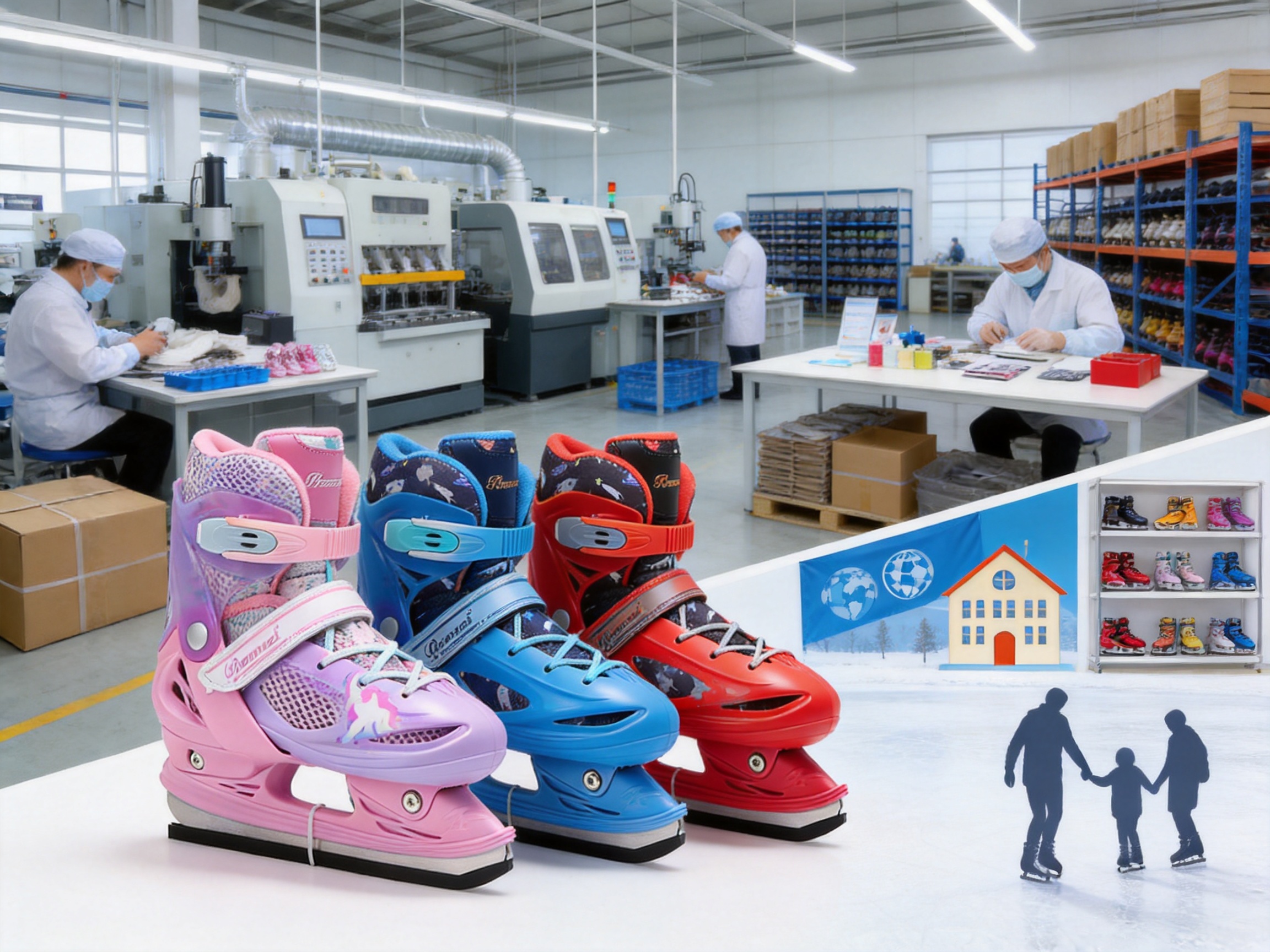
The quality of a finished skate depends on more than the listed materials. Consistent molding, accurate adjustment components, reliable stitching, controlled assembly, and effective inspection all influence the user experience. Ningbo Feile Sporting Goods Co., Ltd. has specialized in children’s scooters, inline skates, roller skates, and ice skates since 2010, giving the company experience across several related categories of wheeled and ice-based sports equipment.
The company operates a workshop of approximately 20,000 square meters and has more than 200 employees. Its production resources include five automatic production lines, a mold workshop, an injection molding workshop, a sewing workshop, and an assembly workshop. This integrated structure allows several important stages to be managed within one manufacturing organization.
In-house or closely coordinated mold development is especially valuable for products with shaped shells and adjustment mechanisms. Accurate molds help maintain consistency from one production batch to another. They also support product refinement, because engineers can modify shell geometry, fastening details, and structural features without depending entirely on outside suppliers.
Injection molding capability supports the production of PVC components with repeatable dimensions. Dimensional consistency is important for a skate because the shell, adjustment mechanism, buckle, and blade assembly must work together correctly. A variation that appears small during manufacturing can affect fit, comfort, or the operation of the adjustment system.
The sewing workshop contributes to the production of MESH uppers, linings, padding, and other textile components. Sewing quality affects durability and comfort. Reinforced seams, controlled tension, and appropriate material handling help prevent premature separation during repeated use. The combination of textile and molded components requires coordinated production standards rather than isolated material inspection.
Assembly is another critical stage. The blade must be attached securely, the shell and upper must be aligned, and the buckle must operate smoothly. A professional assembly process should include checks for loose parts, uneven construction, damaged surfaces, and functional problems. Finished products should be evaluated not only for appearance but also for usability.
Research, Development, and Product Improvement
A dedicated R&D engineering team allows the manufacturer to develop new products and refine existing designs. Children’s sports equipment requires ongoing attention because user expectations, safety standards, material technologies, and retail requirements continue to change.
Product development may involve testing different shell shapes, experimenting with ventilation patterns, improving the adjustment range, refining buckle ergonomics, or evaluating blade integration. Engineering decisions must consider the needs of children, parents, retailers, coaches, and distributors simultaneously.
The company reports launching new products each year to respond to customer and market needs. This ongoing development approach is important for OEM and sourcing customers who may require updated styles, customized colors, packaging changes, or product portfolios covering multiple age groups.
More than 30 college-educated management staff support company operations. A trained management team can assist with production scheduling, quality coordination, export documentation, customer communication, and compliance management. These capabilities matter to international buyers who need dependable communication in addition to physical product quality.
Quality Systems and Certifications
Manufacturing certifications and product testing provide useful evidence of process discipline, although buyers should always confirm the documentation relevant to their intended market and product configuration. The company has passed ISO9001, BSCI, and Kmart factory certification systems. It also reports product certifications and compliance credentials including 3C, CE, EN71, EN62115, ASTM, EMC, and EN13843:2009.
Different standards address different aspects of production and product use. ISO9001 is associated with quality management systems. BSCI relates to social compliance and responsible supply-chain practices. CE marking may be relevant to products placed on applicable European markets, while ASTM standards are often referenced in North American product requirements. EN standards address specific European safety or performance areas depending on the product category.
For importers, certification review should be part of the purchasing process. Buyers should request current reports, verify that the reports correspond to the exact model, and confirm that color, material, blade, and packaging changes do not affect compliance. A reliable manufacturer should be prepared to discuss testing scope, production control, labeling, and documentation.
Quality management is most effective when it is integrated throughout the production process. Incoming material checks, mold inspection, in-process inspection, assembly checks, functional tests, and final sampling can work together to reduce defects. This approach is more dependable than relying only on a final visual inspection after the product is complete.
OEM and Wholesale Sourcing Potential
The BW-905BD model can be relevant to distributors, retailers, sports-equipment importers, school suppliers, rink operators, and private-label customers. Its broad size adjustment range and multiple color options create opportunities for different sales channels. A retailer may position it as a family-friendly seasonal product, while an institutional buyer may emphasize inventory efficiency and service life.
OEM customers may also evaluate the manufacturer’s ability to support packaging, color selection, labeling, documentation, and coordinated product sourcing. Because the company produces children’s scooters, inline skates, roller skates, and ice skates, buyers may be able to develop a broader skating and scooter assortment through one manufacturing partner.
One-stop sourcing can reduce the administrative burden associated with managing multiple suppliers. It may simplify communication about quality expectations, packaging standards, shipment schedules, and product compliance. It can also help buyers create coordinated product lines with similar color themes, age targeting, and retail presentation.
Before placing a production order, commercial buyers should confirm minimum order quantities, sample procedures, lead times, carton dimensions, packaging options, blade protection requirements, warranty terms, replacement-part availability, and inspection procedures. They should also establish how product changes are approved and documented.
Packaging, Storage, and Logistics Considerations
The supplied information includes carton dimensions for the four adjustment ranges. The reported dimensions are 420 × 360 × 345 mm for sizes 27–30, 470 × 390 × 345 mm for sizes 31–34, 500 × 420 × 345 mm for sizes 35–38, and 545 × 430 × 350 mm for sizes 39–42. These measurements are useful for warehouse planning, freight estimation, pallet configuration, and retail distribution.
| Size Range | Reported Carton Dimensions | Logistics Relevance |
|---|---|---|
| 27–30 | 420 × 360 × 345 mm | Suitable for smaller-size inventory planning |
| 31–34 | 470 × 390 × 345 mm | Useful for preschool and lower elementary ranges |
| 35–38 | 500 × 420 × 345 mm | Requires additional volume planning for larger boots |
| 39–42 | 545 × 430 × 350 mm | Largest reported carton size for older users |
Ice skates should be stored in a clean, dry environment. During transportation and warehouse handling, the blade area should be protected from impact and moisture. Retailers should avoid placing heavy products on top of skate cartons if the packaging is not designed for stacking pressure.
After a consumer uses the product, the skates should be removed from any closed bag and dried before long-term storage. Blade guards may be used when walking short distances away from the ice, but wet guards should not remain installed during storage because trapped moisture can encourage corrosion.
How to Select the Correct Size and Adjust the Skates
Start by measuring the child’s feet according to the seller’s or manufacturer’s recommended method. Measure both feet because one foot may be slightly longer than the other. Select the size range that includes the larger foot, then adjust the skates to provide a secure fit without excessive empty space.
The child should wear the socks intended for skating during the fitting process. The heel should sit firmly in the rear of the boot, and the toes should not be forced against the front. When the child bends the knees slightly, the heel should remain stable rather than lifting significantly inside the skate.
After fastening the buckle, ask the child whether there is pressure, numbness, pinching, or discomfort. Children may describe fit differently from adults, so parents should also observe walking posture and foot movement. If the child cannot stand comfortably or repeatedly removes the skate, the fit should be checked before entering the ice.
It is not advisable to choose a substantially oversized adjustment setting simply to obtain more growing room. Excess movement may reduce control and cause rubbing. The best long-term value comes from using the adjustment mechanism gradually while maintaining a safe and comfortable fit at every stage.
Care and Maintenance Recommendations
Wipe the blades after each session with a dry cloth. Remove visible ice, water, and residue before placing the skates in a bag. Inspect the blade edge and mounting area regularly for damage or looseness.
Allow the MESH lining and padding to dry naturally. Avoid placing the skates directly against a heater or using excessive heat, since high temperatures may affect synthetic materials, adhesives, padding, or the shape of the shell.
Clean the exterior with a soft, slightly damp cloth. Strong solvents and abrasive cleaners should be avoided unless specifically approved for the materials. Check the buckle and adjustment mechanism for dirt or obstruction, and operate them gently rather than forcing them.
Store the skates in a ventilated location away from prolonged sunlight, extreme heat, and damp conditions. Before each use, confirm that both skates are structurally sound, the adjustment setting has not moved unintentionally, the buckle closes correctly, and the blade appears suitable for skating.
Safety Guidance for Young Skaters
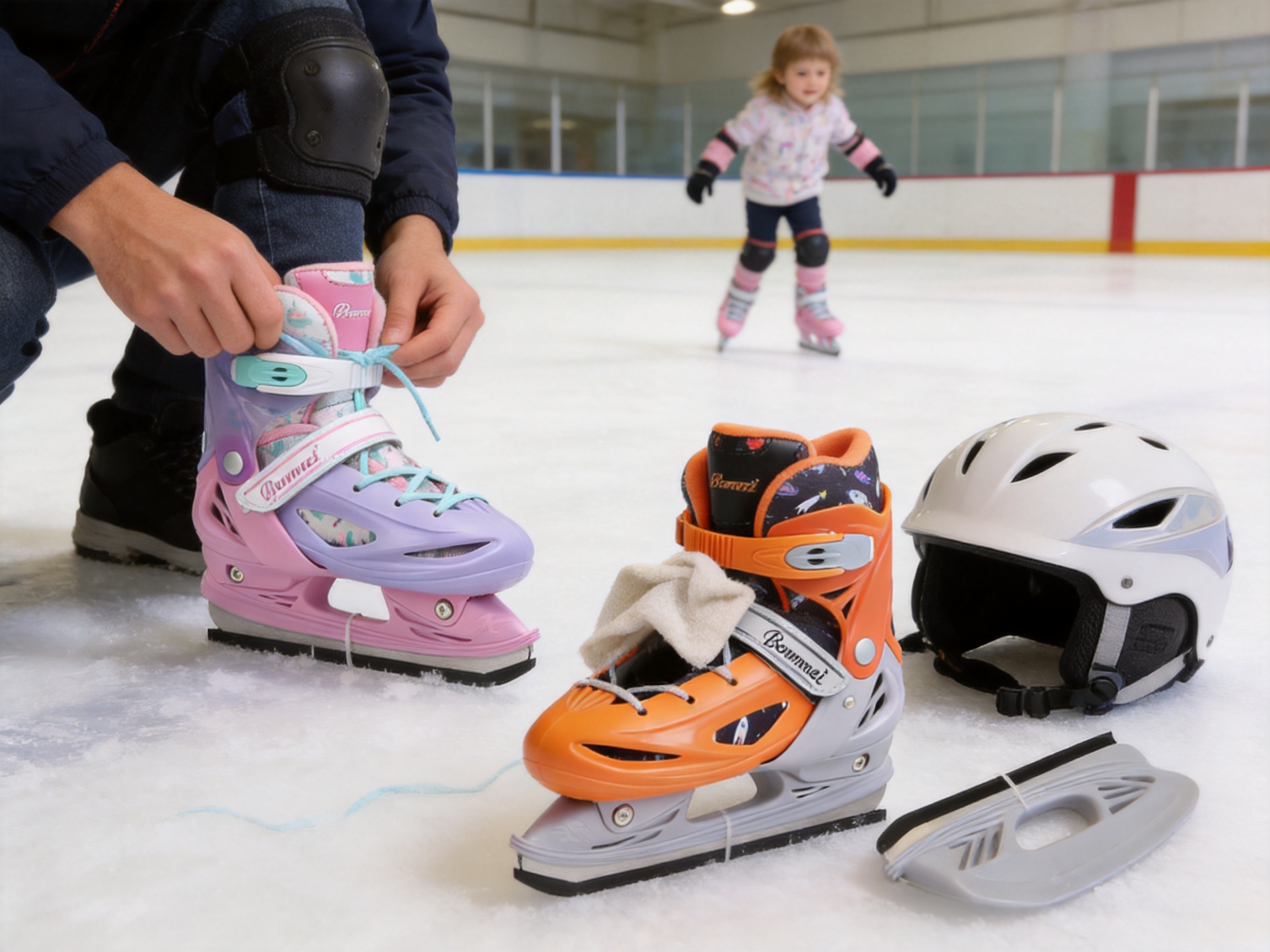
Children should skate in facilities appropriate to their age and skill level. Beginners should receive supervision, especially during their first sessions. A helmet and suitable protective equipment are recommended, and local rink rules should always be followed.
Children should learn to walk carefully while wearing skates and should avoid running on hard surfaces. They should not touch the blade edge with bare fingers or place their hands near another skater’s blades. Parents and instructors should explain how to fall safely according to the child’s training level.
The skates are designed to support skating, but no equipment can prevent every injury. Correct sizing, proper adjustment, suitable instruction, and responsible behavior remain essential. Parents should stop the activity if the child experiences pain, numbness, unusual instability, or a suspected equipment problem.
Frequently Asked Questions
What makes these ice skates adjustable?
The BW-905BD uses an adjustment system that allows the skate length to be changed across four ranges: 27–30, 31–34, 35–38, and 39–42. The setting can be adapted as the child’s feet grow, reducing the need for frequent replacement.
Are the skates suitable for beginners?
Yes. The hard PVC shell provides supportive structure, the padded interior improves comfort, and the carbon steel blades offer stable ice contact. These features make the skates suitable for children beginning ice sports and for supervised recreational skating.
What materials are used?
The skates combine breathable MESH material with a hard PVC shell and carbon steel blades. The MESH is intended to improve airflow and moisture management, while the PVC shell contributes ankle support and external protection.
Which size should parents choose?
Parents should measure the child’s feet and select the appropriate range based on the larger foot. The skate should be adjusted to provide a secure fit without compressing the toes or allowing significant heel movement. Age ranges are only general references and should not replace actual fitting.
Are pink, blue, and red the available colors?
Yes. The product is available in pink, blue, and red. These options allow children to choose a preferred appearance and can help families or organizations distinguish different pairs.
How should the carbon steel blades be maintained?
Dry the blades after every use, avoid walking on hard surfaces whenever possible, and inspect them regularly for rust, damage, or looseness. Professional sharpening should be arranged when the edge requires service.
Can children put the skates on by themselves?
The buckle system is designed to make putting on and removing the skates easier for children. Younger users should still receive adult supervision to confirm that the adjustment and fastening are secure.
Are these skates suitable for competitive figure skating or hockey?
The product is intended for beginner, recreational, family, school, and introductory training use. Advanced figure skating and hockey may require discipline-specific skates with specialized blade profiles, support characteristics, and performance features. Buyers should consult a qualified coach when selecting advanced equipment.
What are the benefits for schools or sports institutions?
The broad adjustment ranges can simplify inventory management because one pair can cover multiple foot sizes. The buckle system can also make preparation more efficient when instructors or staff are assisting several children.
Where is the product manufactured?
The product is manufactured by Ningbo Feile Sporting Goods Co., Ltd., located in Yuyao, Ningbo, Zhejiang Province, China. The company operates mold, injection molding, sewing, and assembly facilities and maintains production lines for skating and scooter products.
What certifications and systems does the manufacturer report?
The manufacturer reports ISO9001, BSCI, and Kmart factory certification systems, along with product-related credentials including 3C, CE, EN71, EN62115, ASTM, EMC, and EN13843:2009. Buyers should request current documentation for the exact product and target market.
Conclusion
The BW-905BD Adjustable Kids Ice Skates are designed as a practical, long-term solution for growing children. Their four-level adjustment system helps extend product usefulness, while the hard PVC shell provides structure and the MESH material supports breathability and comfort. Carbon steel blades offer stable ice contact, and the child-friendly buckle system simplifies preparation for both children and adults.
The product’s advantages become especially clear when it is compared with fixed-size, short-life alternatives. Families may benefit from reduced replacement frequency, schools can simplify equipment allocation, and sports institutions can manage broader size coverage with fewer individual models. The range of pink, blue, and red color options also gives the product a child-friendly appearance suitable for retail and group use.
Behind the product is a manufacturer with experience in children’s skating and scooter equipment, a large production workshop, automatic production lines, mold and injection molding capabilities, sewing and assembly facilities, an R&D engineering team, and reported international quality and compliance credentials. These manufacturing strengths support consistent product development and make the company suitable for OEM, wholesale, institutional, and distribution partnerships.
For the best experience, the skates should be fitted carefully, adjusted as the child grows, maintained after every use, and used with appropriate supervision and protective equipment. When these practices are followed, the BW-905BD can provide children with a comfortable and supportive introduction to ice skating while delivering practical value to families and professional buyers.
References
1. Product specification and feature information for the BW-905BD Adjustable Kids Ice Skates.
2. Manufacturer-provided information regarding materials, adjustment ranges, applications, packaging dimensions, and color options.
3. Manufacturer company profile describing production facilities, workforce, research and development, certifications, and product categories.
4. General principles of children’s sports-equipment fitting, blade care, moisture management, and supervised ice-skating safety.
5. General quality-management and product-compliance practices applicable to children’s sporting goods manufacturing.
Product: BW-905BD Adjustable Kids Ice Skates

Recommended Articles
-
BW-127BD Kids Ice Skate05/09

Get in Touch
Your email address will not be published. Required fields are marked *
Have a project in mind? Contact with us!
We are happy to answer your questions. Please fill out this form
and one of our professional team will get back to you as soon as possible.

We specialize in producing various types of children's toy cars, children's skateboards, and ice skates.
