
 En
 Español
 русский
 عربى

Why a Two-in-One Toddler Scooter Supports Safer Early Mobility
Date:Sep 17, 2026
Content
- 1 A Mobility Product Designed Around Toddler Development
- 2 Two-in-One Use for a More Flexible Product Experience
- 3 Stability and Low-Center-of-Gravity Construction
- 4 Lightweight Handling and Simple Operation
- 5 Supporting Balance, Coordination, and Physical Activity
- 6 Advantages Compared with Single-Function Alternatives
- 7 Manufacturing Strengths Behind the Product
- 8 Quality Management and International Market Readiness
- 9 Materials, Comfort, and User-Oriented Design
- 10 Indoor and Outdoor Use
- 11 Commercial Value for Distributors and Retailers
- 12 Recommended Product Presentation
- 13 Safety-Oriented Use and Parental Supervision
- 14 Frequently Asked Questions
- 14.1 What is the FL-630 Child Seat Children Scooter?
- 14.2 Is the product powered by batteries?
- 14.3 What is the main advantage of the removable seat?
- 14.4 Is it suitable for children who are learning to walk?
- 14.5 Can the scooter be used indoors?
- 14.6 Can it be used outdoors?
- 14.7 What are the approximate product dimensions?
- 14.8 What developmental skills can riding practice support?
- 14.9 How stable is the product?
- 14.10 How does it compare with a battery-powered ride-on toy?
- 14.11 How does it compare with a conventional standing scooter?
- 14.12 What manufacturing capabilities support this product?
- 14.13 Does the manufacturer support OEM or private-label business?
- 14.14 What certifications are associated with the manufacturer’s product portfolio?
- 14.15 How should the product be maintained?
- 15 Conclusion
- 16 References
- 17 Product: FL-630 Child Seat Children Scooter
Choosing a first wheeled toy for a toddler requires more than looking at color, appearance, or a low purchase price. Young children are still developing balance, coordination, leg strength, confidence, and body awareness. A suitable product must therefore be easy to control, stable during movement, comfortable to use, and adaptable as the child develops. The FL-630 Child Seat Children Scooter is designed around these early-development needs. It combines a removable seat with a low, stable scooter platform so that toddlers can begin by sitting and gliding before progressing toward standing balance practice.
This two-in-one approach gives the product a practical advantage over single-purpose ride-on toys. A conventional seated ride-on may provide comfort but offer limited opportunities for standing balance. A standard standing scooter may be unsuitable for a child who is still learning to walk. The FL-630 bridges these stages by allowing a gradual transition. Children can first sit securely, push against the ground with their feet, and learn how movement responds to their actions. Later, after they gain confidence, the seat can be removed for standing and balance practice.
Designed for indoor and outdoor leisure use, early walking practice, and basic balance development, the scooter is compact, lightweight, and easy for toddlers to handle. Its one-piece molded structure, low center of gravity, and stable chassis are intended to reduce the likelihood of tipping during ordinary use. For parents, this means a mobility toy that supports active play while remaining simple to supervise. For distributors and retailers, it offers a versatile product concept with broad appeal in the early-childhood, toy, sporting-goods, and gift markets.
Ningbo Feile Sporting Goods Co., Ltd. manufactures this type of product within a broader sports-equipment production system covering children’s scooters, inline skates, roller skates, ice skates, and protective gear. The company’s facilities, engineering capabilities, quality systems, and experience in molded sporting goods provide an important foundation for consistent production. The FL-630 is therefore not only a toddler mobility toy; it is also an example of how specialized manufacturing can turn developmental requirements into a practical, market-ready product.
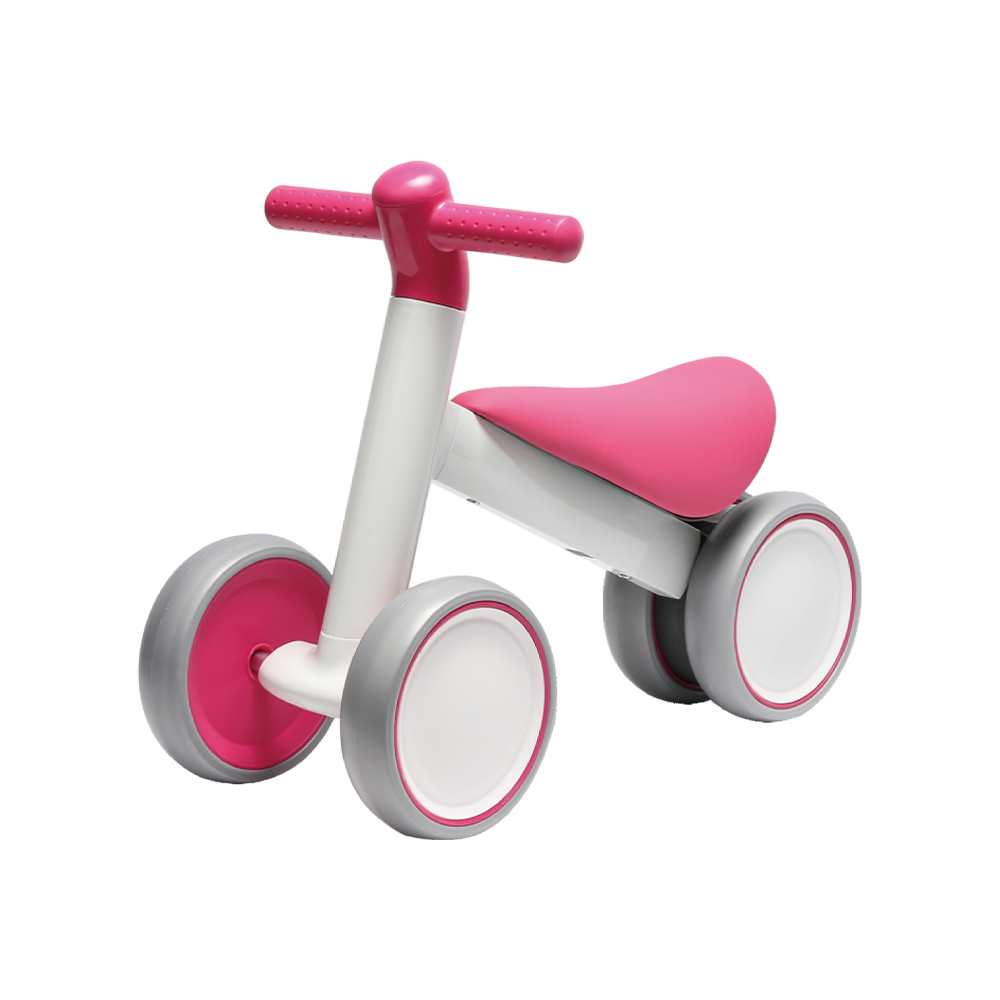
FL-630 Child Seat Children Scooter
A Mobility Product Designed Around Toddler Development
Toddlers learn through repeated physical experiences. Pushing, stopping, shifting weight, turning, and maintaining a stable sitting or standing position all help children understand how their bodies interact with the surrounding environment. A product intended for this age group should make these experiences accessible rather than demanding advanced athletic ability from the beginning.
The FL-630 is based on a simple movement principle: the child propels the scooter by pushing against the floor with the feet. There are no pedals, batteries, motors, or charging requirements. This direct relationship between the child’s movement and the scooter’s motion makes the product easy to understand. When the child pushes harder, the scooter moves forward; when the child stops pushing, the scooter slows naturally. This can help children develop an early sense of cause and effect while practicing basic mobility.
Unlike powered ride-on products, the scooter does not require parents to manage a charging cycle or supervise a motorized mechanism. It also avoids the complexity associated with pedals, which may be difficult for a young child who is still developing leg coordination. The child can use both feet naturally and choose the speed that feels comfortable. This creates an approachable first step between walking independently and using more advanced wheeled equipment.
The seated configuration is particularly useful for children who are learning to walk or who are not yet ready to stand on a scooter. A stable seat allows the child to sit and glide while using the feet for support and propulsion. This position can provide a greater sense of security than standing, especially during the first sessions. As the child becomes more familiar with movement, the seat can be removed so that the same product supports a different type of activity.
That progression is central to the product’s value. Parents do not need to replace a seated ride-on immediately when their child begins to show interest in standing balance. The same scooter can continue to serve the child through multiple stages of early mobility. From a purchasing perspective, this creates a longer useful life and improves the value of the product compared with equipment designed for only one developmental phase.
Two-in-One Use for a More Flexible Product Experience
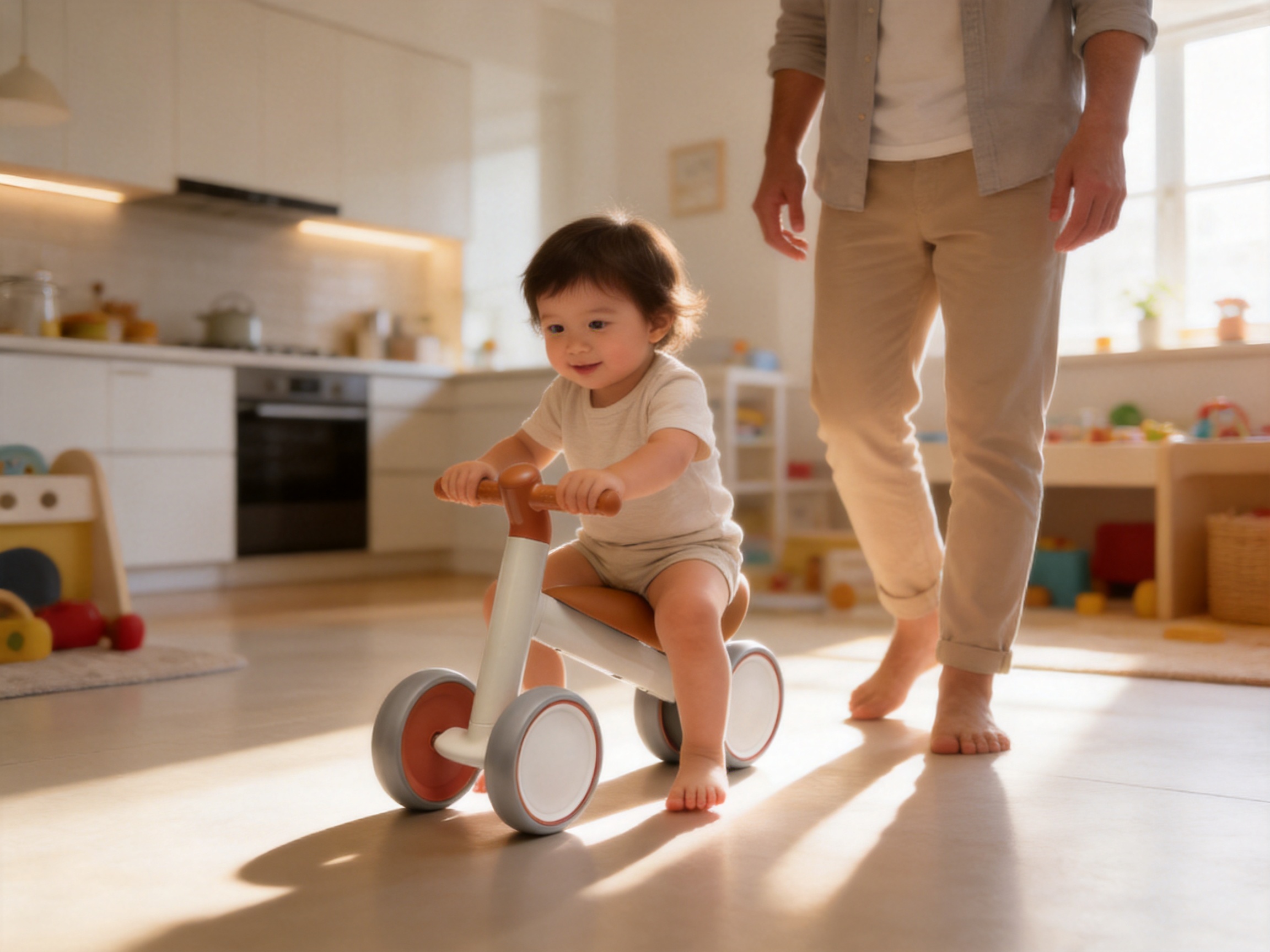
The removable-seat design gives the FL-630 two distinct modes of use. In seated mode, the product functions as a stable balance bike-style ride-on for toddlers. In standing mode, it becomes a basic scooter platform for practicing balance and controlled gliding. These modes are connected, but they do not force a child to advance before being ready.
Seated Gliding Mode
In seated mode, the child sits on the dedicated seat and places the feet on the ground. By pushing alternately or simultaneously, the child can move forward at a self-selected pace. The seat provides support for the torso while the feet remain available for balance and braking. This arrangement is suitable for early practice because the child does not need to maintain full standing stability while learning how to move a wheeled product.
The seated position may also reduce psychological hesitation. Some toddlers are eager to explore but become uncomfortable when placed on a tall or unstable standing toy. A lower seated position can feel more familiar and less demanding. With parental supervision, the child can repeat short movements, learn how the scooter responds, and gradually build confidence.
Standing Balance Mode
When the child has developed greater confidence, the seat can be removed to create a standing practice configuration. The child can then place one foot on the platform and use the other foot to push, or experiment with both feet while remaining close to the ground. This mode encourages weight transfer, posture control, leg strength, and coordination.
The standing mode does not turn the scooter into an advanced performance scooter. Its purpose is early balance practice and gentle gliding, not speed or trick riding. This distinction is important because toddler products should emphasize controlled movement and developmental suitability. The FL-630’s compact construction and low center of gravity support this intended use by keeping the riding position close to the ground.
A Gradual Transition Instead of an Abrupt Change
Many children benefit from products that allow gradual progression. A toy that is too simple may quickly become uninteresting, while a product that is too advanced may be difficult to control. The FL-630 addresses this issue by keeping the basic platform consistent while changing the way the child interacts with it. The child can become familiar with the wheels, chassis, and general movement in seated mode before facing the additional balance challenge of standing mode.
This flexibility can also benefit families with children at slightly different developmental stages. Parents can select the appropriate configuration based on the child’s confidence, physical ability, and interest. Retailers can present the product as a developmental mobility solution rather than as a short-term novelty item.
Stability and Low-Center-of-Gravity Construction
Stability is one of the most important considerations in a toddler mobility product. Young children have a higher center of mass relative to their body size, and they are still learning to react when a product changes direction or encounters a minor surface variation. A stable chassis can help make ordinary use more predictable, although responsible supervision and suitable riding surfaces remain essential.
The FL-630 uses a one-piece molded structure designed to provide a solid foundation. One-piece molding can reduce the number of major structural joints in the main body, creating a clean and integrated frame. It also supports repeatable production because the same mold can be used to produce consistent shapes across manufacturing cycles. When properly engineered and inspected, this type of structure can help maintain dimensional uniformity and reduce assembly complexity.
The product’s low center of gravity is another important design feature. By positioning the riding area close to the ground and keeping the chassis compact, the scooter is less likely to feel top-heavy during gentle movement. A low profile can also make it easier for a child to place the feet down quickly. This is especially useful in seated mode, where the child may need to stabilize the body while beginning or ending a glide.
A stable chassis does not eliminate all risk, and it should not be presented as a substitute for supervision. Children should use the scooter on suitable surfaces away from stairs, traffic, open water, sharp obstacles, and steep slopes. Parents should check that the child is using the correct configuration and should inspect the product periodically. Nevertheless, a thoughtfully shaped frame gives the child a more reliable platform for practicing basic movement.
Compact Dimensions for Child-Friendly Handling
The listed product dimensions are approximately 505 by 230 by 275 millimeters. This compact size is tailored to toddlers rather than older children or adults. A smaller body can be easier for a young rider to approach, mount, dismount, and control. It also takes up less space in a home, classroom, playroom, nursery, or retail package.
Compact proportions can improve parental handling as well. Adults can carry the scooter from one room to another, place it in a vehicle, or store it after use without the difficulty associated with larger ride-on products. For retailers, the compact format may support more efficient warehousing, shelf presentation, and carton planning, subject to the final packaging specifications.
The dimensions should be considered together with the child’s age, height, ability, and manufacturer guidance. A product may be physically compact but still require an appropriate level of supervision. Distributors should communicate the intended use clearly and avoid presenting the scooter as suitable for children who are too young, too small, or unable to support themselves safely.
Lightweight Handling and Simple Operation
A toddler product must be manageable not only for the child but also for the parent. The FL-630 emphasizes a lightweight and compact design so that it can be moved, stored, and repositioned without excessive effort. This is useful in households where the product may be used both indoors and outdoors.
For the child, a lighter structure can make pushing and turning more accessible. If the product is excessively heavy, a toddler may struggle to initiate movement or may lose control when changing direction. A proportionate lightweight design allows the child to focus on learning balance and coordination rather than overcoming the weight of the equipment.
The operating concept is intentionally straightforward. There is no electrical control panel, charging port, motor switch, or complicated adjustment procedure. The child sits or stands, places the feet in a stable position, and begins to move by pushing. Parents can explain the activity in simple terms and observe the child’s progress without having to manage a technical system.
Simple operation also supports reliability in everyday use. Fewer active mechanisms can mean fewer controls to maintain and fewer components that require user instruction. This does not remove the need for quality inspection, but it can make the product easier to understand across different markets and languages. For international buyers, intuitive use is a meaningful advantage because the core function can be communicated visually and with limited text.
Supporting Balance, Coordination, and Physical Activity
The FL-630 is designed as a play product, but its physical activity benefits are closely connected with early childhood development. Regular, age-appropriate riding practice can encourage children to use their legs, shift their weight, coordinate their movements, and control the pace of travel.
Balance Development
Balance involves maintaining the body in a stable position while responding to movement. In seated mode, the child begins to understand how the body moves when the feet push against the ground. In standing mode, the child must make more active adjustments through the legs, hips, and torso. These experiences can contribute to the child’s growing awareness of posture and weight distribution.
Leg Strength and Movement Control
Pushing a scooter requires repeated use of the leg muscles. The effort is generally gentle and can be adjusted naturally by the child. Short play sessions may help build basic leg strength and endurance, while repeated starting and stopping encourages improved movement control. Children should be allowed to rest and should never be pressured to continue when tired or uncomfortable.
Hand, Foot, and Eye Coordination
Riding requires several actions to occur together. The child must look ahead, place the feet appropriately, maintain a stable sitting or standing position, and guide the direction of movement. These combined tasks create an opportunity to practice whole-body coordination. The product’s simple design allows the child to focus on these fundamentals without the distraction of a motor or complex control system.
Confidence and Independent Exploration
Learning to move independently can be an important emotional milestone. A child who successfully glides a short distance may become more willing to try new physical activities. The FL-630 gives parents a way to support this process while allowing the child to participate actively. The child is not simply being carried or moved by an adult; the child contributes directly to the motion.
Parents should keep expectations realistic. Developmental progress differs from one child to another, and a scooter should be viewed as an opportunity for active play rather than as a formal training device. The best results come from short, positive, supervised sessions that allow the child to explore at a comfortable pace.
Advantages Compared with Single-Function Alternatives
The children’s mobility market includes ride-on cars, seated push toys, balance bikes, conventional scooters, and battery-powered products. Each category serves a different purpose. The FL-630’s primary competitive advantage is not that it replaces every alternative, but that it combines two important early-use functions in one compact product.
| Product characteristic | FL-630 two-in-one scooter | Single-purpose seated ride-on | Conventional standing scooter | Battery-powered ride-on |
|---|---|---|---|---|
| Seated use | Yes, with a dedicated removable seat | Usually available | Usually unavailable | Usually available |
| Standing balance practice | Yes, after seat removal | Limited | Yes, but may be advanced for beginners | Usually limited |
| Power source | Child-powered, no charging | Child-powered | Child-powered | Battery or electrical system |
| Operation complexity | Simple push-and-glide movement | Simple push-and-glide movement | Simple but requires standing balance | Requires powered controls and charging |
| Developmental transition | Seated practice to standing practice | Generally limited to seated play | Generally begins with standing play | Movement is largely motor-assisted |
| Storage and handling | Compact and lightweight design | Varies by model | Often compact | Often heavier and larger |
Compared with a single-purpose seated ride-on, the FL-630 can remain useful after a child begins to seek more challenging balance activities. Compared with a conventional standing scooter, it provides an easier entry point for toddlers who are not yet ready to balance while standing. Compared with a battery-powered ride-on, it encourages the child to create movement through physical effort and does not require charging or electronic controls.
The product may also offer a more practical ownership experience. A family can use it inside for short periods of guided practice and take it outdoors for leisure play, provided that the surface is appropriate and the child is supervised. Its small footprint makes it easier to store than many motorized alternatives. For gift buyers, the two-in-one design communicates both immediate usability and potential longer-term value.
These advantages should be presented responsibly. The FL-630 is designed for gentle toddler mobility, not high-speed riding, competitive scooter use, or advanced stunts. Its value lies in accessibility, progression, and simplicity. Clear positioning helps consumers choose the product for the right reason and helps distributors avoid unrealistic performance expectations.
Manufacturing Strengths Behind the Product
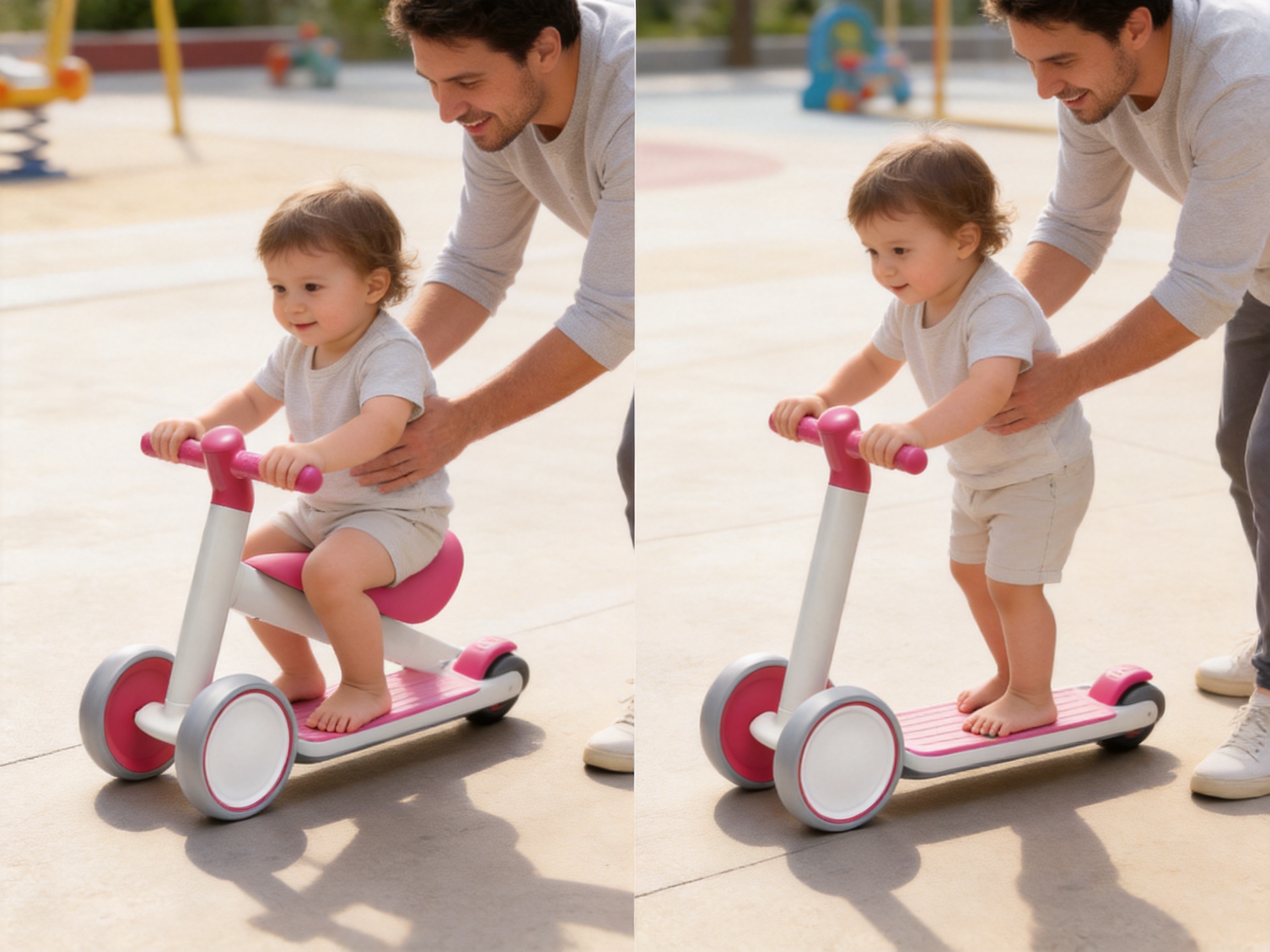
The product’s design is supported by the manufacturing capabilities of Ningbo Feile Sporting Goods Co., Ltd. Established in 2010, the company specializes in children’s scooters, inline skates, roller skates, and ice skates. This category experience is relevant because these products require knowledge of molded plastics, wheel assemblies, structural stability, user comfort, visual design, and safety-oriented production control.
The company operates a workshop of approximately 20,000 square meters and employs more than 200 people. Its production system includes five advanced automatic production lines, as well as mold, injection molding, sewing, and assembly workshops. This combination allows multiple stages of development and production to be coordinated within one organization.
Mold Development and Injection Molding
For a molded scooter body, mold quality is essential. The mold determines the shape, dimensions, surface finish, and repeatability of the main structural components. An experienced mold workshop can support product development by helping engineers evaluate wall thickness, parting lines, draft angles, fastening areas, and material flow. These details influence both appearance and production stability.
Injection molding is particularly suitable for producing consistent plastic components at commercial volume. Once the mold and process parameters have been validated, repeated cycles can create parts with closely controlled dimensions. Consistency is important for a product such as the FL-630 because the seat, chassis, wheel area, and connecting elements must work together as intended.
Automatic production lines can improve throughput and process repeatability. Automation may assist with material handling, molding cycles, inspection points, or assembly operations, depending on the specific line configuration. The company’s ability to combine automatic lines with dedicated workshops provides a foundation for meeting regular export orders and managing product variations.
Integrated Assembly Capabilities
A scooter is not defined by a plastic shell alone. The final product depends on the correct integration of the body, seat, wheels, axles, fasteners, and other components. An internal assembly workshop allows the manufacturer to coordinate these stages and evaluate the complete product rather than treating each component as an isolated item.
Integrated assembly can also improve communication between production and engineering teams. If an assembly worker identifies an issue with fit, movement, or ease of installation, the information can be passed to technical staff for review. This feedback loop supports continuous improvement and can reduce delays caused by communication between unrelated suppliers.
Professional Research and Development
The company maintains a professional research and development engineering team and launches new products regularly. This is important in a market where children’s products must balance safety, comfort, function, visual appeal, and cost. Product development is not limited to creating a new shape; it also includes selecting materials, refining proportions, simplifying use, improving assembly, and preparing the product for different market requirements.
For the FL-630, research and development considerations include the relationship between the removable seat and the chassis, the child’s position relative to the ground, the overall dimensions, the ease of handling, and the stability of the one-piece structure. A well-coordinated engineering process helps convert these requirements into a product that can be manufactured consistently rather than remaining only as a concept.
Quality Management and International Market Readiness
International buyers often require more than an attractive product. They need confidence in production consistency, supplier organization, documentation, and the manufacturer’s ability to support repeat orders. Ningbo Feile Sporting Goods Co., Ltd. reports that it has passed ISO9001, BSCI, and Kmart factory certification systems. These systems address different aspects of quality management, social compliance, and factory evaluation.
The company also reports certifications and testing references including 3C, CE, EN71, EN62115, ASTM, EMC, and EN13843:2009 across its product portfolio or applicable product categories. The exact certification requirements for a specific model, destination market, age range, material, and sales channel should always be confirmed before commercial distribution. Importers should request current technical files, test reports, declarations, labeling information, and packaging requirements relevant to the final product.
Quality management is most effective when it operates throughout the production process. Incoming materials may require verification, molded parts may require dimensional inspection, and assembled products may need functional checks. Visual inspection can identify surface defects, assembly problems, or inconsistent finishes. Functional evaluation can confirm that the seat is properly fitted, the wheels move as intended, and the product remains stable during appropriate use.
A mature quality system should also include traceability and corrective action. If a recurring issue is identified, the manufacturer should be able to investigate its source, determine whether other units are affected, and implement a corrective measure. For international customers, this ability is valuable because it supports long-term supply relationships rather than one-time transactions.
Materials, Comfort, and User-Oriented Design
Parents generally evaluate toddler products from several perspectives at once. They want a product that looks appealing, but they also want it to be comfortable, easy to clean, simple to store, and appropriate for daily use. The FL-630’s compact molded body supports a clean, uncomplicated appearance that can be adapted to different color and market preferences, subject to available customization options.
The stable seat is central to the seated configuration. It should provide a comfortable place for the child to sit while leaving sufficient room for the feet to contact the ground. The relationship between seat height, wheel placement, and chassis width affects how naturally the child can push and stabilize the body. These details demonstrate why early-childhood product design requires more than simply adding a seat to a standing scooter.
Lightweight construction contributes to comfort and handling, but it must be balanced with structural strength. The frame needs to remain sufficiently robust for ordinary toddler use while avoiding unnecessary bulk. This balance is achieved through design, material selection, molding expertise, and production control. A product that is too light may feel unstable, while one that is too heavy may be difficult for both child and parent to manage.
Surface finish and component edges also deserve attention. Children interact with products closely and frequently, so exposed edges, transitions, and contact areas should be designed with care. Retail customers may not see the engineering decisions behind these features, but they notice whether a product feels smooth, secure, and thoughtfully made.
Indoor and Outdoor Use
The FL-630 can support early walking practice at home, balance development, indoor leisure play, outdoor leisure play, and daily physical activity. Indoor use may be suitable on clean, level floors with sufficient open space. Outdoor use may be suitable on smooth, flat, obstacle-free surfaces, such as an appropriate patio or protected play area.
Surface selection is important. Loose gravel, wet floors, steep slopes, rough pavement, and crowded public areas can make control more difficult. Parents should remove obstacles and maintain a clear path. The product should not be used near roads, driveways with moving vehicles, stairs, balconies, swimming pools, or other hazards. Protective equipment may be considered according to the child’s activity and local safety guidance.
Outdoor play can add variety to the child’s routine, while indoor play can make short practice sessions convenient. The scooter’s compact size makes it suitable for families who do not have access to a large yard. This versatility broadens its appeal to urban households, childcare settings, and gift buyers looking for an active toy that does not require a large installation area.
After outdoor use, parents should check the wheels and chassis for dirt, stones, moisture, or other debris. Cleaning and drying the product according to the manufacturer’s instructions can help maintain appearance and function. Periodic inspection of fasteners, seat attachment points, and moving components is also advisable.
Commercial Value for Distributors and Retailers
For distributors, the FL-630 offers a product story that is easy to communicate: one compact scooter, two configurations, and a gradual path from seated gliding to standing balance practice. This message can be used in catalog descriptions, product packaging, retail displays, online listings, and sales presentations.
The product fits several commercial categories at the same time. It can be listed under children’s scooters, toddler ride-on toys, balance-development toys, active-play products, early-learning gifts, or entry-level sports equipment. This category flexibility can help retailers present it to parents, relatives, educational buyers, and gift purchasers.
The product may also complement a broader sports-equipment range. A supplier that offers children’s scooters, inline skates, roller skates, ice skates, and protective gear can help buyers develop a coordinated assortment. Retailers may introduce the FL-630 for younger children and later offer more advanced scooters, skates, helmets, or protective products as children grow. This creates opportunities for a staged product pathway rather than a single isolated sale.
For original equipment manufacturing and private-label customers, the manufacturer’s internal facilities may support more efficient communication from concept to production. Buyers should discuss color options, logo placement, packaging, instruction manuals, carton design, minimum order quantities, sampling procedures, lead times, and destination-market compliance during the quotation process. Customization depends on tooling, order volume, material availability, and technical approval.
Product content should remain accurate. Claims should focus on the two-in-one design, compact handling, child-powered operation, low-center-of-gravity construction, and intended developmental play. Retail materials should not promise that the product prevents falls, guarantees developmental outcomes, or replaces adult supervision. Responsible marketing strengthens consumer trust and supports sustainable brand growth for the buyer.
Recommended Product Presentation
A strong product presentation should explain how the scooter works before discussing secondary features. The first message can introduce the removable seat and the two available modes. The second can explain that the child pushes with the feet and does not need pedals, batteries, or charging. The third can describe the compact frame, low center of gravity, and stable chassis. The fourth can explain how the product supports balance, coordination, leg strength, and active play.
Images and demonstrations should show both configurations clearly. A parent should be able to understand how the seat is removed, how the child sits, where the feet are placed, and how standing practice differs from seated gliding. Instructional materials should use simple language and clear safety guidance.
Packaging can emphasize portability and everyday convenience. The approximate product dimensions of 505 by 230 by 275 millimeters may be useful for storage planning, but buyers should verify final production and packaging measurements before printing. Product weight, carton dimensions, materials, age guidance, and testing information should also be confirmed through the official technical documentation.
Safety-Oriented Use and Parental Supervision
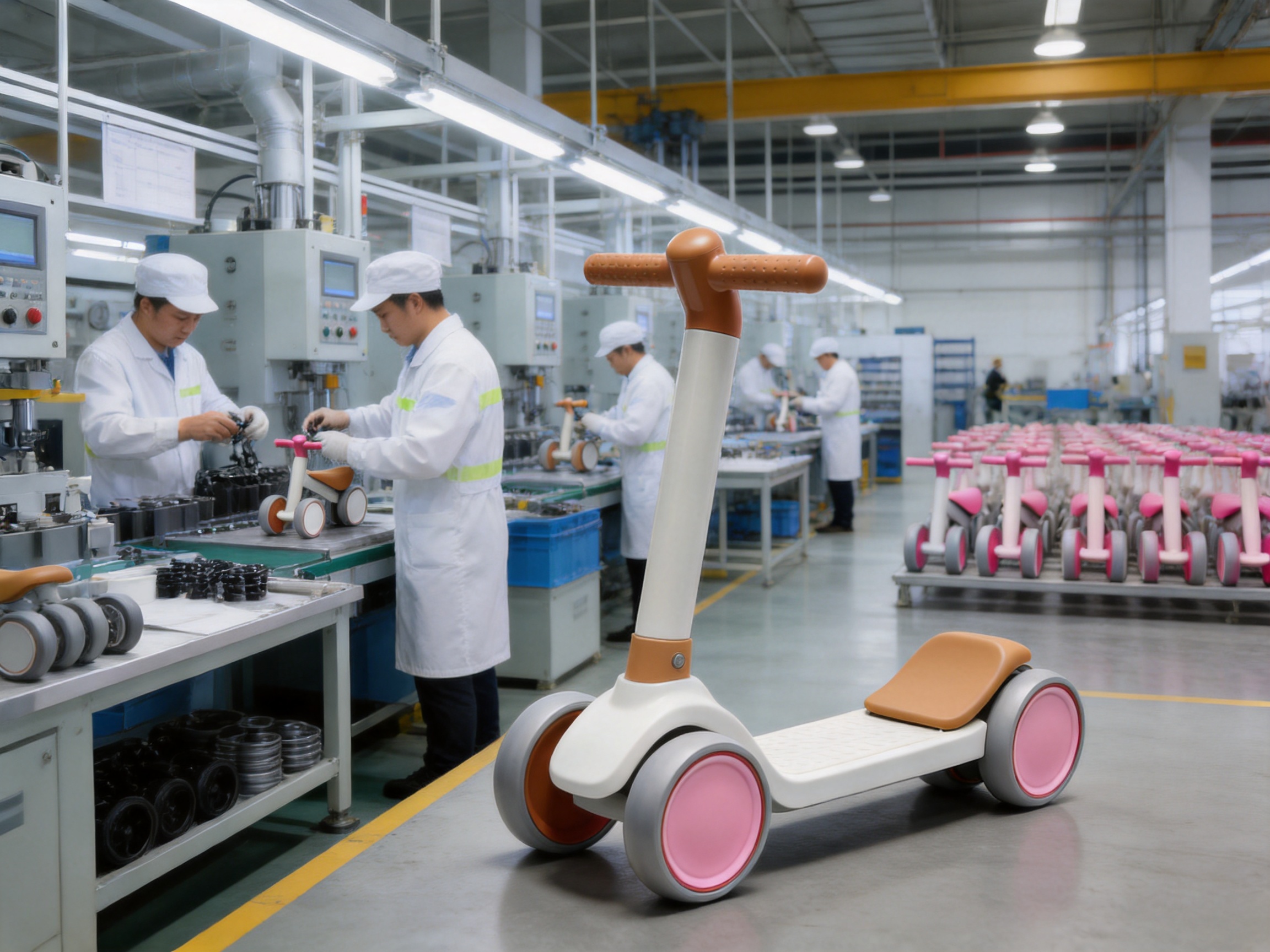
The FL-630 is intended to support supervised early mobility play. Parents or caregivers should remain nearby, especially when the child is using the product for the first time or transitioning from seated to standing mode. The child should be physically able to sit securely, place the feet on the ground, and respond to simple instructions appropriate to the intended use.
Before each session, an adult should check that the scooter is correctly assembled and that the removable seat is securely fitted when seated mode is being used. The chassis, wheels, axles, and fastening points should be free from visible damage. If any component is loose, cracked, deformed, or malfunctioning, the product should not be used until it has been inspected and properly repaired or replaced.
Children should wear clothing that allows free movement and footwear that provides suitable contact with the floor. Loose straps, scarves, or other items that could catch on wheels or surrounding objects should be avoided. The scooter should be used away from traffic, stairs, steep inclines, pools, and other hazards. It should never be used as a high-speed device or for jumps, tricks, or rough play.
Parents should introduce the product gradually. A short session in seated mode can help the child learn how to push and stop. Once the child demonstrates greater confidence, the standing configuration may be introduced in a controlled area. Progress should be based on the child’s ability and comfort, not on a fixed schedule. The product is most beneficial when active play remains enjoyable and pressure-free.
Frequently Asked Questions
What is the FL-630 Child Seat Children Scooter?
The FL-630 is a two-in-one toddler mobility product with a removable seat. In its seated configuration, a child can sit and glide by pushing against the ground with the feet. After the seat is removed, the product can be used for basic standing balance and gliding practice.
Is the product powered by batteries?
No. The scooter is child-powered and does not require batteries, pedals, motors, or charging. The child creates movement by pushing against the floor with the feet.
What is the main advantage of the removable seat?
The removable seat allows the product to support more than one stage of early mobility. A child can begin with seated gliding for greater support and later progress to standing balance practice without immediately needing a different product.
Is it suitable for children who are learning to walk?
The product is designed for toddlers learning to walk and practicing basic gliding, but suitability depends on the individual child’s physical ability and development. Parents should follow the manufacturer’s age and safety guidance, supervise use closely, and select a configuration that the child can control comfortably.
Can the scooter be used indoors?
Yes, it can be used indoors on a clean, level, unobstructed surface with adequate space. Parents should protect floors as appropriate and keep the child away from stairs, furniture corners, doors, and other hazards.
Can it be used outdoors?
It may be used outdoors on suitable smooth and level surfaces away from traffic, steep slopes, wet areas, loose gravel, and obstacles. Outdoor use requires close adult supervision and regular inspection after play.
What are the approximate product dimensions?
The listed dimensions are approximately 505 by 230 by 275 millimeters. Buyers should confirm final measurements and packaging dimensions with the manufacturer before placing an order or preparing retail materials.
What developmental skills can riding practice support?
Age-appropriate riding practice can encourage balance, leg strength, coordination, weight shifting, body awareness, and confidence in independent movement. The product is a play and mobility aid, not a guarantee of a particular developmental result.
How stable is the product?
The FL-630 uses a one-piece molded structure, a low center of gravity, and a stable chassis intended to support controlled toddler riding. No wheeled toy can eliminate every risk, so the product must be used on appropriate surfaces with adult supervision.
How does it compare with a battery-powered ride-on toy?
The FL-630 does not require charging or electronic controls, and the child creates the movement through physical effort. This encourages active participation and may make the product lighter, simpler, and easier to store than many powered alternatives.
How does it compare with a conventional standing scooter?
A conventional standing scooter generally requires the child to begin with standing balance. The FL-630 provides a seated starting mode, which can make it more approachable for toddlers who are not yet ready to balance while standing. It can later support standing practice after the seat is removed.
What manufacturing capabilities support this product?
The manufacturer operates mold, injection molding, sewing, and assembly workshops, along with five automatic production lines and a professional research and development engineering team. These resources support product development, molded-component production, assembly coordination, and repeat manufacturing.
Does the manufacturer support OEM or private-label business?
The company is described as a China OEM skating and scooter equipment manufacturer and sports equipment factory. Buyers should discuss available customization, colors, packaging, logos, technical requirements, order quantities, and delivery schedules directly with the manufacturer.
What certifications are associated with the manufacturer’s product portfolio?
The company reports certifications and testing references including ISO9001, BSCI, Kmart factory certification systems, 3C, CE, EN71, EN62115, ASTM, EMC, and EN13843:2009. The specific documents applicable to the FL-630 and the destination market should be confirmed before import or sale.
How should the product be maintained?
Parents should keep the scooter clean and dry, inspect the wheels and chassis after use, and check the seat attachment and fasteners regularly. Any damaged or loose component should be addressed before the child uses the product again.
Conclusion
The FL-630 Child Seat Children Scooter is designed to make early mobility more accessible, progressive, and practical. Its central advantage is the combination of seated and standing use in one compact product. Toddlers can begin by sitting, pushing with their feet, and learning how movement responds to their actions. As confidence and balance improve, the removable seat allows a transition toward standing practice.
The product’s low center of gravity, stable chassis, one-piece molded structure, compact dimensions, and lightweight handling contribute to its suitability for supervised toddler play. Its child-powered operation avoids batteries, charging, pedals, and complicated controls. These features distinguish it from many single-purpose ride-ons, advanced standing scooters, and motorized alternatives.
Behind the product is a manufacturer with experience in children’s scooters and skating equipment, supported by automatic production lines, mold and injection-molding workshops, assembly capabilities, research and development resources, and international quality systems. This manufacturing foundation can provide value for OEM buyers, distributors, retailers, and families seeking a reliable early-childhood mobility product.
Used correctly and under adult supervision, the FL-630 can become part of a child’s active-play routine at home or outdoors. It encourages movement without demanding advanced skills at the beginning, and it offers a gradual path from supported seated gliding to basic standing balance. That combination of developmental flexibility, simple operation, compact design, and manufacturing capability makes it a strong option within the toddler scooter and early mobility market.
References
1. Product information supplied for the FL-630 Child Seat Children Scooter, including design features, intended uses, dimensions, and product configurations.
2. Company information supplied for Ningbo Feile Sporting Goods Co., Ltd., including manufacturing facilities, production lines, workforce, research and development resources, and quality systems.
3. General principles of early-childhood gross-motor development, including balance, coordination, leg strength, body awareness, and progressive physical play.
4. General guidance for the supervised use of wheeled toys and toddler mobility products on safe, level, and unobstructed surfaces.
5. International product-safety and conformity-assessment concepts referenced in the supplied company materials, including ISO9001, BSCI, 3C, CE, EN71, EN62115, ASTM, EMC, and EN13843:2009.
Product: FL-630 Child Seat Children Scooter

Recommended Articles
-
BW-137 Boys Inline Skate05/09

Get in Touch
Your email address will not be published. Required fields are marked *
Have a project in mind? Contact with us!
We are happy to answer your questions. Please fill out this form
and one of our professional team will get back to you as soon as possible.

We specialize in producing various types of children's toy cars, children's skateboards, and ice skates.
