
 En
En
 Español
 русский
 عربى
عربى
FL-1200 Cartoon Children’s Scooter: Modular Play, Stable Riding, and Scalable OEM Manufacturing
Date:Aug 24, 2026
Content
- 1 Introduction
- 2 1. Product Overview and Design Concept
- 3 2. The Advantage of Modular Dual-Use Construction
- 4 3. Stability and Child-Friendly Riding Features
- 5 4. Adjustable Handle for Growth Adaptability
- 6 5. Lightweight Portability and Storage Convenience
- 7 6. Suitable Application Environments
- 8 7. Safety-Oriented Product Use
- 9 8. Manufacturing Strengths Behind the Product
- 10 9. Research, Development, and Product Improvement
- 11 10. Quality Management and International Market Readiness
- 12 11. OEM and Wholesale Cooperation Advantages
- 13 12. Competitive Positioning
- 14 13. Packaging, Merchandising, and Customer Communication
- 15 14. Care, Maintenance, and Product Life
- 16 15. Why Manufacturing Integration Matters to Buyers
- 17 16. Recommended Buying and Evaluation Process
- 18 17. Frequently Asked Questions
- 18.1 Q1: What makes the FL-1200 different from a conventional children’s scooter?
- 18.2 Q2: Can the cartoon car module and scooter body be separated?
- 18.3 Q3: Does the handle adjust to different heights?
- 18.4 Q4: Why is a low center of gravity useful for young riders?
- 18.5 Q5: Is the scooter suitable for indoor use?
- 18.6 Q6: Where can children use the product outdoors?
- 18.7 Q7: Does the product help children develop balance and coordination?
- 18.8 Q8: Is the FL-1200 easy to carry and store?
- 18.9 Q9: What protective equipment should a child wear?
- 18.10 Q10: Does the product come with a specific age or weight recommendation?
- 18.11 Q11: What manufacturing facilities support this product?
- 18.12 Q12: Can the product be customized for OEM orders?
- 18.13 Q13: What certifications are associated with the manufacturer’s products?
- 18.14 Q14: Can the FL-1200 be combined with protective gear in a product range?
- 18.15 Q15: How should the scooter be maintained?
- 19 Conclusion
- 20 References
- 21 Product: FL-1200 Cartoon Children Scooter
Introduction
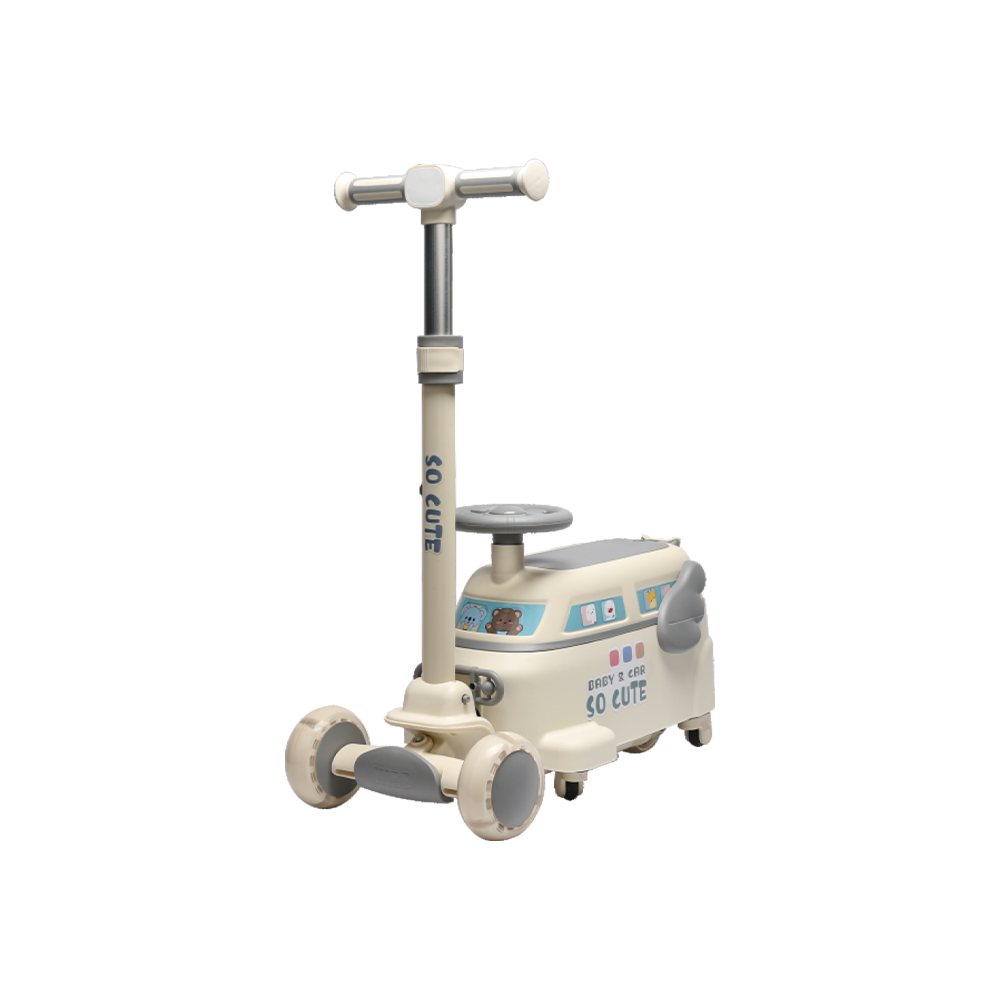
Children’s mobility products are no longer limited to a single function. Families increasingly look for toys and sports equipment that combine entertainment, physical activity, practical value, and age-appropriate safety. The FL-1200 Cartoon Children’s Scooter responds to this demand with a playful car-shaped design and a modular dual-use structure. Its cartoon car module and scooter body can be combined for riding or separated for independent play, creating a product that offers more than a conventional children’s scooter.
This flexible construction is one of the product’s most important advantages. A traditional scooter generally provides one primary activity: gliding. The FL-1200 expands that experience by allowing children to enjoy imaginative car play when the modules are separated and active riding when they are combined. Parents receive a product with multiple uses, while children gain opportunities to develop balance, coordination, steering control, and confidence through play.
The product is designed for preschool children and young riders who need a stable, approachable platform. A low center of gravity, two-wheel balance frame, widened anti-slip pedal, adjustable handle, and quiet wheels contribute to a comfortable riding experience. At the same time, its lightweight and separable construction makes transportation, storage, and assembly more convenient for families, retailers, and distributors.
Behind the product is a sporting goods manufacturer with experience in children’s scooters, inline skates, roller skates, and ice skates. Its manufacturing capabilities include mold development, injection molding, sewing, assembly, research and development, and quality management. This integrated production structure supports consistent product development and provides a practical foundation for OEM and wholesale cooperation.
This article examines the FL-1200 in detail, including its modular design, riding stability, ergonomic features, portability, applications, manufacturing advantages, quality systems, and suitability for international sourcing.
FL-1200 Cartoon Children Scooter
1. Product Overview and Design Concept
The FL-1200 is a cartoon car-shaped children’s scooter built around the idea of two products in one. The scooter body provides the riding platform, wheels, steering structure, handle, and footboard. The removable cartoon car module adds an imaginative play element and gives the scooter a distinctive visual identity. These parts can be used together or separated according to the child’s activity and the family’s needs.
When combined, the product becomes an engaging ride-on scooter that encourages children to move through outdoor spaces such as parks, playgrounds, community squares, and suitable paved areas. When separated, the cartoon car module can function as an independent toy for casual indoor or outdoor play, while the scooter body remains a separate mobility product. This modular approach helps the product serve different play modes without requiring families to purchase multiple large toys.
The design is particularly appropriate for children who respond strongly to visual themes and pretend play. A standard scooter may offer exercise and transportation, but a cartoon vehicle can also stimulate storytelling and role-play. Children can imagine driving a small car, visiting destinations, or taking part in make-believe adventures. These imaginative elements can increase the frequency with which a child chooses to interact with the product.
From a retail perspective, the product’s appearance also creates strong shelf and online presentation potential. The cartoon car form immediately communicates that the product is designed for children. Its distinctive shape can help it stand apart from basic scooters with minimal styling. For distributors, this can support product segmentation in the children’s outdoor toy and sports equipment categories.
Core product characteristics
The main characteristics of the FL-1200 include:
• A modular structure that combines a cartoon car module with a scooter body.
• Two ways to play: combined riding and separated toy play.
• A height-adjustable anti-slip handle designed to accommodate children as they grow.
• A low-profile frame and low center of gravity intended to support balance.
• A two-wheel balance structure for stable movement.
• A widened anti-slip pedal that gives the child a more secure standing area.
• Quiet wheels for smoother and more comfortable operation.
• A lightweight structure that is easier to assemble, separate, transport, and store.
• A stated overall size of approximately 565 × 320 × 870, subject to final technical confirmation and measurement conventions.
The combination of these features positions the FL-1200 between a conventional scooter and a multifunctional children’s ride-on toy. It is not only a mobility product, and it is not only a decorative toy. Its design is intended to connect physical activity with imaginative play.
2. The Advantage of Modular Dual-Use Construction
The modular structure is the defining advantage of the FL-1200. In many children’s product categories, a toy has a short period of appeal because it supports only one activity. A child may enjoy it intensely for several weeks or months and then move on to another product. The FL-1200 addresses this challenge by providing more than one play mode.
Combined mode for active riding
In its combined configuration, the cartoon car module and scooter body work together as a playful riding product. The car-shaped styling gives the child a sense of identity and ownership, while the scooter platform provides the physical activity. This configuration is suitable for gliding in appropriate outdoor areas and for supervised riding in spacious indoor environments.
The combined mode encourages children to practice body control. Depending on how the product is operated, children can learn to shift weight, maintain posture, guide the handle, control speed, and coordinate their movements with the direction of travel. These basic abilities are useful foundations for later participation in other wheeled sports.
Separated mode for independent play
When the modules are separated, the product can provide a different kind of experience. The cartoon car module becomes a toy for imaginative play, while the scooter component can be stored or used separately according to the product configuration and instructions. This separation allows the child to enjoy a quieter play session without riding.
For parents, this dual-use structure can improve the value of the purchase. A single product can support outdoor movement, pretend play, and casual indoor entertainment. This is especially useful for families living in apartments or homes where storage space is limited. Rather than storing a separate ride-on toy and a separate scooter, families may be able to organize one modular product more efficiently.
Benefits for retailers and distributors
Modular functionality also provides commercial benefits. Retailers can present the FL-1200 as a product with multiple selling points rather than as a basic scooter. Product descriptions can highlight play value, exercise, growth adaptability, portability, and storage convenience. This allows the item to appeal to several purchasing motivations within the same family audience.
For distributors, the product can be placed in more than one category, including children’s scooters, outdoor toys, ride-on toys, and beginner sports equipment. Its category flexibility can support different sales channels, including sporting goods stores, toy retailers, department stores, online marketplaces, and specialty children’s product stores.
The dual-use design may also support seasonal marketing. During warm seasons, the product can be promoted as an outdoor gliding and coordination product. During colder or rainy periods, the separated cartoon car module can remain relevant for indoor play, provided that the available space is suitable and the product is used according to safety instructions.
3. Stability and Child-Friendly Riding Features
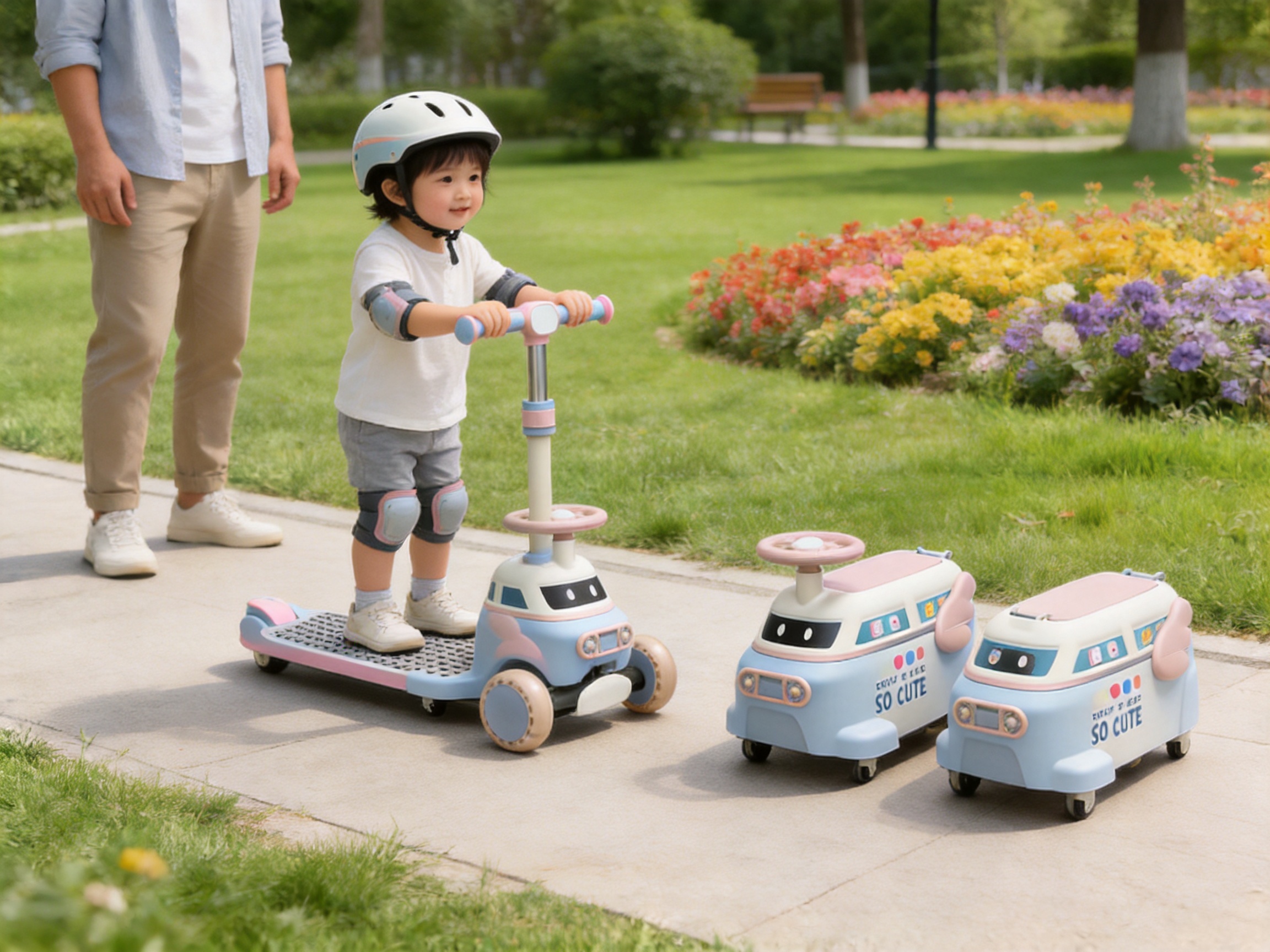
Stability is essential in the design of a beginner-oriented children’s scooter. Young riders are still developing their balance, spatial awareness, and ability to control direction. A product that feels unstable may reduce confidence and discourage continued use. The FL-1200 incorporates several structural elements intended to make the riding experience more approachable.
Low-profile structure
The low-profile design helps keep the product close to the ground. A low riding platform can make it easier for a child to step onto the scooter and maintain a comfortable posture. It can also help reduce the height of the child’s center of mass relative to the frame, which may support a more stable feeling during slow-speed riding.
The low center of gravity is particularly valuable for preschool users. Beginners often make small and unpredictable movements while learning to steer or adjust their body position. A lower structure can help the product remain composed during these early learning stages, although adult supervision and appropriate riding conditions remain essential.
Two-wheel balance frame
The two-wheel balance frame is designed to provide a stable base for riding. A balanced wheel arrangement can help distribute load and support predictable movement on suitable flat surfaces. For children, predictable movement is important because it allows them to learn gradually rather than having to compensate for an overly responsive or unstable platform.
This design can be especially useful for short-distance recreational gliding. Children may use the scooter in a park, playground, or community square where they can practice at a controlled pace. Parents can introduce the product at low speed, help the child understand the steering action, and gradually allow more independent movement as confidence improves.
Widened anti-slip pedal
The footboard is another important contact point between the child and the product. A widened anti-slip pedal provides more room for foot placement and can reduce the feeling that the child must stand on a narrow surface. The anti-slip texture is intended to help the foot remain securely positioned during normal use.
A larger standing area can also support better posture. Children can place their feet more naturally, bend their knees slightly, and maintain balance without concentrating excessively on foot placement. This contributes to a more relaxed riding experience and can make the scooter more accessible to beginners.
Quiet wheels
Quiet wheels are beneficial in both outdoor and indoor environments. Reduced rolling noise can make the experience more pleasant for the child and less disruptive for parents, teachers, or other people nearby. In suitable spacious indoor areas, quiet wheels may allow limited recreational use without the loud sound associated with some hard-wheel toys.
Wheel performance depends on surface conditions, rider weight, maintenance, and operating environment. The product should be used on smooth, clean, and appropriate surfaces. Uneven pavement, loose gravel, wet ground, steep slopes, and crowded areas can increase risk and may reduce the effectiveness of the stability features.
4. Adjustable Handle for Growth Adaptability
Children grow quickly, and fixed-height equipment can become uncomfortable or unsuitable in a relatively short period. The FL-1200 addresses this issue with an anti-slip handle that supports multiple height adjustments. The adjustable structure is intended to accommodate changing child heights and different riding postures.
A properly positioned handle can help the rider maintain a natural upper-body posture. If the handle is too low, the child may need to bend excessively. If it is too high, steering may become awkward and less controlled. Multiple adjustment levels give parents more flexibility when setting up the product for the child’s current size.
Growth adaptability can improve the product’s practical service life. Instead of immediately replacing the scooter as the child becomes taller, the family can adjust the handle to suit the new height within the product’s intended range. This supports better value for money and reduces the pressure to purchase replacement equipment frequently.
The adjustable handle also helps the product serve children in different age groups and stages of development. A younger child may benefit from a lower setting that encourages controlled movement, while a taller or more experienced child may prefer a higher position. The exact adjustment range, recommended age, and load capacity should be confirmed in the final product specification and user manual.
Because the handle is an important control point, it should be checked regularly. Parents should confirm that the adjustment mechanism is fully locked before each use. Any looseness, unusual movement, damage, or wear should be addressed before the child rides the scooter.
5. Lightweight Portability and Storage Convenience
Children’s products are often moved between rooms, vehicles, parks, playgrounds, and storage areas. A scooter that is difficult to carry may be left unused even if the child enjoys it. The FL-1200 is designed to be lightweight and not bulky, making it easier for adults to transport and organize.
The modular construction contributes to portability because the car module and scooter body can be separated. Parents can carry the components individually when needed, place them more easily in a vehicle, or store them in smaller spaces at home. This is a practical advantage over larger fixed-form ride-on toys that may be difficult to lift or fit into a car trunk.
Assembly and disassembly are also important for international distribution. Products that can be packed efficiently may offer advantages in container utilization, warehouse organization, and last-mile handling. Final packaging performance depends on carton design, protective materials, packing method, and order quantity, but a separable structure gives manufacturers more options during packaging development.
For families, convenient storage can help maintain a safer home environment. The product can be placed in a designated storage area instead of being left in a hallway or at the bottom of a staircase. Keeping the scooter organized also makes it easier to inspect and maintain before the next use.
Portability is valuable for schools, childcare facilities, activity centers, and rental operators as well. Staff may need to move several units between storage rooms and play areas. A lightweight design can reduce handling effort and support more flexible activity planning.
6. Suitable Application Environments
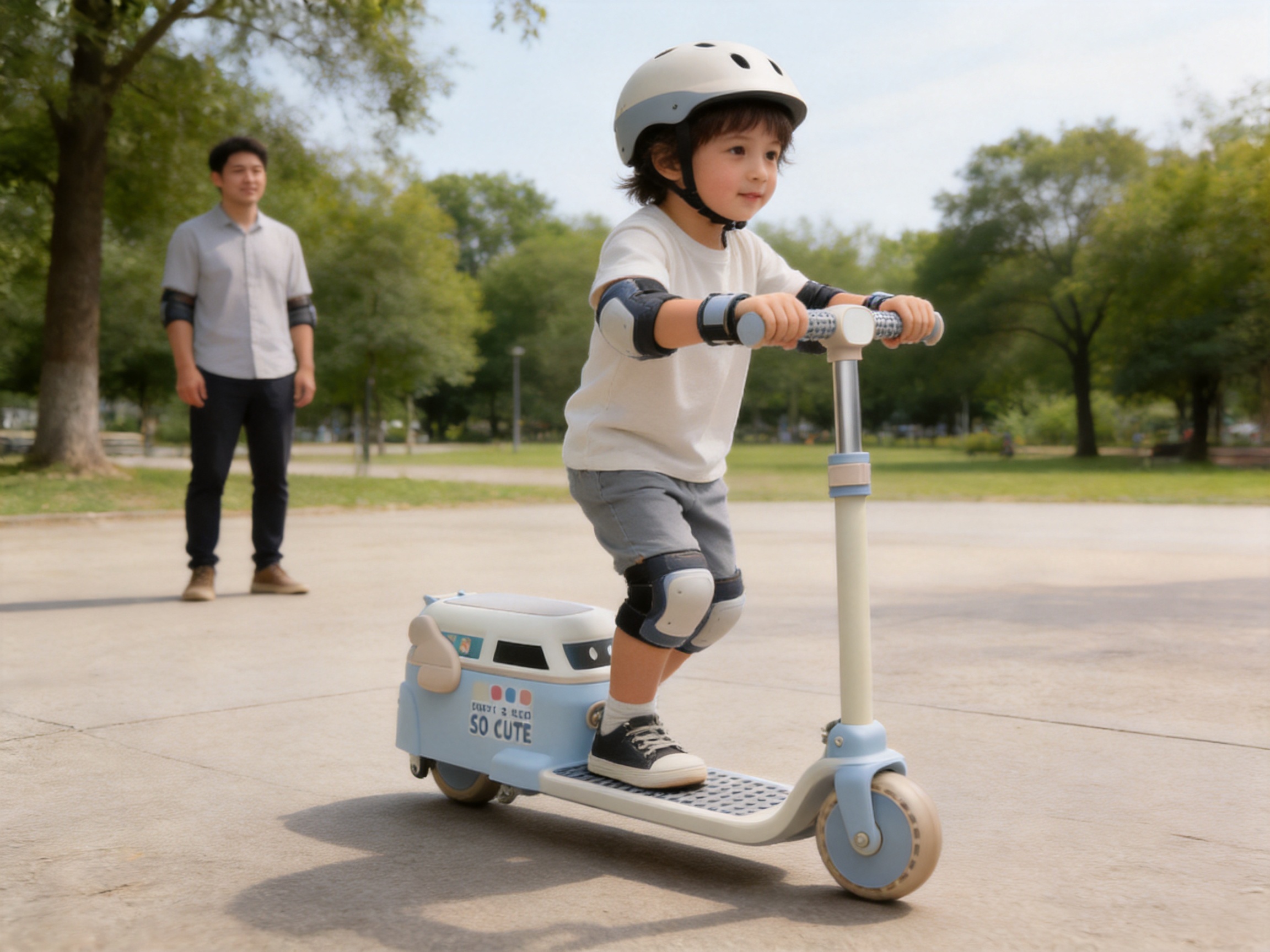
The FL-1200 is intended for a variety of recreational and developmental settings. Its primary outdoor applications include community squares, parks, playgrounds, and other suitable paved areas. These locations give children room to practice movement, steering, and balance while remaining under adult supervision.
Community squares and parks
Community squares and parks can provide open areas for beginning riders. Parents can select a quiet section with a smooth surface and sufficient clearance from pedestrians, bicycles, roads, stairs, and other obstacles. The child can start with short, slow gliding sessions and gradually increase activity as confidence improves.
Playgrounds
In playground environments, the scooter can complement other physical activities. Children may alternate between riding, climbing, running, and imaginative play. The cartoon car styling makes the product visually compatible with play-oriented environments, while the scooter function adds a structured balance activity.
Short preschool commutes
The FL-1200 may serve as a convenient alternative to walking for short daily journeys involving preschool children, but it should not be treated as a replacement for adult supervision or suitable transport planning. The route should be carefully assessed for surface quality, traffic, slopes, intersections, crowds, and other potential hazards. For many families, the product is more appropriate for recreational movement than for road travel.
Indoor leisure use
In spacious indoor areas, the product may support casual recreational play. Indoor use should take place only where the floor is suitable, the area is free of fragile objects, and sufficient space is available for turning and stopping. Hard furniture corners, glass surfaces, stairs, slippery floors, and crowded rooms should be avoided.
Developmental value
Regular age-appropriate riding can help children practice balance and coordination. Steering encourages hand-eye coordination, while standing and gliding require the child to coordinate posture, foot placement, and movement. The car module adds imaginative play, which can support communication and creative thinking when children play with parents, siblings, or peers.
These benefits should be understood as developmental opportunities rather than guaranteed outcomes. Children progress at different rates, and the product should always be selected and used according to the child’s physical ability, maturity, and confidence.
7. Safety-Oriented Product Use
The FL-1200 includes several design features intended to support stable and comfortable use, but no scooter can eliminate all riding risks. Safe operation depends on the product, the environment, the child’s behavior, and adult supervision.
Children should wear suitable protective equipment, including a properly fitted helmet and appropriate protective pads for the knees, elbows, and wrists. Closed-toe shoes with secure soles are preferable. Loose clothing, untied shoelaces, scarves, and accessories that could catch in moving parts should be avoided.
Parents or caregivers should inspect the scooter before every use. The handle adjustment should be locked securely, the modules should be properly connected when used in combined mode, and the wheels should rotate normally. The footboard should be clean and free of oil, water, or other substances that could reduce traction.
Riding should begin on a flat, dry, smooth surface away from vehicles and water. Children should not ride near stairs, steep slopes, busy roads, swimming pools, open drains, or areas with heavy pedestrian traffic. Jumping, performing tricks, racing, or carrying another child should not be permitted unless a specific model is designed and rated for such activities.
The product should be used within the manufacturer’s recommended age, height, and weight limits. These limits should be stated clearly in the final packaging and user documentation. Retailers and distributors should ensure that translated safety information is accurate and easy for customers to understand.
8. Manufacturing Strengths Behind the Product
A successful children’s scooter depends not only on its appearance but also on production consistency. Components must fit together correctly, the steering system must function smoothly, the wheels must be properly installed, and the finished product must meet applicable market requirements. The manufacturer behind the FL-1200 has developed an integrated production structure to support these needs.
The company was established in 2010 and specializes in children’s scooters, inline skates, roller skates, and ice skates. This focused product experience provides a relevant foundation for the development of children’s wheeled sports equipment. Knowledge gained from multiple skating categories can contribute to material selection, wheel design, structural engineering, comfort, and safety evaluation.
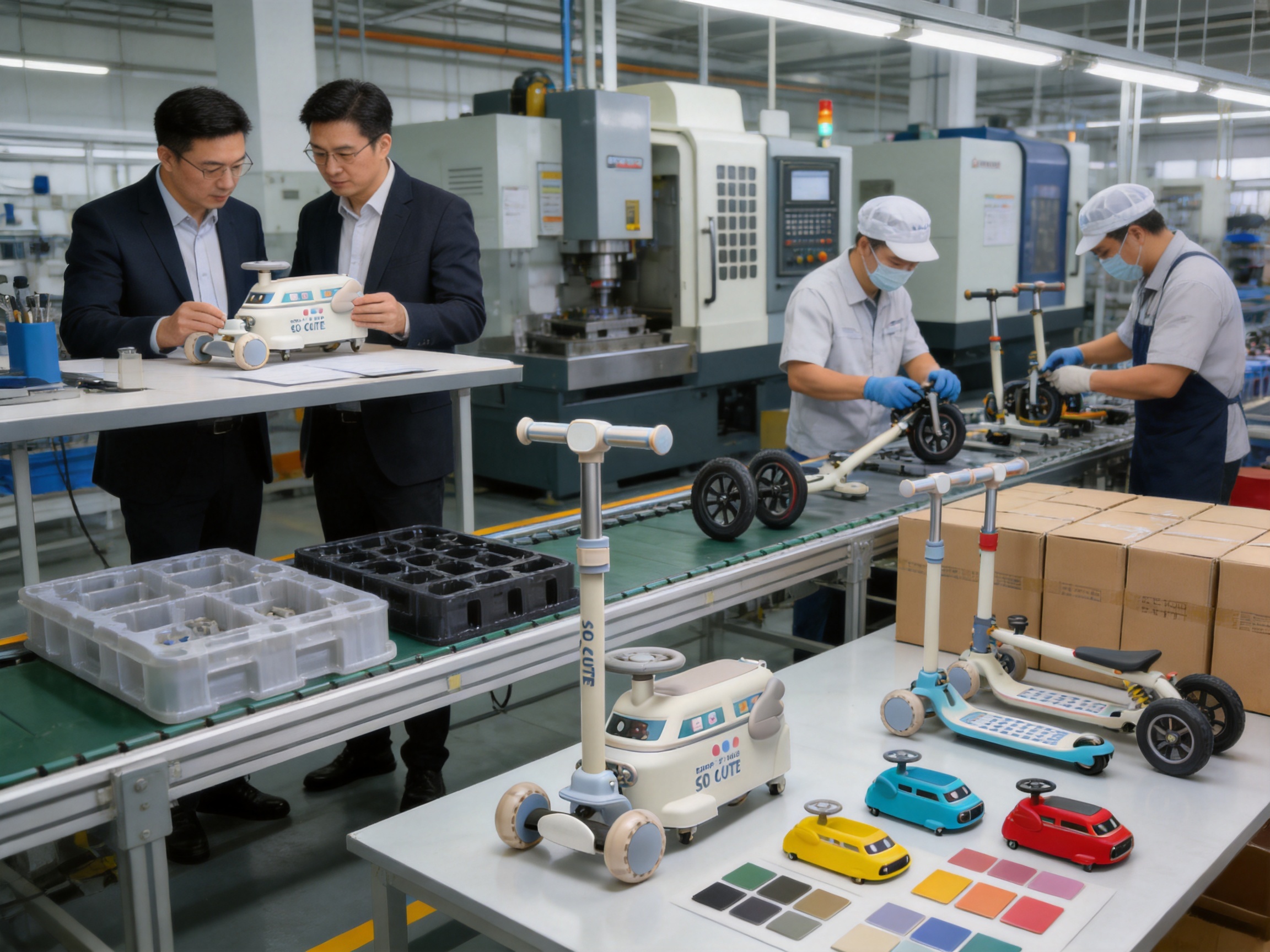
The company operates a workshop of approximately 20,000 square meters and employs more than 200 people. It has five advanced automatic production lines and a professional research and development engineering team. These resources support the transition from concept development to tooling, component manufacturing, assembly, inspection, and finished-product preparation.
Integrated mold capabilities
In-house mold capabilities can improve control over product development. For a cartoon-shaped product such as the FL-1200, molds are central to the appearance, dimensional accuracy, connection points, and surface quality of plastic components. Having mold expertise within the production system can help the manufacturer refine details and respond to engineering changes more efficiently.
Mold development also affects repeatability. When the same tooling is used under controlled conditions, production batches can maintain more consistent dimensions and fit. This is important for modular products because the car module and scooter body must connect reliably while still being manageable for assembly and separation.
Injection molding workshop
Injection molding is used to produce many structural and visual plastic components. The process involves melting suitable plastic material and injecting it into a prepared mold under controlled conditions. Cooling and ejection then produce the finished component. Process control can influence strength, surface appearance, dimensional stability, and defect rates.
For children’s products, injection molding quality is especially important around edges, handles, footboards, wheel housings, and connection areas. The manufacturer’s injection molding workshop provides a dedicated environment for producing these components and managing production consistency.
Sewing and assembly workshops
The company also maintains sewing and assembly workshops. Sewing capabilities are valuable for sports products that include soft goods, protective accessories, straps, or packaging-related components. Assembly capabilities are essential for integrating wheels, handles, pedals, decorative modules, fasteners, and other parts into a finished scooter.
A structured assembly process can include work instructions, component verification, functional checks, visual inspection, and packaging inspection. For an OEM customer, this integrated approach may simplify communication because multiple production stages can be coordinated through one manufacturing partner.
9. Research, Development, and Product Improvement
Children’s sporting goods must evolve with changing consumer expectations. Buyers want attractive designs, improved usability, reasonable prices, safe materials, and products that remain relevant as children develop. The manufacturer maintains a professional R&D engineering team and launches new products each year to respond to market and customer needs.
The FL-1200 demonstrates how product development can combine several requirements in one design. The cartoon car appearance addresses visual appeal. The modular structure addresses multifunctionality. The adjustable handle addresses growth adaptability. The low-profile frame and widened anti-slip pedal address stability and comfort. Lightweight construction addresses portability and storage.
Product development for an item like this normally involves several stages. Designers first consider the target age group, usage scenarios, appearance, and basic functionality. Engineers then evaluate the mechanical structure, module connections, handle adjustment, wheel placement, footboard dimensions, and material selection. Prototype samples can be used to review assembly, appearance, ergonomics, and operation.
After prototype evaluation, the design may be refined before mold production and mass manufacturing. Engineering changes at this stage can improve fit, reduce unnecessary material, simplify assembly, and strengthen areas exposed to repeated use. A manufacturer with internal mold, injection molding, and assembly capabilities can coordinate these improvements more directly than a company that relies entirely on unrelated subcontractors.
For OEM customers, R&D support can be valuable when developing market-specific versions. Potential areas of customization may include color combinations, printed graphics, packaging language, warning labels, instruction manuals, accessory bundles, and branding elements. Any proposed customization should be reviewed for tooling requirements, minimum order quantity, testing needs, and production lead time.
10. Quality Management and International Market Readiness
International buyers need confidence that a product can be manufactured consistently and supported with appropriate documentation. The company has passed ISO9001, BSCI, and Kmart factory certification systems. These certifications and assessments indicate attention to quality management, social compliance, and factory evaluation, although buyers should always confirm current certificates, scope, validity, and applicable product coverage during the procurement process.
The company’s products have received certifications or compliance recognition including 3C, CE, EN71, EN62115, ASTM, EMC, and EN13843:2009. The exact standard or certification applicable to a particular FL-1200 configuration depends on the destination market, product classification, design, materials, electrical content if any, and customer requirements. Importers should work with the manufacturer and qualified testing organizations to confirm the correct testing plan.
Quality management is especially important for a children’s product because buyers expect attention to mechanical safety, material safety, labeling, packaging, and usability. A suitable quality process may include incoming material inspection, first-piece approval, in-process checks, assembly verification, finished-product inspection, and pre-shipment review.
For a modular scooter, additional attention should be given to connection strength, separation instructions, handle locking, wheel installation, pedal surface quality, sharp edges, decorative component security, and packaging protection. Repeated assembly and disassembly may also need evaluation to ensure that the structure remains functional over the intended product life.
International customers may request factory audits, inspection reports, test reports, material declarations, packaging specifications, product drawings, and quality-control records. A professional manufacturer should be prepared to discuss the documentation required for the customer’s market and sales channel.
11. OEM and Wholesale Cooperation Advantages
The FL-1200 can be considered by importers, wholesalers, retailers, online sellers, sporting goods distributors, and children’s product brands seeking a distinctive scooter platform. The manufacturer provides one-stop sourcing across skates, scooters, and protective gear, allowing customers to develop a broader children’s sports equipment range through one supplier.
A single-source strategy can reduce communication complexity. Instead of coordinating separate factories for scooters, inline skates, roller skates, ice skates, and protective products, a buyer can discuss product planning, quality expectations, packaging, and shipping schedules with one experienced partner.
The company’s factory resources may also support coordinated seasonal programs. For example, a distributor could combine children’s scooters with helmets, knee pads, elbow pads, inline skates, and roller skates in a broader outdoor activity collection. Product bundling decisions depend on the customer’s market strategy, but a supplier with multiple related categories can make assortment planning more efficient.
OEM cooperation should begin with a clear product brief. The buyer should identify the target market, age range, required standards, colors, logo placement, packaging format, language requirements, order quantity, delivery schedule, and expected retail price. The manufacturer can then evaluate tooling, testing, sampling, and production requirements.
Sample approval is a critical stage. Buyers should review the sample for appearance, module fit, steering feel, handle adjustment, wheel performance, footboard texture, packaging, instructions, and overall finish. Any changes should be documented before mass production to reduce misunderstandings.
For wholesale customers, the existing FL-1200 design may offer a faster route to market than a completely new product. A buyer can focus on color, packaging, and market positioning while using an established product concept. For customers requiring differentiation, the modular platform may provide a starting point for customized graphics, themed styling, or accessory combinations, subject to engineering and tooling review.
12. Competitive Positioning
The FL-1200 has several characteristics that can help it compete with basic children’s scooters and single-purpose ride-on toys. Its strongest distinction is multifunctionality. A conventional scooter may be easy to understand but offer limited play variation. A fixed ride-on toy may provide imaginative play but occupy more space and offer less active gliding practice. The FL-1200 attempts to combine both advantages in one modular product.
| Feature | FL-1200 Modular Scooter | Basic Children’s Scooter | Fixed Ride-On Toy |
|---|---|---|---|
| Primary play modes | Combined gliding and separated imaginative play | Primarily gliding | Primarily ride-on or pretend play |
| Visual appeal | Cartoon car-shaped design | Often simplified scooter styling | Usually themed vehicle styling |
| Growth adaptability | Multiple handle height levels | Depends on model | Often limited |
| Storage flexibility | Modules can be separated | Usually one fixed structure | Often bulky and fixed |
| Balance support | Low-profile frame, low center of gravity, two-wheel balance structure | Varies by wheel arrangement and frame | Usually stable but may offer less gliding practice |
| Developmental focus | Balance, coordination, movement, and imaginative play | Balance and movement | Imaginative play and basic movement |
This comparison does not mean that every competing product has the same limitations. The children’s scooter market includes many designs with different wheel arrangements, materials, age ranges, and performance levels. However, the FL-1200 offers a clear value proposition by combining modularity, playful styling, stability-oriented construction, and adjustability.
Its competitive appeal is also connected to cost efficiency. A product that provides two play modes may offer stronger perceived value than a single-function item at a similar price point. Its adjustable handle can potentially extend the usage period, while its separable design can reduce storage challenges. These benefits may be important to parents who evaluate products according to both immediate enjoyment and longer-term usefulness.
13. Packaging, Merchandising, and Customer Communication
Because the FL-1200 has several functions, product communication should explain the concept clearly. Retailers should show the product in both combined and separated configurations where possible. Customers need to understand how the modules connect, how they separate, and which activities are appropriate for each mode.
Packaging should include clear assembly instructions, adjustment guidance, safety warnings, recommended user information, care instructions, and applicable compliance markings. Visual diagrams can help parents understand the product more quickly than text alone. For international markets, all required information should be translated accurately and reviewed for local regulatory expectations.
Online product pages should emphasize the main benefits in a logical order. A strong presentation can begin with the two-in-one concept, followed by stability features, adjustable handle, lightweight portability, application environments, and manufacturer capabilities. High-quality product images should demonstrate the cartoon design, riding configuration, separated modules, handle adjustment, and footboard.
Retail staff can position the FL-1200 as a beginner-friendly children’s mobility product with additional toy value. Parents may appreciate the practical advantages, while children are likely to respond to the car-themed appearance. This combination creates a useful bridge between the emotional appeal of toys and the functional appeal of sports equipment.
For distributors, merchandising can include related protective products such as helmets, knee pads, elbow pads, and wrist guards. Offering a complete beginner riding package reinforces the importance of safe use and can increase the average value of a purchase. Any bundle should use compatible products with clearly stated sizing information.
14. Care, Maintenance, and Product Life
Regular maintenance helps preserve performance and appearance. The scooter should be wiped with a clean, slightly damp cloth after use in dusty environments. Moisture should be removed promptly, and the product should be stored indoors in a dry place. Exposure to prolonged rain, standing water, extreme heat, or direct sunlight may affect certain materials and finishes.
Wheels should be checked for abnormal wear, cracks, embedded debris, or uneven rotation. The handle and module connection areas should be examined for looseness. Fasteners should be checked according to the manufacturer’s instructions, but users should avoid making unauthorized structural modifications.
If the scooter develops unusual noise, unstable steering, a loose handle, damaged plastic, cracked components, or a malfunctioning connection mechanism, it should not be used until it has been inspected and repaired or replaced as appropriate. Replacement parts should be sourced from the manufacturer or an approved supplier whenever possible.
Proper care can improve the useful life of the product and preserve its resale, hand-me-down, or secondary-use potential. For retailers and rental operators, a documented inspection routine is recommended. Each unit can be checked before being placed on the sales floor, issued to a customer, or returned to service.
15. Why Manufacturing Integration Matters to Buyers
For importers and brands, manufacturing integration can influence more than production speed. It can affect communication, quality consistency, product iteration, cost control, and the ability to solve problems. A supplier that manages mold, injection molding, sewing, assembly, R&D, and quality systems within one organization may offer a more coordinated development process.
This is particularly relevant for a modular product. The product’s appearance, structural parts, connection points, handle mechanism, and packaging must work together. If these stages are disconnected, changes in one area may create problems in another. Integrated management makes it easier to evaluate the whole product instead of treating every component as an isolated item.
The manufacturer’s location in Yuyao, Ningbo, Zhejiang Province provides access to an established plastics and manufacturing region. The area is known for industrial supply networks and convenient transportation connections to Ningbo Airport and Shanghai. These geographic advantages can support material sourcing, supplier coordination, export logistics, and communication with international customers.
More than 30 college-educated management staff support the company’s organizational capabilities. Combined with the R&D engineering team and production workforce, this structure is intended to support both standard product manufacturing and customer-specific projects.
The company also participates in international exhibitions each year. Exhibition participation can help the manufacturer monitor market trends, gather customer feedback, present new products, and maintain contact with overseas buyers. For an international customer, this provides additional opportunities to review products and discuss sourcing requirements directly.
16. Recommended Buying and Evaluation Process
Potential buyers should begin by defining the target customer. The FL-1200 is most suitable for children who are ready for supervised riding and imaginative play, but the exact age and load limits must be confirmed through official product documentation. Market positioning should consider local consumer preferences, competitive pricing, packaging expectations, and applicable regulations.
The next step is technical review. Buyers should request detailed information about dimensions, net weight, gross weight, materials, wheel specifications, handle adjustment range, recommended user information, load capacity, packaging size, available colors, and module connection instructions.
Testing and compliance planning should be completed before mass production. The required standards may differ by destination market. Buyers should confirm whether the product requires mechanical testing, chemical testing, toy safety testing, electromagnetic testing, labeling review, or other evaluations. Existing certificates may not automatically cover every customized version.
Sample inspection should focus on both adult and child usability. Adults can evaluate assembly clarity, carrying convenience, storage, cleaning, and adjustment. A controlled user evaluation can provide feedback on steering, balance, pedal width, visual appeal, and the child’s ability to understand the product. Such evaluation should be conducted safely and should not replace formal testing.
Finally, buyers should approve packaging artwork, warning labels, manuals, colors, logos, and inspection standards in writing. A clear pre-production approval process helps ensure that the delivered goods match the agreed requirements.
17. Frequently Asked Questions
Q1: What makes the FL-1200 different from a conventional children’s scooter?
The main difference is its modular cartoon car-shaped structure. It can function as a playful combined scooter for gliding and can also be separated into components for independent toy play. It therefore offers more than the single primary function commonly associated with a basic scooter.
Q2: Can the cartoon car module and scooter body be separated?
Yes. The product is designed with a modular structure that allows the cartoon car module and scooter body to be combined or separated. Users should follow the official assembly and separation instructions and ensure that all components are secure before riding.
Q3: Does the handle adjust to different heights?
Yes. The anti-slip handle supports multiple height levels. This allows the product to adapt to children’s changing heights and helps accommodate different riding postures within the intended adjustment range.
Q4: Why is a low center of gravity useful for young riders?
A low center of gravity can help make the product feel more stable and easier to control at low speeds. It may also reduce the tendency to tip during ordinary riding movements. However, children still require supervision and should ride only on suitable surfaces.
Q5: Is the scooter suitable for indoor use?
It may be used indoors in spacious areas with smooth, dry, suitable flooring and sufficient clearance. Indoor riding should be avoided near stairs, fragile objects, slippery surfaces, furniture corners, and crowded areas.
Q6: Where can children use the product outdoors?
Suitable locations may include community squares, parks, playgrounds, and other smooth, safe outdoor areas. Children should avoid roads, steep slopes, wet surfaces, loose gravel, crowded walkways, and areas near traffic or hazards.
Q7: Does the product help children develop balance and coordination?
The riding activity gives children opportunities to practice balance, steering, posture, foot placement, and hand-eye coordination. The product can support physical development through age-appropriate play, although individual results vary from child to child.
Q8: Is the FL-1200 easy to carry and store?
The product is designed to be lightweight and not bulky. Its modular structure allows the components to be separated, which can make transport and storage more convenient. Final handling characteristics depend on the exact configuration and packaging.
Q9: What protective equipment should a child wear?
A properly fitted helmet is recommended, along with suitable knee, elbow, and wrist protection. Children should wear secure closed-toe shoes and avoid loose clothing or accessories that could interfere with movement.
Q10: Does the product come with a specific age or weight recommendation?
The exact age, height, and weight recommendations should be confirmed in the official product specification and instruction manual. Buyers should not rely only on the product’s appearance when determining suitability for a particular child.
Q11: What manufacturing facilities support this product?
The manufacturer operates mold, injection molding, sewing, and assembly workshops, as well as automatic production lines and an R&D engineering team. These capabilities support product development, component production, assembly, and quality control.
Q12: Can the product be customized for OEM orders?
OEM possibilities should be discussed directly with the manufacturer. Potential areas may include colors, graphics, packaging, labels, manuals, and branding elements. Customization requirements can affect tooling, testing, minimum order quantities, and delivery schedules.
Q13: What certifications are associated with the manufacturer’s products?
The company reports product certifications or compliance recognition including 3C, CE, EN71, EN62115, ASTM, EMC, and EN13843:2009. The correct requirements for the FL-1200 depend on the destination market and final product configuration, so buyers should verify current documentation.
Q14: Can the FL-1200 be combined with protective gear in a product range?
Yes. Since the manufacturer also specializes in skating and protective equipment, buyers may discuss related products such as helmets, knee pads, elbow pads, and wrist guards. Compatible sizing, market regulations, and packaging should be reviewed before creating a bundle.
Q15: How should the scooter be maintained?
Users should keep the product clean and dry, inspect the wheels and handle regularly, check the module connection, and store the scooter indoors. Damaged or loose parts should be repaired or replaced before further use.
Conclusion
The FL-1200 Cartoon Children’s Scooter presents a practical response to the demand for multifunctional children’s products. Its central advantage is the modular dual-use structure, which combines active gliding with imaginative cartoon car play. This gives children more ways to interact with one product and gives parents greater perceived value, storage flexibility, and long-term usefulness.
The low-profile frame, low center of gravity, two-wheel balance structure, widened anti-slip pedal, quiet wheels, and adjustable handle support a beginner-friendly design approach. These features are intended to make riding more stable, comfortable, and adaptable as children grow. The lightweight and separable construction further improves portability for families, schools, retailers, and distributors.
From a sourcing perspective, the product is supported by a manufacturer with experience in children’s scooters and skating equipment, integrated mold and injection molding capabilities, sewing and assembly workshops, automatic production lines, R&D resources, quality systems, and international market experience. This combination can provide a solid foundation for OEM, wholesale, and private-label cooperation.
For importers and brands seeking a product that combines sports activity, toy appeal, and practical design, the FL-1200 offers a distinctive market proposition. Final purchasing decisions should be based on confirmed technical specifications, applicable certifications, sample approval, safety documentation, packaging requirements, and commercial terms. When properly matched with the target market and used under suitable conditions, the product can contribute to a broader children’s sports range focused on movement, imagination, comfort, and responsible play.
References
1. Product information supplied for the FL-1200 Cartoon Children’s Scooter, including design features, application scenarios, dimensions, images, and product structure.
2. Manufacturer profile supplied for Ningbo Feile Sporting Goods Co., Ltd., including factory capabilities, workforce, production lines, R&D resources, certifications, and company history.
3. General principles of children’s wheeled sports equipment design, including balance, stability, ergonomic adjustment, anti-slip surfaces, and supervised recreational use.
4. General quality-management practices for molded plastic products, modular assemblies, children’s toys, and sporting goods.
5. General international product-compliance considerations for children’s toys, scooters, protective equipment, labeling, packaging, and market-specific testing.
Product: FL-1200 Cartoon Children Scooter

Recommended Articles
-
BW-127BD Kids Ice Skate05/09

Get in Touch
Your email address will not be published. Required fields are marked *
Have a project in mind? Contact with us!
We are happy to answer your questions. Please fill out this form
and one of our professional team will get back to you as soon as possible.

We specialize in producing various types of children's toy cars, children's skateboards, and ice skates.
