
 En
En
 Español
 русский
 عربى
عربى
Three-Wheel Adjustable Speed Inline Skates for Long-Distance Performance
Date:Aug 16, 2026
Content
- 1 Product Overview and Design Purpose
- 2 Why the Three-Wheel Large-Wheel Configuration Matters
- 3 Adjustable Sizing for Families, Clubs, and Growing Users
- 4 Frame Strength, Stability, and Custom Branding
- 5 Comfort Features for Extended Outdoor Use
- 6 Applications Across Different User Groups
- 7 Advantages Compared with Conventional Recreational Skates
- 8 Manufacturing Strengths of the Supplier
- 9 Production Process from Concept to Finished Skate
- 10 Customization and Sourcing Support
- 11 Maintenance and Responsible Use
- 12 How to Select the Correct Size and Set Up the Skate
- 13 Purchasing Considerations for Distributors and Organizations
- 14 Quality, Value, and Competitive Positioning
- 15 Q&A
- 15.1 What type of skate is the BW-228?
- 15.2 What sizes are available?
- 15.3 Why does the skate use three large wheels?
- 15.4 Is the product suitable for beginners?
- 15.5 Can the frame carry a company logo?
- 15.6 What material is used for the frame?
- 15.7 What kind of wheels does the product use?
- 15.8 How does the skate support comfort?
- 15.9 What bearings are included?
- 15.10 What activities are recommended?
- 15.11 What manufacturing capabilities does the supplier have?
- 15.12 Which certifications are associated with the company?
- 15.13 How should the skates be maintained?
- 16 Conclusion
- 17 References
- 18 Product: BW-228 Speed Inline Skate
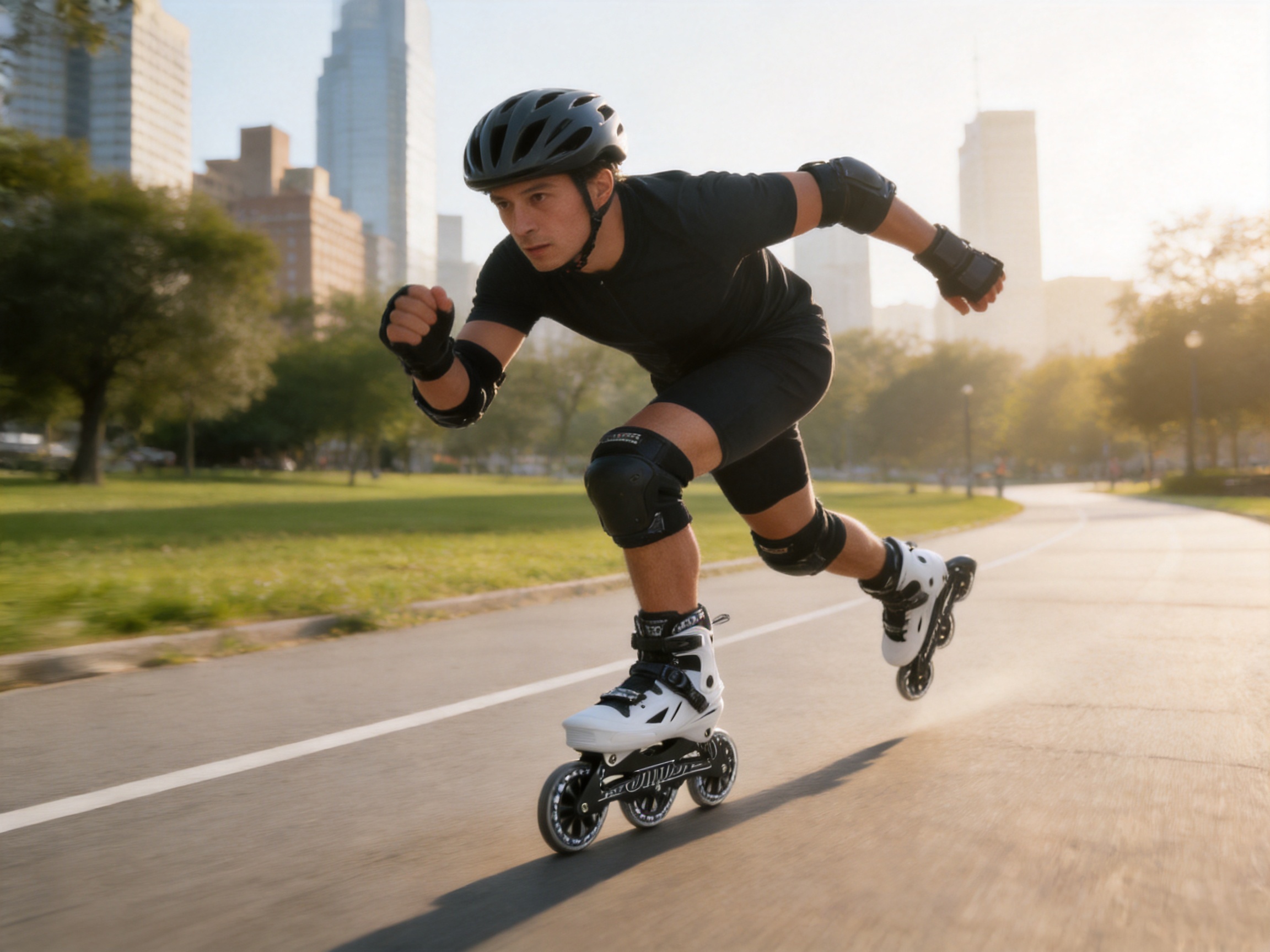
Inline skating continues to develop from a recreational activity into a practical fitness routine, commuting option, and competitive training discipline. As skaters become more experienced, many look for equipment that can deliver greater speed, longer rolling distance, improved comfort, and dependable control. The BW-228 speed inline skate is designed specifically for these needs. Its three-wheel large-wheel configuration, adjustable sizing, reinforced metal frame, comfortable upper, and high-speed carbon steel bearings create a balanced platform for outdoor skating, speed practice, leisure exercise, and short-distance commuting.
Unlike conventional inline skates that often use four smaller wheels, this model is engineered around a three-wheeled speed-skating structure. The larger racing PU wheels reduce rolling resistance and help the skater maintain momentum over longer distances. The design is particularly suitable for outdoor roads and open paths where efficient gliding is more important than compact maneuverability. At the same time, the adjustable construction makes the skate accessible to users with different foot lengths, including growing children, teenagers, and adults.
The product is manufactured by Ningbo Feile Sporting Goods Co., Ltd., an established sporting goods producer specializing in children’s scooters, inline skates, roller skates, and ice skates. The company combines product development, mold production, injection molding, sewing, assembly, quality management, and international supply capabilities within one manufacturing organization. This integrated approach gives buyers more than a finished skate: it provides access to coordinated product engineering, customization, quality control, and OEM support.
Product Overview and Design Purpose
The BW-228 is a high-speed inline skate intended for skaters who want an efficient rolling experience without moving immediately to a highly specialized professional racing setup. It is available in adjustable size ranges corresponding to approximately 35–38, 39–42, and 42–45. These ranges are commonly presented as M, L, and XL options, allowing one skate structure to accommodate several foot lengths. This is valuable for families, clubs, training organizations, retailers, and rental-oriented businesses that need flexible sizing.
The central design feature is the three-wheel large-wheel layout. Three wheels provide a longer effective wheelbase while leaving more room for oversized wheels. Larger wheels generally help maintain speed because they roll over small surface irregularities more smoothly and lose less momentum during extended skating. A three-wheel arrangement can also reduce the number of contact points and lower rolling resistance when compared with traditional four-wheel recreational configurations.
The skate includes a reinforced aluminum metal frame. The frame is designed to provide stability under the forces created during acceleration, cornering, braking, and repeated outdoor use. Aluminum is widely used in performance skating equipment because it offers a useful combination of structural strength, relatively low weight, and resistance to deformation. The thickened frame construction further supports a stable connection between the boot and the wheels.
Another important feature is the frame’s customization capability. The metal frame can be printed with a customer’s logo or visual identity. This makes the product suitable for skating clubs, sports schools, training institutions, retail programs, event organizers, and private-label distributors. Instead of treating the skate as a standard stock item, buyers can use the frame as a visible branding surface that supports recognition during group training, competitions, demonstrations, or promotional activities.
The upper is designed with breathability in mind, while the cushioned lining improves comfort during longer sessions. Because long-distance skating places continuous pressure on the feet and ankles, internal comfort is not a minor detail. A supportive, padded interior can help reduce discomfort caused by friction and repeated impact. The design therefore aims to combine speed-oriented performance with the everyday usability required by recreational and fitness skaters.
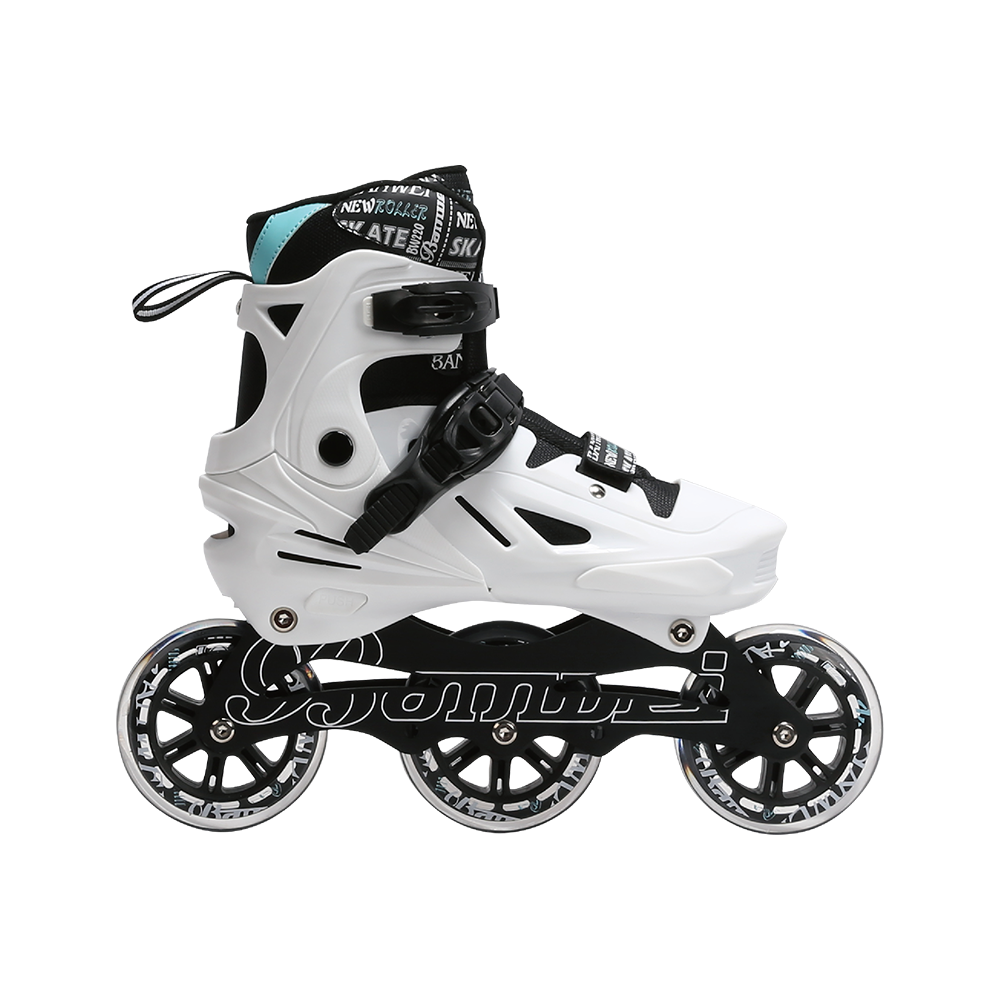
BW-228 Speed Inline Skate
Why the Three-Wheel Large-Wheel Configuration Matters
Wheel configuration has a direct effect on how an inline skate feels during acceleration, cruising, turning, and distance skating. Four-wheel recreational skates are often selected for their familiar handling and accessible balance. However, they can be less efficient when the main objective is sustained speed. The BW-228 takes a different approach by using three oversized PU wheels to create a speed-oriented platform.
A larger wheel travels farther with each rotation. This allows the skater to cover more ground while maintaining a steady rhythm. Once the skater has accelerated, the wheels are designed to preserve momentum efficiently, which can reduce the effort required to continue moving. This characteristic is especially useful on longer outdoor routes, where repeated acceleration and deceleration can quickly cause fatigue.
The larger diameter also helps the skate pass over minor cracks, surface texture, and small imperfections more smoothly than many small-wheel designs. Outdoor pavement is rarely perfectly uniform. A wheel that can bridge small irregularities with less abrupt interruption can make the ride feel more stable and predictable. Skaters still need to select suitable surfaces and maintain proper technique, but the wheel size provides a useful mechanical advantage.
Three wheels can also create a longer wheelbase without adding the additional contact point of a four-wheel structure. The longer platform supports directional stability at higher speeds. For a skater traveling along a straight road or wide path, this can help the skate feel planted and less nervous. The configuration is therefore well matched to long-distance street skating, endurance practice, and commuting routes.
At the same time, large wheels require the user to develop appropriate balance and control. Beginners may notice that the skate feels different from a standard four-wheel recreational model. The adjustable design and stable frame make the BW-228 approachable, but users should still learn gradually, practice braking, and wear suitable protective equipment. The product is built for performance, but responsible progression remains essential.
Low Drag and Efficient Cruising
The oversized racing PU wheels are designed to support low-drag movement. Polyurethane is commonly used in quality skating wheels because it offers a useful balance of grip, resilience, wear resistance, and smooth rolling behavior. The wheel compound works together with the bearing system and frame alignment to influence the overall glide. When these components are properly matched, the skater can maintain speed with less repeated pushing.
Efficient cruising is one of the product’s strongest advantages over ordinary entry-level skates. A recreational skater may use the BW-228 for exercise without needing to increase effort simply to cover a longer route. A commuter may appreciate the ability to maintain a practical travel speed. A training institution can use the product to introduce students to speed-skating techniques while still offering an adjustable platform that serves multiple users.
Acceleration and Long-Distance Endurance
The large-wheel setup supports rapid acceleration after the skater establishes a stable stance and effective push. Once moving, the wheel diameter helps preserve forward energy. This combination is useful for speed practice, where the skater may alternate between acceleration drills, sustained laps, and endurance intervals.
Long-distance skating is not determined by wheel size alone. Frame rigidity, bearing performance, boot comfort, foot alignment, and user technique all contribute to endurance. The BW-228 addresses these factors as a complete system. The firm aluminum frame transfers power effectively, the bearings support smooth rotation, and the padded breathable upper helps the skater remain comfortable during longer sessions.
Adjustable Sizing for Families, Clubs, and Growing Users
One of the most practical advantages of the BW-228 is its adjustable sizing system. Rather than requiring a new pair of skates every time a child’s foot grows, an adjustable model can accommodate changes within a defined range. The available size groupings cover approximately 35–38, 39–42, and 42–45, providing options for children with larger feet, teenagers, and adults.
Adjustability also simplifies inventory management for retailers and organizations. A store can offer a flexible product that fits more than one exact shoe size. A skating club can purchase fewer size variations while still serving members with different foot lengths. A training institution can allocate equipment more efficiently among participants. Families can share the same skate structure within the suitable range, provided that each user receives a secure and correctly adjusted fit.
The adjustment mechanism is intended to be simple and convenient. Precise tension control allows the wearer to adapt the skate to the foot length and create a stable fit. A properly adjusted skate should hold the foot securely without creating excessive pressure. Users should check the fit before every session, especially when the skate is used by children or shared among different skaters.
Practical Benefits of a Flexible Fit
A fixed-size skate may offer a precise fit when the size is selected correctly, but it can become unusable if the wearer’s foot changes. An adjustable skate extends the useful service period and may lower the total cost of ownership. This is particularly important for parents purchasing equipment for active children and for organizations that need durable products with broad usability.
The adjustable structure can also assist beginners who are still learning how a performance skate should feel. The user can make small fit adjustments as socks, comfort preferences, or skating conditions change. However, adjustability should never be used to compensate for a fundamentally unsuitable size range. The foot must remain properly supported, and the fastening system must be secured before movement begins.
| Feature | BW-228 Design | Practical Advantage |
| Wheel layout | Three large racing PU wheels | Supports speed, efficient rolling, and long-distance momentum |
| Frame | Thickened reinforced aluminum metal frame | Provides stability, rigidity, and resistance to deformation |
| Size system | Adjustable ranges approximately 35–38, 39–42, and 42–45 | Accommodates different foot lengths and growing users |
| Bearing system | High-speed carbon steel bearings | Promotes smooth and stable wheel rotation |
| Upper construction | Breathable upper with cushioned lining | Improves comfort during extended use |
| Customization | Logo printing available on the metal frame | Supports private labeling, clubs, institutions, and branded programs |
| Primary applications | Street skating, commuting, speed practice, leisure, and fitness | Offers broad use across consumer and organized sports markets |
Frame Strength, Stability, and Custom Branding
The frame is the structural foundation of an inline skate. It connects the boot to the wheels and must withstand repeated loading from the skater’s body weight, push-off force, road vibration, and directional changes. The BW-228 uses a reinforced aluminum frame to provide a stable performance base for high-speed and outdoor applications.
A stable frame helps the skater transfer energy from the leg into the wheels. When the frame flexes excessively or loses alignment, a portion of the push may be wasted, and the skate can feel less predictable. The reinforced design is intended to maintain structural integrity during normal use, supporting consistent control in acceleration and cruising.
Aluminum also contributes to a practical balance between strength and weight. A frame that is too heavy can increase fatigue, while a frame that is too light without adequate reinforcement may not provide the rigidity required for speed skating. The BW-228 is designed to offer a strong platform without making the skate unnecessarily cumbersome for everyday users.
OEM and Private-Label Potential
The customizable frame creates a clear advantage for buyers who want more than a generic product. A printed logo can support brand visibility in skating schools, sports clubs, dealer programs, and promotional campaigns. Group users can create a consistent appearance, while distributors can offer a product with their own identity in selected markets.
Customization is especially valuable for organizations that use skating as part of a structured program. A training academy may place its identity on the frame so that students use visually coordinated equipment. A retail brand may create a private-label version for a seasonal product line. An event organizer may use branded skates for demonstrations or organized activities.
OEM customization should be planned with the manufacturer in advance. Buyers should confirm logo artwork, printing location, color requirements, minimum order quantities, packaging expectations, sample approval procedures, and production schedules. Since the frame is a visible and functional part of the product, the customization process should protect both visual quality and structural performance.
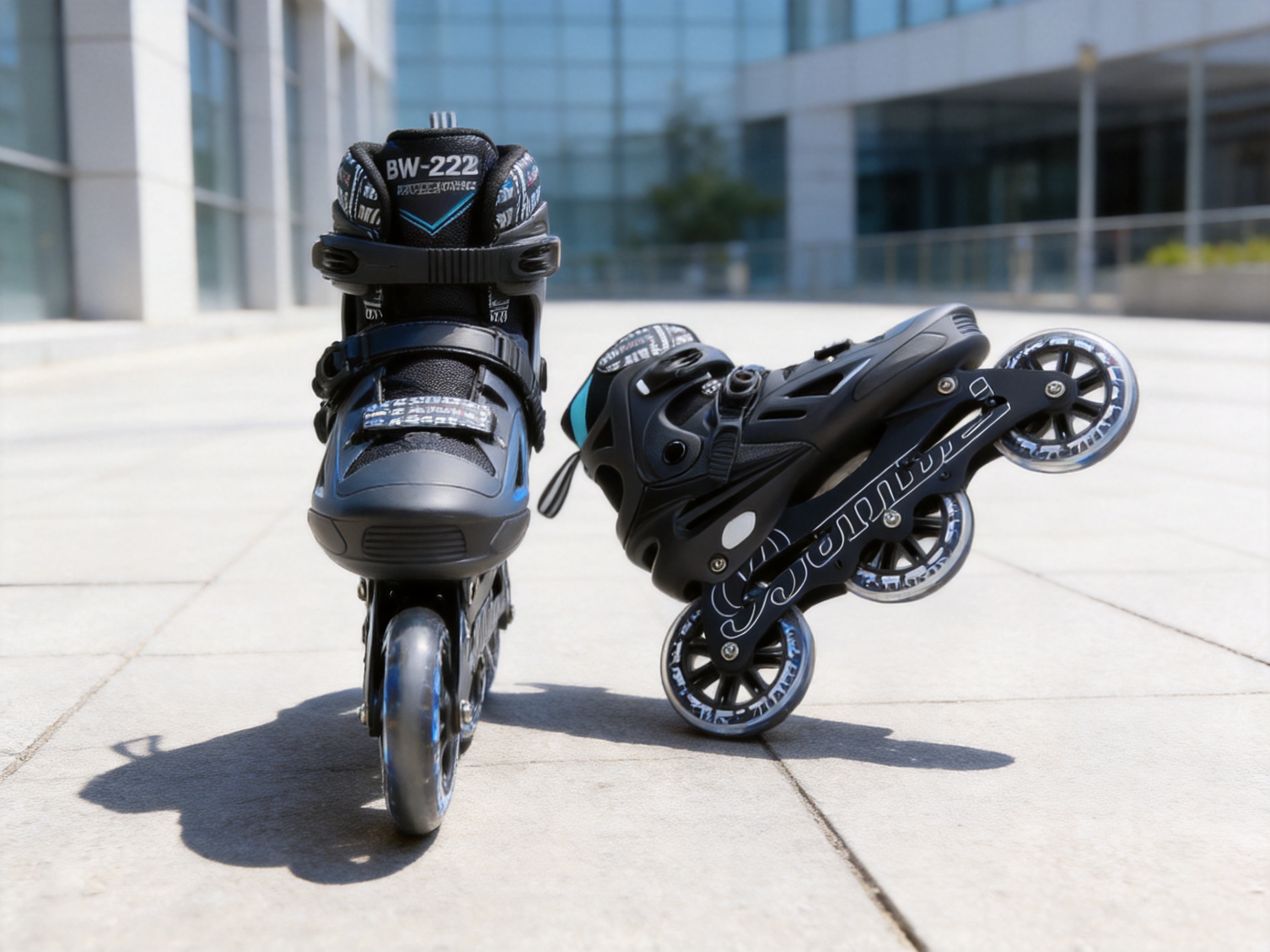
Comfort Features for Extended Outdoor Use
Speed is only useful when the skater can remain comfortable and in control. Long-distance skating may involve continuous movement for a considerable period, so the upper and lining must support the foot without causing unnecessary heat or pressure. The BW-228 uses a breathable upper and cushioned lining to create a more comfortable internal environment.
Breathability helps manage heat and moisture during physical activity. While no skate can eliminate perspiration, an upper that allows better airflow can improve the overall wearing experience. This is useful during summer outdoor sessions, fitness training, and commuting. A cushioned lining adds softness around contact areas and can help reduce discomfort caused by repeated movement.
Comfort also depends on correct adjustment. The skate should be tightened enough to secure the heel and maintain control, but not so tightly that circulation is restricted. Users should wear suitable skating socks, confirm that the toes have enough room within the selected adjustment range, and stop to inspect any persistent pressure points.
Ride Smoothness and Bearing Performance
The BW-228 uses high-speed carbon steel bearings to support smooth and stable wheel rotation. Bearings are small components, but they have a major influence on glide quality. Clean, correctly installed bearings reduce friction between the wheel assembly and axle, allowing the wheels to rotate consistently.
Smooth bearings can make the skate feel more responsive during acceleration and more efficient during cruising. They also contribute to a stable ride by helping the wheels rotate evenly. Like all performance components, bearings require care. Dust, moisture, and insufficient maintenance can affect their performance over time. After outdoor use, skaters should inspect the wheels and bearing areas, remove visible debris, and store the skates in a dry environment.
Carbon steel bearings are valued for their strength and smooth running characteristics when properly maintained. They should not be exposed unnecessarily to water or corrosive conditions. If the skates are used on damp pavement, they should be dried thoroughly afterward. Routine inspection can help identify unusual noise, resistance, or looseness before these issues affect the skating experience.
Applications Across Different User Groups
Long-Distance Street Skating
The primary application of the BW-228 is long-distance outdoor skating. The large-wheel configuration is intended to help skaters maintain momentum on roads, paths, and other suitable paved surfaces. The reinforced frame provides stability, while the adjustable fit allows the skater to maintain a secure connection with the skate throughout the session.
Street skaters should select routes with smooth, dry, and legally permitted surfaces. They should avoid heavy traffic, steep descents, loose gravel, deep cracks, and areas with poor visibility. The product can improve rolling efficiency, but route selection and user awareness remain essential for safety.
Short-Distance Commuting
For users who live near schools, workplaces, parks, or transit connections, inline skating can be a practical short-distance transportation method. The three large wheels help the skater move efficiently, reducing the effort required to cover a regular route. The adjustable sizing makes the product suitable for users whose equipment may be used frequently throughout the week.
Commuters should plan for changing conditions. A route that is suitable for skating should provide adequate surface quality, space, visibility, and pedestrian consideration. Users should carry ordinary footwear when necessary and should not assume that high-speed equipment automatically provides stopping ability in every situation. Braking and maneuvering should be practiced before using the skates for transportation.
Speed-Skating Practice
The BW-228 can serve as a training tool for users who want to improve acceleration, endurance, posture, stride efficiency, and rhythm. The large-wheel design introduces the skater to characteristics associated with speed skating, including longer glide phases and the need for stable balance at increased velocity.
Training can include warm-up laps, controlled acceleration drills, steady-distance sessions, cornering practice, and interval work. Beginners should start at a comfortable speed and focus on posture and braking before attempting longer distances. More experienced skaters can use the equipment for endurance development and outdoor technique practice.
Daily Leisure and Fitness
Inline skating provides an enjoyable form of cardiovascular exercise and coordination training. It engages the legs, hips, core, and stabilizing muscles while requiring continuous balance and directional awareness. The BW-228 supports this type of activity by combining a performance-oriented wheel design with comfort features suitable for repeated use.
For leisure users, the product can provide a more energetic and efficient experience than basic recreational skates. Skaters can choose shorter sessions for general activity or gradually extend their distance as their technique improves. Regular skating may support physical conditioning, coordination, and confidence, provided that users progress at an appropriate pace.
Advantages Compared with Conventional Recreational Skates
The BW-228 differs from many conventional recreational skates in several important ways. First, its large three-wheel configuration is oriented toward speed and distance rather than only beginner stability. Second, its adjustable sizing creates longer-term value for families and organizations. Third, the reinforced metal frame supports a more performance-focused ride. Fourth, the frame customization option gives commercial buyers a branding advantage.
Traditional four-wheel skates can be highly suitable for beginners, children learning basic skating, and users who prioritize compact maneuverability. However, they may require more effort to maintain speed over long distances, particularly when fitted with smaller wheels. The BW-228 is designed for users who want to transition toward faster rolling and more efficient outdoor movement.
Compared with fixed-size products, the adjustable construction can reduce replacement frequency as a user’s foot length changes. This may make the product more economical over its service life. It also reduces the complexity of stocking multiple precise sizes for clubs, schools, and retailers.
Compared with products that use less substantial frames, the reinforced aluminum structure offers a stronger foundation for repeated outdoor use. Structural stability is especially important when the skate is used for speed practice, where acceleration and directional forces are higher than in slow recreational sessions.
Compared with non-customizable stock items, the BW-228 offers a route to visible brand differentiation. The frame can be used as a practical branding surface without changing the fundamental performance purpose of the skate. This is useful for buyers seeking a combination of product function and market identity.
Manufacturing Strengths of the Supplier
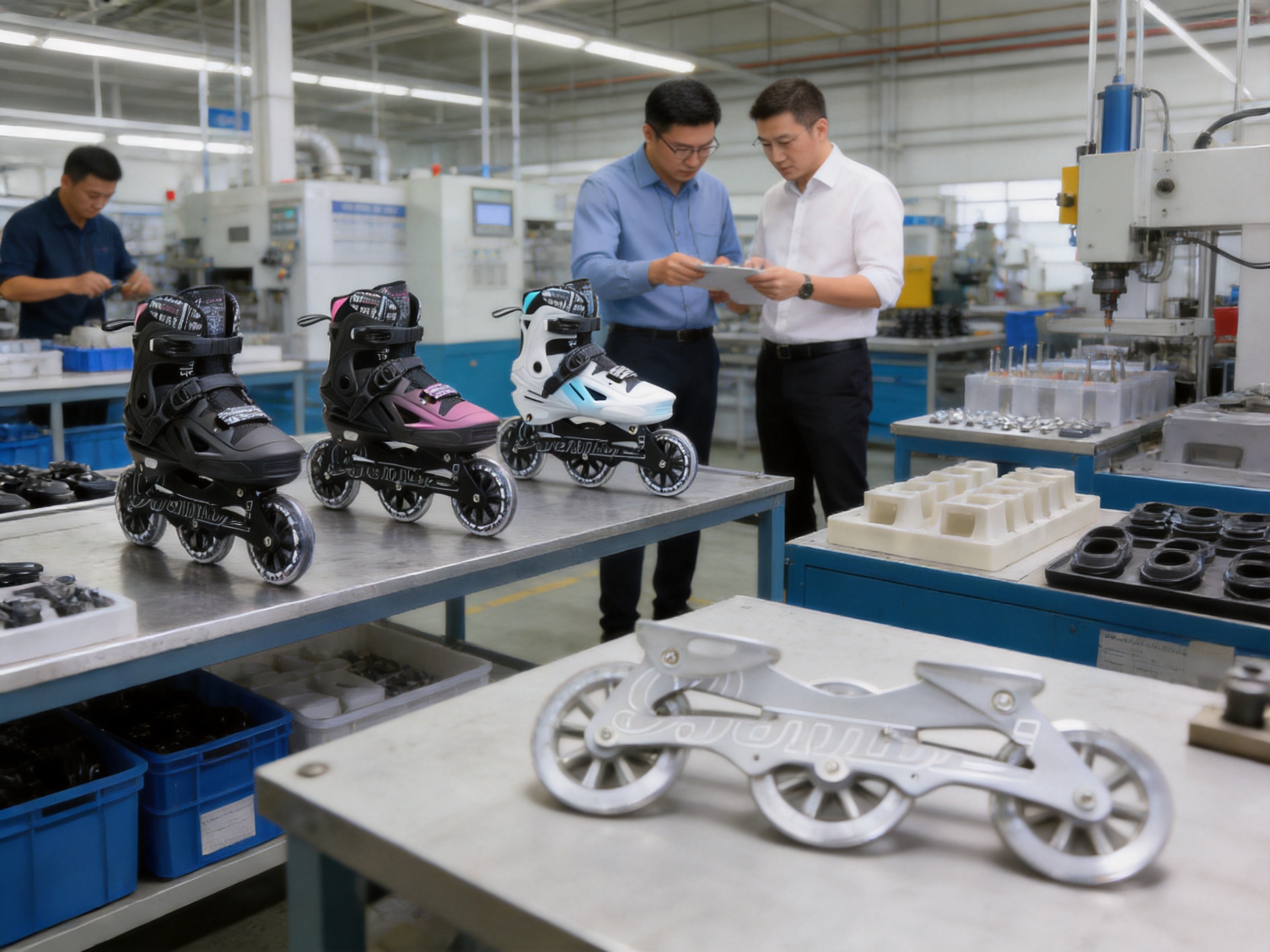
Ningbo Feile Sporting Goods Co., Ltd. was established in 2010 and has developed specialized experience in the production of children’s scooters, inline skates, roller skates, and ice skates. Its manufacturing base is located in Yuyao City, Ningbo, Zhejiang Province, an area recognized for plastics production and supported by convenient connections to Ningbo Airport and Shanghai.
The company operates a workshop of approximately 20,000 square meters and employs more than 200 people. Its facilities include five advanced automatic production lines, as well as dedicated mold, injection molding, sewing, and assembly workshops. This combination allows the company to manage multiple stages of product manufacturing within a coordinated production environment.
For skate buyers, integrated manufacturing can provide several advantages. Mold development can be coordinated with product engineering. Injection-molded parts can be produced according to approved specifications. Sewing and assembly teams can work from established construction requirements. Quality checks can be conducted throughout the process rather than relying only on a final visual inspection.
Product Development and Engineering
The company maintains a professional research and development engineering team. This capability is important for products such as adjustable speed skates because the design requires cooperation between the boot, adjustment mechanism, frame, wheels, axles, bearings, and packaging. Each component must work as part of a complete system.
Engineering support is also valuable for OEM projects. A buyer may need a different logo treatment, color combination, packaging format, size allocation, or market-specific configuration. A manufacturer with internal technical resources can evaluate these requests more efficiently and identify potential effects on tooling, assembly, cost, and delivery schedules.
The company has more than 30 college-educated management staff and has obtained multiple national patents according to the supplied company information. These resources support planning, production coordination, quality systems, and continuous product development. The company also launches new products each year to respond to changing market and customer needs.
Quality and Compliance Systems
Feile has passed ISO9001, BSCI, and Kmart factory certification systems, according to the provided company profile. These systems and audits are relevant to buyers evaluating manufacturing organization, social responsibility, and quality management. The company also reports product certifications including 3C, CE, EN71, EN62115, ASTM, EMC, and EN13843:2009 across its product portfolio.
Certification requirements can vary according to product type, market, age group, and destination country. Buyers should confirm which certifications apply specifically to the selected skate model and target market. They should also request current documentation, test reports, labeling requirements, and packaging information before placing a commercial order.
A structured quality system can help create repeatability between production batches. For distributors and retailers, consistency is important because customers expect the same fit, appearance, and basic performance from every unit. Quality control should cover raw materials, molded components, frame dimensions, wheel installation, bearing rotation, adjustment operation, stitching, printing, packaging, and final inspection.
Production Process from Concept to Finished Skate
The manufacturing process begins with product planning and engineering. Designers and engineers define the intended use, size range, wheel configuration, frame structure, upper materials, adjustment system, and target market. For a speed-oriented adjustable skate, these decisions must be coordinated so that the final product remains stable, comfortable, and practical to manufacture.
Mold development is an important stage for components produced through injection molding. Accurate molds help determine the consistency of shell parts, adjustment components, and other molded elements. Mold quality influences dimensional accuracy, surface finish, assembly fit, and production efficiency. An in-house mold workshop can shorten communication between design and production teams.
Injection molding is then used to produce selected plastic components. Proper material control, temperature management, cycle monitoring, and inspection help ensure that parts meet the required specification. Components are checked for visible defects, deformation, incomplete filling, and dimensional problems before moving to later stages.
The upper and lining are prepared through cutting, sewing, padding, and shaping operations. The breathable upper and cushioned lining must be assembled carefully because they directly affect comfort and fit. Stitching quality, seam placement, reinforcement, and material consistency are all relevant to the service experience.
The aluminum frame is prepared and integrated with the wheel system. The reinforced frame must be correctly aligned, and the wheels and bearings must be installed securely. Proper axle tightening, wheel spacing, and rotation checks are necessary to support smooth movement. Any logo printing or other approved customization is completed according to the buyer’s specifications and sample approval.
Final assembly brings together the upper, adjustment mechanism, frame, wheels, bearings, fasteners, and accessories. Finished skates should be inspected for fit, appearance, adjustment function, wheel rotation, frame security, and packaging accuracy. A clear assembly and inspection procedure helps reduce variation across units.
Customization and Sourcing Support
The BW-228 is suitable for buyers seeking OEM skating and scooter equipment. The customizable metal frame is the most prominent branding option identified in the product information, but a complete OEM project may also involve color coordination, packaging, labels, size allocation, instruction materials, and shipping marks. These details should be discussed during the quotation and sampling stages.
Commercial buyers should prepare vector artwork or high-resolution logo files and specify the preferred printing position. They should request a physical or digital sample before mass production. The sample should be checked for logo clarity, color accuracy, alignment, durability, and overall appearance. Approval records help ensure that the production team and buyer share the same expectations.
Product selection should also consider the destination market. Age grading, safety labeling, language requirements, packaging laws, and testing obligations can differ between countries. Feile’s broad certification experience may support the process, but the importer remains responsible for confirming all local requirements and ensuring that the final product configuration matches the approved documentation.
Packaging can be optimized for retail display, e-commerce delivery, club distribution, or container loading. Buyers may need individual color boxes, master cartons, barcode labels, instruction sheets, or protective packing around the frames and wheels. Early packaging planning can reduce damage risk and improve warehouse efficiency.
Maintenance and Responsible Use
Regular maintenance helps preserve the performance of any inline skate. Users should inspect the wheels before each session for excessive wear, cuts, embedded debris, or uneven rotation. Wheels that become significantly worn or damaged should be replaced according to the manufacturer’s recommendations. Uneven wheel wear may indicate skating habits, alignment issues, or the need to rotate wheel positions when appropriate.
Bearings should be kept clean and dry. After skating outdoors, users should remove dirt from the wheel area and store the skates in a ventilated location. Water exposure should be minimized because moisture can affect carbon steel bearing components and other metal parts. If unusual noise, grinding, or resistance develops, the skate should be inspected before continued high-speed use.
The adjustment mechanism should be checked regularly to confirm that it locks securely and operates smoothly. Fasteners should not be loose, and the frame should be examined for visible damage or deformation. Any component that affects structural integrity or foot security should be repaired or replaced before skating resumes.
Protective equipment is strongly recommended. A helmet, wrist guards, elbow pads, and knee pads can reduce the severity of injuries during falls. Users should practice on suitable surfaces, avoid traffic, maintain a safe distance from others, and learn effective stopping techniques. Children should skate under appropriate adult supervision and should use equipment that matches their ability level.
How to Select the Correct Size and Set Up the Skate
Begin by measuring the user’s foot length while wearing the socks intended for skating. Compare the measurement with the applicable adjustable range rather than selecting a size based only on ordinary shoe labeling. The foot should fit securely inside the boot, with the heel held in place and enough room for natural toe comfort.
Adjust one skate at a time. Release the adjustment system, position the boot to the desired length, and tighten the mechanism according to the product instructions. Fasten the upper securely and check that the foot does not slide excessively forward, backward, or sideways. Repeat the process on the second skate, then stand on a safe, level surface to confirm balance and comfort.
New users should begin with short practice sessions. They should learn how to stand, march, glide, turn, slow down, and stop before attempting high-speed movement. The large-wheel configuration may feel more responsive and faster than a basic recreational skate, so gradual familiarization is important.
Purchasing Considerations for Distributors and Organizations
Retailers should evaluate the product according to their customer profile. The BW-228 may be appropriate for customers interested in speed, distance, outdoor fitness, and adjustable sizing. Product descriptions should clearly explain that three-wheel large-wheel skates are designed for efficient gliding and may feel different from traditional four-wheel beginner skates.
Clubs and schools should consider size distribution, user skill levels, maintenance arrangements, and storage. Adjustable sizes simplify purchasing, but the organization should still provide enough units in each range to serve its members. A basic inspection schedule can help maintain wheels, bearings, fasteners, and adjustment systems between sessions.
Importers should request information about minimum order quantities, lead times, logo printing, packaging, sampling, loading plans, payment terms, and shipping documentation. They should also clarify whether product specifications may change between samples and mass production. A written technical specification is useful for confirming wheel size, frame material, bearing type, color, logo treatment, size ranges, and carton dimensions.
The supplied carton dimensions are approximately 830 x 430 x 330 millimeters for size range 35–38, 860 x 440 x 340 millimeters for size range 39–42, and 890 x 440 x 340 millimeters for size range 42–45. Buyers should verify whether these dimensions refer to individual cartons or outer packaging before final logistics planning. Accurate carton information supports container utilization, freight calculations, warehouse layout, and retail planning.
Quality, Value, and Competitive Positioning
The BW-228 competes through a combination of performance design and commercial flexibility. Its advantage is not based on a single component. Instead, it brings together large wheels, a three-wheel configuration, an adjustable fit, a reinforced aluminum frame, smooth bearings, comfort-focused materials, and logo customization.
For consumers, this combination creates a product that can support several types of activity without requiring separate equipment for every purpose. A user can practice speed skating, take a fitness ride, travel a short distance, or enjoy recreational outdoor skating. For organizations, the adjustable sizing and customization options can simplify purchasing while strengthening visual identity.
The product also benefits from the supplier’s manufacturing depth. Internal mold, injection molding, sewing, assembly, engineering, and quality resources can make communication more direct and support repeatable production. Buyers seeking long-term cooperation may value a manufacturer that can provide multiple related product categories, including scooters, inline skates, roller skates, ice skates, and protective equipment.
Q&A
What type of skate is the BW-228?
It is a three-wheel, large-wheel adjustable inline skate designed for speed skating, long-distance outdoor riding, short-distance commuting, leisure, and fitness activities.
What sizes are available?
The product is available in adjustable ranges corresponding approximately to 35–38, 39–42, and 42–45. These ranges are commonly identified as M, L, and XL. Buyers should confirm the final size labeling and measurement standard for their market.
Why does the skate use three large wheels?
The three-wheel large-wheel design supports efficient gliding, rapid acceleration, low rolling resistance, and better momentum retention over longer distances. It is especially suitable for outdoor routes and speed-oriented skating.
Is the product suitable for beginners?
The adjustable fit and stable reinforced frame can make the skate accessible to developing users, but beginners should learn gradually. They should practice balance, turning, braking, and speed control before attempting long or fast rides.
Can the frame carry a company logo?
Yes. The metal frame supports custom logo printing. Buyers should confirm artwork specifications, printing position, colors, sampling procedures, minimum order quantities, and production terms with the manufacturer.
What material is used for the frame?
The frame is made from thickened and reinforced aluminum metal. It is designed to provide stability, strength, and resistance to deformation during normal skating use.
What kind of wheels does the product use?
The skate uses oversized racing PU three-wheels. The wheel design is intended to support speed, smooth rolling, acceleration, and long-distance endurance.
How does the skate support comfort?
The upper is designed to be breathable, and the interior includes cushioned lining. Correct sizing, suitable socks, and careful adjustment are also important for maintaining comfort during extended sessions.
What bearings are included?
The product information specifies high-speed carbon steel bearings. They are intended to support smooth and stable wheel rotation when properly installed and maintained.
What activities are recommended?
Recommended activities include long-distance street skating, short-distance commuting, speed-skating practice, outdoor leisure, and fitness training on suitable paved surfaces.
What manufacturing capabilities does the supplier have?
The supplier has more than 200 employees, a 20,000-square-meter workshop, five automatic production lines, mold and injection molding facilities, sewing and assembly workshops, an R&D engineering team, and experience in OEM sports equipment production.
Which certifications are associated with the company?
The company reports ISO9001, BSCI, and Kmart factory certification systems, along with product certifications including 3C, CE, EN71, EN62115, ASTM, EMC, and EN13843:2009. Buyers should verify which documents apply to the specific model and destination market.
How should the skates be maintained?
Inspect wheels, bearings, fasteners, frame alignment, and the adjustment mechanism regularly. Keep the skates dry and clean, remove debris after outdoor use, and replace worn or damaged components before continued skating.
Conclusion
The BW-228 speed inline skate is designed for users who want to move beyond basic recreational skating and experience a more efficient long-distance ride. Its three large PU wheels support speed and momentum, while the reinforced aluminum frame provides a stable structural foundation. Adjustable sizing increases practicality for growing users, families, clubs, schools, and commercial operators. Breathable materials, cushioned lining, and high-speed carbon steel bearings contribute to a smoother and more comfortable experience.
From a business perspective, the product offers additional value through frame logo customization and the manufacturing capabilities of Ningbo Feile Sporting Goods Co., Ltd. The company’s engineering resources, automatic production lines, mold and injection molding workshops, sewing and assembly facilities, quality systems, certifications, and product-development experience create a strong foundation for OEM cooperation.
For consumers, the skate is best suited to controlled outdoor skating, speed practice, fitness, and commuting on suitable surfaces. For buyers, it represents a flexible product platform that combines performance-oriented design with adjustable sizing and private-label potential. With correct fitting, responsible use, and regular maintenance, it can serve as a reliable option for modern skating programs and active outdoor lifestyles.
References
1. Product specification and feature information supplied for the BW-228 Speed Inline Skate.
2. Company profile and manufacturing information supplied by Ningbo Feile Sporting Goods Co., Ltd.
3. General principles of inline skate wheel configuration, rolling efficiency, and outdoor skating performance.
4. General guidance on inline skate fitting, maintenance, protective equipment, and progressive skills training.
5. General quality-management and product-compliance considerations for sports equipment manufacturing and international sourcing.
Product: BW-228 Speed Inline Skate

Recommended Articles

Get in Touch
Your email address will not be published. Required fields are marked *
Have a project in mind? Contact with us!
We are happy to answer your questions. Please fill out this form
and one of our professional team will get back to you as soon as possible.

We specialize in producing various types of children's toy cars, children's skateboards, and ice skates.
