
 En
En
 Español
 русский
 عربى
عربى
Adjustable Children’s Ice Skates: A Practical Guide to Comfort, Safety, Performance, and OEM Manufacturing
Date:Jul 23, 2026
Content
- 1 Why Adjustable Ice Skates Matter for Growing Children
- 2 Construction Designed for Beginner Confidence
- 3 Breathable MESH Material for Everyday Comfort
- 4 Carbon Steel Blades and Stable Ice Contact
- 5 Child-Friendly Fastening and Independent Use
- 6 Color Choices That Support Personal Preference and Organization
- 7 Advantages Over Basic Fixed-Size Alternatives
- 8 Suitable Applications for Different Buyers
- 9 Manufacturing Strengths Behind the Product
- 10 Quality Management and Certification Experience
- 11 OEM and Sourcing Advantages for International Buyers
- 12 Material Combination and Product Life Cycle
- 13 Safety Practices for Young Skaters
- 14 Retail Positioning and Market Appeal
- 15 How the Product Supports a Complete Equipment Strategy
- 16 Recommended Inspection and Maintenance Routine
- 17 Frequently Asked Questions
- 17.1 What age group can use these adjustable ice skates?
- 17.2 How does the adjustable system benefit families?
- 17.3 Are the skates suitable for beginners?
- 17.4 What colors are available?
- 17.5 What materials are used in the skates?
- 17.6 How should the blades be maintained?
- 17.7 Can children put the skates on independently?
- 17.8 Are these competition skates?
- 17.9 Can schools and skating centers purchase the product?
- 17.10 What should OEM buyers confirm before ordering?
- 17.11 Where is the manufacturer located?
- 17.12 What manufacturing resources does the company have?
- 18 Conclusion
- 19 References
- 20 Product: BW-905BD Adjustable Kids Ice Skates
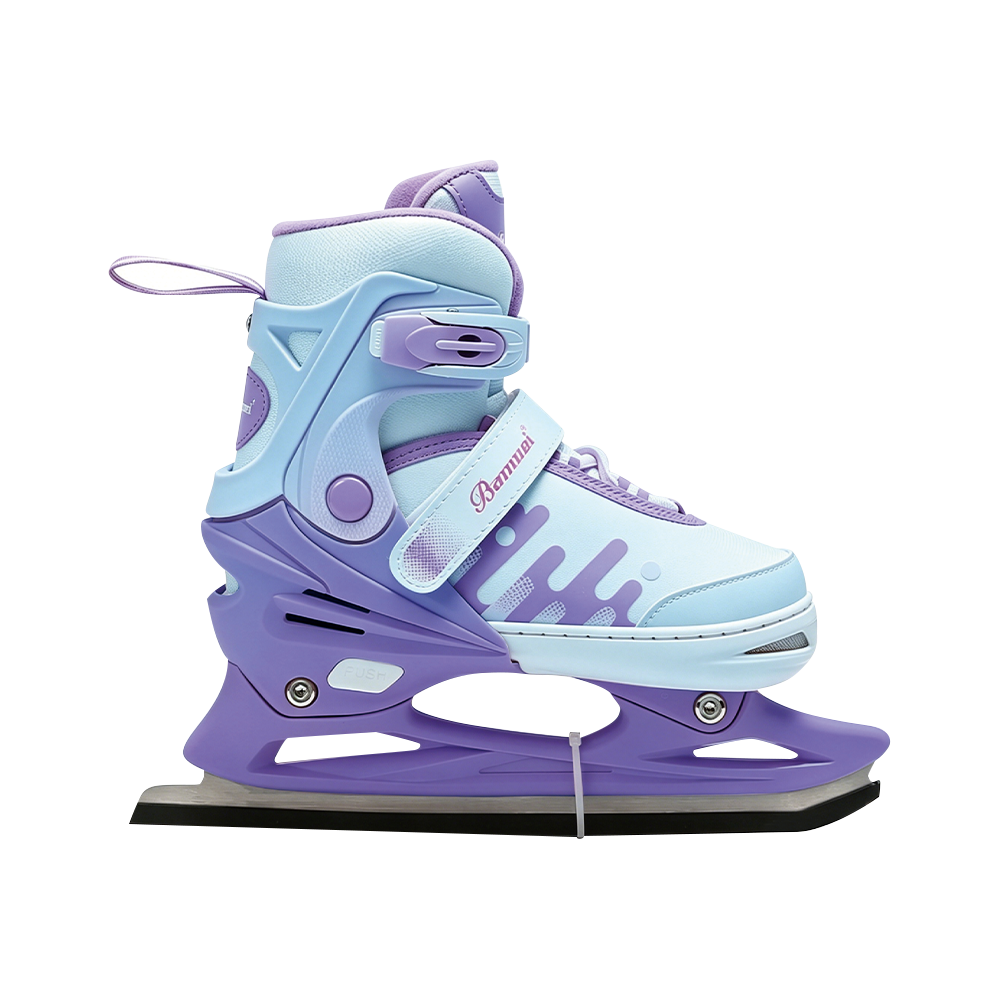
Children’s ice skating is an enjoyable way to develop balance, coordination, confidence, and an appreciation for active lifestyles. However, choosing suitable equipment for young skaters requires more consideration than simply selecting an attractive pair of boots. Children’s feet grow quickly, beginners need reliable ankle support, and parents often want products that provide value over several seasons rather than becoming unsuitable after a short period of use. The BW-905BD Adjustable Kids Ice Skates – Pink/Blue/Red are designed to address these practical needs through adjustable sizing, supportive construction, breathable materials, durable carbon steel blades, and a child-friendly fastening system.
These adjustable ice skates are made for children at different stages of development, from small-foot beginners to older children and teenagers. Instead of offering only one fixed shoe size, the design covers four size ranges: 27–30, 31–34, 35–38, and 39–42. This structure allows one pair to adapt as a child’s feet grow, helping families reduce the frequency of replacement. It also makes the product attractive to schools, training centers, rental programs, retailers, and distributors that need versatile equipment suitable for multiple age groups.
Beyond adjustability, the product combines a hard PVC outer shell, soft padded lining, MESH material, a buckle system, and carbon steel blades. Each component contributes to the overall experience. The shell provides structure and ankle support, the lining improves comfort, the MESH material helps manage heat and moisture, the buckle supports a secure fit, and the blades provide contact with the ice. Together, these features create a balanced product for beginner practice, recreational skating, family activities, and organized training.
Why Adjustable Ice Skates Matter for Growing Children
Children’s footwear is difficult to manage because growth can make a previously suitable pair too small within a relatively short time. In ice skating, the issue is especially important. A skate that is too tight may cause discomfort, pressure points, and reluctance to continue skating. A pair that is too loose may reduce control and make it more difficult for the child to maintain a stable position on the ice. Fixed-size skates can therefore create a compromise between immediate fit and long-term value.
An adjustable skate offers a more practical solution. The BW-905BD design is intended to cover multiple shoe sizes within each range, enabling the user to modify the fit as the child grows. This means that families can purchase equipment for a developmental period rather than for only one moment in time. The result is lower replacement frequency, improved product utilization, and better value for households with active children.
The same benefit applies to organizations. Ice skating schools and sports programs often serve children of different ages and foot sizes. A versatile adjustable model allows an institution to manage its equipment inventory more efficiently. Instead of purchasing many fixed sizes, a training center can stock a smaller number of adjustable pairs across the four available ranges. This can simplify storage, allocation, maintenance, and equipment rotation.
Adjustability also supports family activities. Parents may have children who are close in age but have different foot sizes. A well-organized selection of adjustable skates can make it easier to assign suitable equipment to each child. The pink, blue, and red color choices can further assist with identification, particularly when several pairs are being used at the same rink or during group lessons.
Four-Level Size Coverage
| Size Level | Recommended Size Range | Typical User Group | Primary Benefit |
|---|---|---|---|
| XS | 27–30 | Small-foot beginners | Provides an entry point for young children beginning ice activities |
| S | 31–34 | Preschool and lower elementary school children | Supports children during early skill development |
| M | 35–38 | Upper elementary school children | Offers additional growing room for developing skaters |
| L | 39–42 | Teenagers and older children | Extends the product range into larger youth sizes |
When selecting a size, users should adjust the skate to fit securely without creating excessive pressure. Thick socks, foot width, and the child’s individual shape should also be considered. The adjustable mechanism should be checked before each skating session to confirm that both skates are set evenly and that the fastening system is fully secured.
Construction Designed for Beginner Confidence
A beginner needs more than a blade mounted to a boot. Young skaters are still learning how to stand, transfer weight, bend the knees, and respond to changes in balance. A supportive boot can help them feel more stable while they develop these foundational skills. The BW-905BD uses a hard PVC shell to provide structure around the foot and ankle area. This construction helps the skate retain its shape and offers a firm platform for basic skating movements.
The hard shell is combined with soft padded lining. This combination is important because a completely rigid interior may feel uncomfortable, while an excessively soft structure may not provide enough support. The outer shell helps with stability and protection, while the padded interior makes the contact area more comfortable for extended use. For children who are still building confidence, comfort can influence whether they enjoy the activity and want to continue practicing.
Ankle support is particularly important during the beginner stage. Children may lean too far forward, move their feet unevenly, or place weight on one side of the skate. A structured boot helps limit unwanted movement and supports a more controlled stance. It does not replace instruction or proper supervision, but it can complement coaching by giving the child a consistent equipment platform.
Compared with basic low-support alternatives, a structured PVC design may be more suitable for young skaters who require guidance from their equipment. The product is not positioned as a specialized competition skate, nor is it intended to replace professional fitting for advanced athletes. Its strength lies in combining practical support, accessible features, and adjustable sizing for children and developing users.
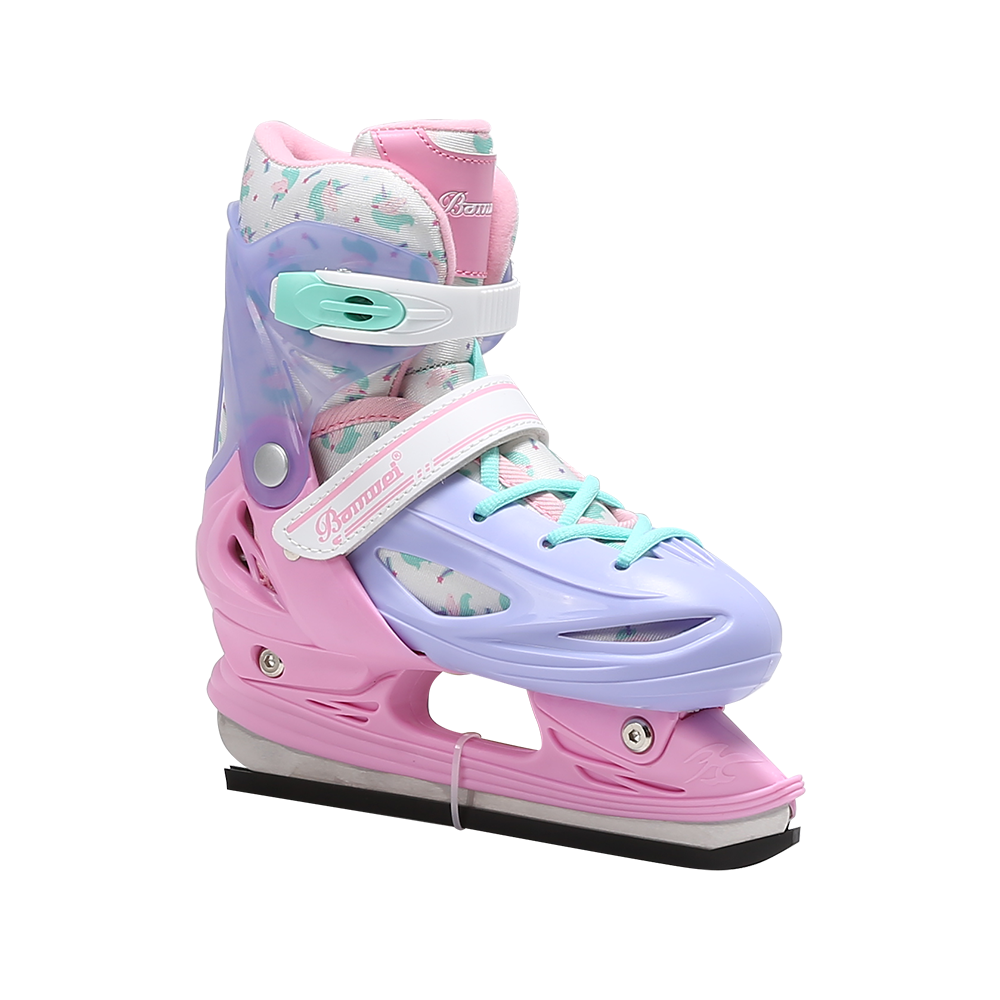
BW-905BD Adjustable Kids Ice Skates
Breathable MESH Material for Everyday Comfort
Ice rinks are cold environments, but skating is still an active sport. Children can generate heat quickly while moving, especially during lessons, games, repeated practice, or long recreational sessions. Footwear that traps excessive heat may become uncomfortable, and moisture can reduce the pleasant feel of the interior. The MESH material used in the skate design is intended to improve ventilation and help reduce heat buildup.
Breathability is valuable for several reasons. First, it can help the foot feel less enclosed during activity. Second, it supports a more comfortable interior environment when the child is wearing the skates for a longer period. Third, breathable construction can make the product more suitable for different use scenarios, including family outings, school activities, and training classes.
The MESH material works together with the padded lining rather than replacing it. The lining provides softness and cushioning, while the MESH contributes airflow and moisture management. This material combination reflects a balanced approach to children’s sports equipment: the product must be protective enough for stability but comfortable enough to encourage regular use.
Parents can help preserve interior comfort by allowing the skates to dry naturally after use. The skates should not be stored wet inside a closed bag for long periods. Removing excess moisture, opening the fastening system, and placing the equipment in a dry, ventilated area can help maintain the materials and reduce unpleasant odors. Care practices are especially important when skates are used frequently by children or shared by an organization.
Carbon Steel Blades and Stable Ice Contact
The blade is the component that connects the skate to the ice, so its material and condition have a direct influence on the skating experience. The BW-905BD features carbon steel blades designed to provide stable contact and smooth gliding performance for recreational and beginner use. Carbon steel is widely used in sports equipment because it offers a useful balance of hardness, durability, and maintainability.
For new skaters, predictable contact with the ice is more important than extreme performance characteristics. Children need to learn how small changes in body position affect movement. A stable blade can help them practice basic gliding, stopping, turning, and balance exercises with greater confidence. The blade design supports the overall purpose of the skate: providing a dependable platform for early skill development and everyday ice activities.
Blade care should be taken seriously. After skating, the blades should be wiped dry to remove moisture and reduce the risk of corrosion. Protective blade guards should be used when walking away from the ice surface, while soft guards or appropriate storage covers may be used for transport and storage according to the equipment program’s procedures. Skating on concrete, stone, or other hard surfaces without suitable protection can damage the blades.
Although the blades are designed for durability, all metal edges require inspection over time. Users should check for visible rust, dents, uneven wear, loose components, or damage after use. Sharpening should be performed by a qualified service provider when necessary. Regular maintenance helps preserve edge quality and supports consistent skating performance.
In comparison with very low-cost products using less durable or poorly maintained blade components, carbon steel construction offers a stronger foundation for repeated recreational use. The advantage is not merely the material itself; it also depends on correct manufacturing, secure attachment, quality inspection, and responsible maintenance by the end user.
Child-Friendly Fastening and Independent Use
Children often feel more confident when they can participate in preparing their own equipment. A fastening system that is simple to understand can help them put on and remove their skates with less assistance. The BW-905BD includes a convenient buckle system designed for children. This feature supports independent use while allowing adults to check the final fit before the child enters the rink.
The buckle should be closed firmly but not excessively tight. The foot should feel secure inside the boot, and the heel should not lift excessively during movement. Parents, coaches, or supervisors should inspect the fastening before skating begins, particularly for younger children. Independence is beneficial, but it should be combined with adult guidance and a final safety check.
A practical fastening system also saves time during group activities. In lessons or school programs, children may need to change equipment within a limited period. A buckle system can be easier to manage than complicated laces, particularly for young users who have not yet developed strong tying skills. This can help reduce delays and make the transition from changing area to rink more efficient.
For retailers and distributors, user-friendly fastening is an important selling point. Parents often look for products that children can manage without constant assistance. The combination of adjustment and buckle fastening gives the product a clear practical identity: it is designed not only to perform on the ice but also to be manageable before and after skating.
Color Choices That Support Personal Preference and Organization
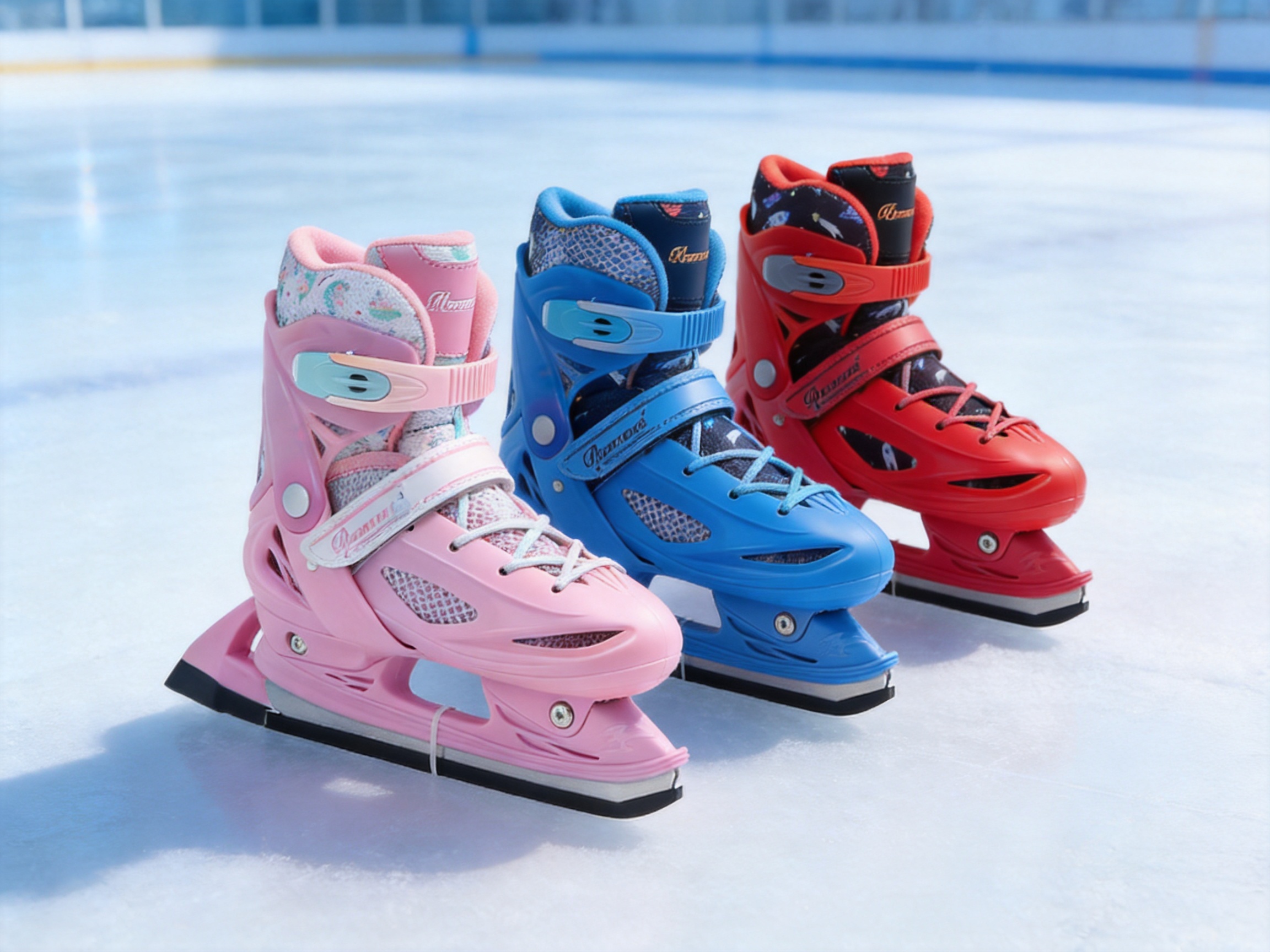
The skate is available in pink, blue, and red. Color is not a performance specification, but it has an important role in children’s products. Young users often feel more attached to equipment that reflects their personal preferences. A color they like may make them more enthusiastic about attending lessons or family skating sessions.
Multiple color options can also support organization. Families can assign different colors to different children, while schools or training centers can use color coding to simplify equipment identification. In a busy rental or group environment, visual distinction can reduce the chance of children accidentally taking the wrong pair.
The availability of three colors also helps retailers serve a wider range of preferences without needing to change the basic product platform. Distributors can present a coordinated product selection while maintaining consistent sizing, materials, and core functions. This flexibility is useful for online catalogs, sporting-goods stores, school supply programs, and seasonal promotional campaigns.
Advantages Over Basic Fixed-Size Alternatives
The primary competitive advantage of the BW-905BD is its combination of adjustable sizing and children-focused construction. Many entry-level fixed-size skates are suitable only for a narrow size range. Once the child’s foot grows, the family may need to purchase another pair even if the original skates remain in good condition. Adjustable sizing directly addresses this problem and can improve the total value of ownership.
A second advantage is the balance between support and comfort. The hard PVC shell contributes structure, while soft padding and MESH material improve wearability. Some products emphasize rigid support without paying enough attention to ventilation or cushioning. Others may feel soft but fail to provide the stable structure that beginners need. The product’s material combination is intended to bridge these priorities.
A third advantage is practical usability. The buckle system is easier for many children to handle than traditional lacing alone. The four size levels allow retailers and organizations to offer a broad youth range. The three color options make the product more appealing to children and easier to distinguish in group settings.
A fourth advantage is suitability for multiple scenarios. The skates can be used for beginner ice skating, recreational rink visits, family activities, training classes, and school sports courses. This broad application makes them more flexible than products designed only for a single specialized purpose.
It is important to define these advantages accurately. The skates are intended for children and developing users rather than professional competitive athletes. Advanced skaters may require specialized boots, custom fitting, performance-oriented blade profiles, or competition-specific features. For the intended market, however, value, adjustability, comfort, and reliable support are often more relevant than specialized racing performance.
Comparison of Key Product Priorities
| Product Priority | BW-905BD Design Approach | Why It Matters to Families and Organizations |
|---|---|---|
| Growth accommodation | Four-level adjustable sizing from 27 to 42 | Reduces replacement frequency and simplifies inventory planning |
| Structural support | Hard PVC shell with padded lining | Helps beginners maintain a more stable ankle and foot position |
| Comfort | Breathable MESH material and soft interior padding | Helps improve wearability during lessons and longer skating sessions |
| Ice contact | Carbon steel blades | Provides a durable foundation for controlled gliding and practice |
| Ease of use | Child-oriented buckle system | Supports quicker fitting and greater independence |
| Visual selection | Pink, blue, and red options | Serves personal preferences and supports equipment identification |
Suitable Applications for Different Buyers
Beginner Ice Skating
The product is especially appropriate for children who are just starting to learn how to skate. Beginners typically need equipment that feels stable and manageable. The supportive shell can help them become familiar with the posture required for skating, while the adjustable design allows the skates to remain useful as their skills and foot size develop.
Beginners should receive instruction on standing, falling safely, getting up, balancing, stopping, and moving at a controlled speed. Equipment can support these lessons, but it cannot replace coaching. Children should always use appropriate protective gear and follow rink rules.
Recreational Rink Skating
Families who visit ice rinks on weekends or during school holidays can benefit from a pair of skates that is comfortable, easy to adjust, and suitable for repeated casual use. The product’s color options make it attractive for children, while the padded and breathable construction helps support longer recreational sessions.
For occasional users, adjustable sizing is particularly valuable because the skates may be used over several months or seasons. A fixed-size product might become unsuitable during periods when it is not used regularly. The adjustable format can preserve usefulness between visits.
Training Classes and School Sports
Skating schools and educational institutions often require products that can be distributed to children with different foot sizes. The four-level system provides a straightforward way to organize inventory. The buckle design can also help students prepare more efficiently, reducing the time instructors spend assisting with basic fastening.
Institutions should establish inspection procedures for blades, buckles, adjustment mechanisms, and interior materials. A maintenance log can record cleaning, sharpening, repairs, and replacement decisions. Proper management improves safety and extends the working life of the equipment.
Family and Parent-Child Activities
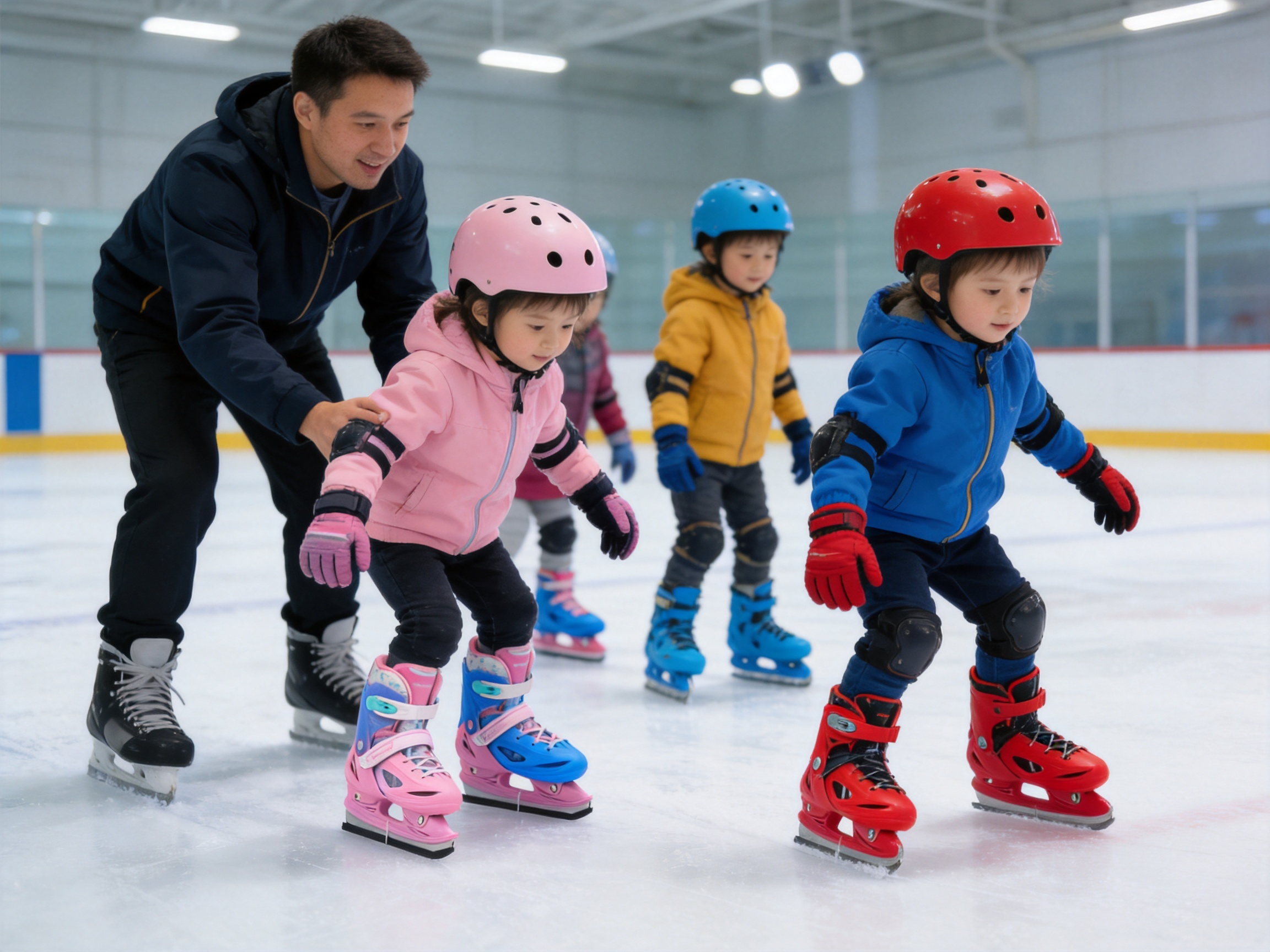
Ice skating is often chosen as a parent-child activity because it combines exercise and shared leisure time. The three available colors can help families distinguish equipment, and the adjustable sizes make it possible to select suitable pairs for children at different growth stages.
Parents should remain close to young or inexperienced skaters, especially during their first sessions. The ice surface can be unpredictable for beginners, and even a supportive skate must be used together with appropriate supervision, clothing, gloves, and protective equipment.
Manufacturing Strengths Behind the Product
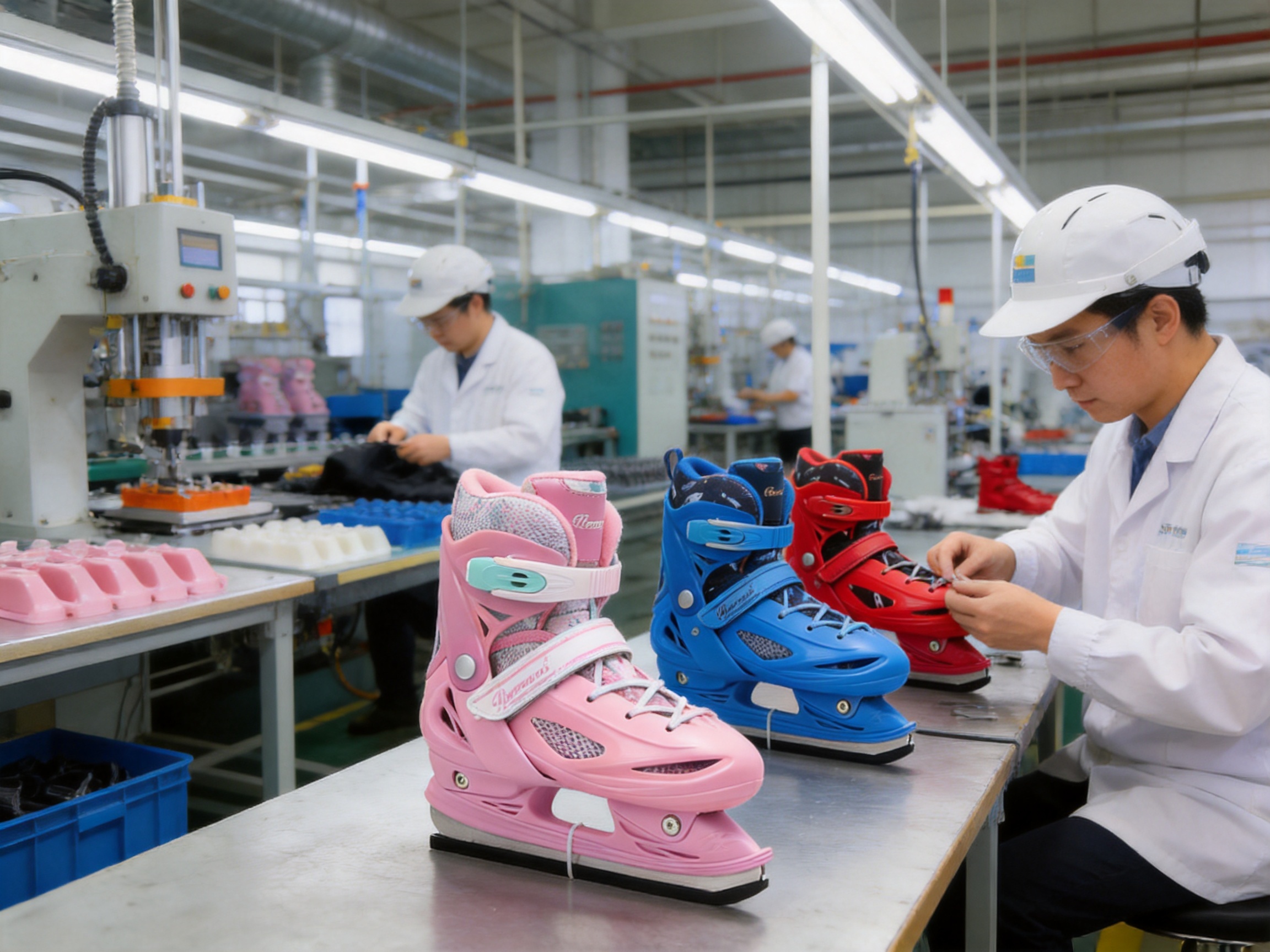
The quality of a children’s ice skate depends on more than its visible design. Consistency in materials, molding, sewing, assembly, inspection, and packaging all contribute to the finished product. Ningbo Feile Sporting Goods Co., Ltd. has specialized in children’s scooters, inline skates, roller skates, and ice skates since 2010. Its experience across several related categories provides a foundation for developing products that combine mobility, support, comfort, and child-oriented usability.
The company operates a workshop of approximately 20,000 square meters and employs more than 200 people. Its production resources include five advanced automatic production lines, a professional R&D engineering team, mold facilities, injection molding workshops, sewing workshops, and assembly workshops. This combination enables the company to manage multiple stages of production within an integrated manufacturing environment.
In-house mold and injection molding capabilities are particularly relevant to products containing shaped PVC components. Mold control can influence dimensional consistency, surface quality, fit, and the repeatability of production. For adjustable children’s skates, consistent shell dimensions and reliable component integration are essential because the product must provide similar support across different size ranges.
Sewing and assembly capabilities are equally important. MESH sections, padded lining, straps, buckles, and other soft or mechanical components must be correctly positioned and securely attached. An integrated production system can make communication between departments more efficient and can support stronger control over production specifications.
The presence of an R&D engineering team supports continuous product development. Children’s sports equipment must respond to changing market expectations, including lighter designs, more comfortable materials, improved adjustment systems, attractive colors, and stronger safety awareness. A dedicated development function allows manufacturers to evaluate these factors and introduce new products according to customer and market requirements.
Quality Management and Certification Experience
The company has passed ISO9001, BSCI, and Kmart factory certification systems and has obtained multiple national patents. Its products have received certifications including 3C, CE, EN71, EN62115, ASTM, EMC, and EN13843:2009. Certification requirements differ according to the product category, market, and application, so buyers should confirm the specific documentation applicable to the exact model and destination country.
Quality management systems help establish repeatable procedures for purchasing, production, inspection, corrective action, and documentation. For an OEM buyer, this is important because stable processes are more valuable than a single successful sample. A long-term supply relationship depends on the ability to reproduce the agreed specifications across multiple production batches.
Factory and social-compliance certifications can also be relevant to international retailers. Buyers may need evidence concerning production conditions, quality systems, product testing, and responsible sourcing. A manufacturer with experience in these areas can make the supplier evaluation process more efficient.
Product certifications should never be treated as a substitute for proper use. Parents and organizations must still inspect equipment, follow care instructions, and use suitable protective gear. Certifications indicate compliance with defined requirements; they do not eliminate the need for supervision, maintenance, or responsible skating practices.
OEM and Sourcing Advantages for International Buyers
For distributors, importers, retailers, and private-label customers, the manufacturer’s capabilities can support a more streamlined sourcing process. Ningbo Feile Sporting Goods Co., Ltd. offers experience in several adjacent product categories, including children’s scooters, inline skates, roller skates, and ice skates. This category breadth can be useful for buyers seeking a broader skating and scooter equipment portfolio from one supplier.
A one-stop sourcing relationship may reduce the need to coordinate multiple factories for related products. Buyers can evaluate complementary items such as protective gear, scooters, roller skates, and ice skates within a single supplier relationship. This can simplify communication, product development, purchasing schedules, quality discussions, and logistics planning.
The company’s location in Yuyao City, Ningbo, Zhejiang Province, provides access to established manufacturing and transportation networks. Ningbo is an important industrial and export region, while the company also describes convenient access to Ningbo Airport and Shanghai. These connections can support international order management and export coordination.
More than 30 college-educated management staff contribute to production administration, engineering coordination, quality control, sales communication, and customer service. For OEM projects, clear communication is essential. Buyers need accurate handling of specifications, packaging requirements, color selections, size structures, testing documentation, and delivery schedules.
The company participates in international exhibitions each year, allowing it to remain in contact with overseas markets and observe changes in product preferences. Exhibition participation can also help suppliers understand the requirements of different regional customers, including demand for product appearance, packaging, certifications, and retail positioning.
OEM Project Considerations
Before placing an OEM order, buyers should establish a clear product specification. The specification may include size ranges, color standards, material requirements, logo placement, packaging format, labeling languages, carton dimensions, testing standards, and inspection procedures. The adjustable mechanism should be defined carefully so that the final product corresponds to the approved sample.
Buyers should also request confirmation of production lead times, minimum order quantities, sample policies, payment terms, shipping arrangements, and after-sales procedures. These commercial details are separate from the product’s technical features but are essential to a successful sourcing program.
When purchasing for a specific country or market, the buyer should verify applicable regulations before production. Requirements may vary for children’s products, sporting goods, packaging, chemicals, labeling, and consumer safety. The supplier can provide available documentation, while the importer remains responsible for confirming local compliance obligations.
Material Combination and Product Life Cycle
The product’s material combination is designed around the practical life cycle of children’s sports equipment. The PVC shell provides a shaped, supportive exterior. The MESH material contributes ventilation. The padded lining improves contact comfort. The carbon steel blade provides the ice-contact surface. The buckle and adjustment system allow the product to be used across several sizes.
These components have different maintenance needs. The shell can generally be wiped with a suitable damp cloth and dried thoroughly. Fabric and MESH areas should be kept free from prolonged moisture. The interior should be aired after use. Blades should be dried and inspected. Buckles and adjustment components should be checked for damage or looseness.
Long-term value depends on the condition of the complete product, not just the outer appearance. A skate may still look attractive while having worn padding, a damaged buckle, corrosion, or an adjustment mechanism that no longer holds securely. Parents, coaches, and equipment managers should assess the entire skate before each use.
Proper storage can extend service life. Skates should be stored in a dry location away from extreme heat and direct sunlight. They should not be compressed under heavy objects, and wet equipment should not be sealed in a closed container. During off-season storage, the skates should be cleaned, dried, protected, and checked again before the next skating session.
Safety Practices for Young Skaters
Ice skates are sports equipment and should be used with appropriate precautions. Children should wear clothing that permits movement without loose parts that may catch on equipment. Gloves are useful for warmth and hand protection. Depending on the child’s level and the activity, a helmet and other protective gear may also be appropriate.
Before entering the rink, adults should inspect the blade, boot, buckle, and adjustment mechanism. The skate should be set to the correct size and secured evenly on both feet. The child should be able to stand comfortably without excessive heel movement or obvious pressure from the boot.
Young children should skate in areas suitable for beginners and follow rink staff instructions. They should avoid excessive speed, crowded areas, and activities beyond their skill level. Falling is a normal part of learning, but children should be taught how to fall safely and how to move away from high-traffic areas after falling.
Blades should be covered when walking off the ice. This protects the blade edge and reduces the risk of slipping or damaging floor surfaces. Users should never walk across hard flooring with unprotected blades unless the rink specifically permits it and the blade design is intended for that use.
Any skate showing a cracked shell, loose blade, damaged buckle, broken adjustment component, severe corrosion, or deteriorated lining should be removed from use until it has been evaluated and repaired or replaced. Continuing to use visibly damaged equipment can increase the risk of instability.
Retail Positioning and Market Appeal
For retailers, the product can be positioned as a value-oriented adjustable skate for children and young recreational users. Its strongest sales messages are easy to communicate: four size ranges, three color options, breathable MESH material, supportive PVC construction, carbon steel blades, and a child-friendly buckle system.
The product can appeal to parents who want to reduce replacement costs as children grow. It can also appeal to first-time skating families who need a practical entry-level product without selecting highly specialized equipment. For seasonal sales, the skates may be promoted around winter sports, school holidays, family activities, and indoor recreation.
Online product presentation should include accurate size information, clear adjustment instructions, material details, care guidance, and safety recommendations. Retailers should avoid promising professional-level performance when the product is designed primarily for beginners and recreational use. Honest positioning helps customers select the right equipment and reduces dissatisfaction.
Color merchandising can create an attractive display. Pink, blue, and red versions may be shown together as a coordinated collection. Size charts can be placed prominently so buyers understand that the ranges refer to adjustable coverage rather than a single fixed shoe size. Images and packaging should communicate the product’s practical benefits without overstating its capabilities.
How the Product Supports a Complete Equipment Strategy
Ice skates are only one part of a child’s skating equipment system. A complete program may also include helmets, gloves, protective pads, warm clothing, carrying bags, blade guards, maintenance tools, and storage solutions. The adjustable skate can serve as the central footwear product within such a system, while protective gear addresses falls and collisions.
For buyers working with a broader product category, the manufacturer’s experience with children’s scooters, inline skates, roller skates, and protective equipment may provide opportunities for product bundling. Retailers can develop seasonal collections, beginner packages, or family activity assortments. Schools and recreation centers can explore coordinated procurement for multiple forms of youth sports equipment.
A coordinated equipment strategy can also make brand communication clearer at the retail level. Parents may be more likely to trust a supplier that offers products designed for several stages of children’s active development. However, each product should still be evaluated according to its specific technical requirements and intended use.
Recommended Inspection and Maintenance Routine
A simple routine can help preserve performance and safety. Before skating, inspect the exterior shell for cracks or deformation. Confirm that the adjustment system is locked in the desired position. Check that the buckle closes correctly and that straps or other fastening components are not damaged.
Examine the blades for visible rust, nicks, unusual wear, or loose attachment. If a blade appears damaged or unstable, the skate should not be used until it has been professionally assessed. After skating, wipe the blades dry and remove visible moisture from the boot and lining.
Open the skates fully after use so air can circulate through the interior. Do not place damp skates immediately into a sealed plastic bag for long-term storage. Allow the materials to dry naturally, then store the pair in a cool, dry location.
For institutions, a written inspection schedule is recommended. Staff can record the user, date, condition of the skate, cleaning status, blade service, and any repairs. This approach helps identify repeated problems and supports timely replacement before equipment becomes unsafe.
Frequently Asked Questions
What age group can use these adjustable ice skates?
The skates are designed for children and young users across four size ranges, from 27–30 through 39–42. Actual suitability depends on foot size, foot shape, skating ability, and the fit achieved through adjustment. Adults should supervise fitting and skating, especially for beginners.
How does the adjustable system benefit families?
The system allows one pair to cover several shoe sizes within a defined range. As a child grows, the skate can be adjusted rather than replaced immediately. This can reduce replacement frequency and improve the product’s value over several growth stages.
Are the skates suitable for beginners?
Yes. The supportive PVC shell, padded lining, buckle system, and stable carbon steel blades are intended to support beginner and recreational skating. Children should still receive instruction and use the skates under appropriate supervision.
What colors are available?
The product is available in pink, blue, and red. These options allow children to choose a preferred color and can help families or institutions distinguish different pairs.
What materials are used in the skates?
The design combines breathable MESH material, a hard PVC shell, soft padded lining, carbon steel blades, and a child-oriented buckle system. Each material serves a different purpose related to comfort, support, fastening, or ice contact.
How should the blades be maintained?
Wipe the blades dry after every use and avoid walking on hard surfaces without suitable blade protection. Store the skates in a dry environment and arrange professional inspection or sharpening when the blades show wear or performance changes.
Can children put the skates on independently?
The buckle system is designed to make putting on and removing the skates easier for children. However, an adult should check the adjustment and fastening before the child enters the ice, particularly when the child is young or inexperienced.
Are these competition skates?
The product is primarily intended for beginner, recreational, family, school, and training use. Advanced or competitive skaters may require specialized equipment selected through professional fitting and based on their discipline and performance requirements.
Can schools and skating centers purchase the product?
Yes. The four adjustable size levels can simplify inventory management for schools, training centers, rental programs, and recreational organizations. Institutional buyers should establish inspection, cleaning, storage, and maintenance procedures.
What should OEM buyers confirm before ordering?
OEM buyers should confirm size ranges, colors, materials, adjustment structure, packaging, labeling, testing documents, inspection standards, order quantities, lead times, and destination-market requirements. A final approved sample should be used as the reference for mass production.
Where is the manufacturer located?
Ningbo Feile Sporting Goods Co., Ltd. is located at No. 27 Maosheng Road, Lianghui Economic District, Yuyao City, Ningbo, Zhejiang Province, China. The company has specialized in children’s scooters, inline skates, roller skates, and ice skates since 2010.
What manufacturing resources does the company have?
The company reports more than 200 employees, a 20,000-square-meter workshop, five advanced automatic production lines, an R&D engineering team, mold facilities, injection molding workshops, sewing workshops, and assembly workshops. These resources support integrated product development and manufacturing.
Conclusion
The BW-905BD Adjustable Kids Ice Skates – Pink/Blue/Red are designed around the practical needs of growing children and the organizations that support them. Their central advantage is the four-level adjustable structure, which allows the skates to remain useful across several foot sizes. This is supported by a hard PVC shell for structure, soft padding for comfort, breathable MESH material for ventilation, carbon steel blades for stable ice contact, and a buckle system that makes fitting more convenient.
The product is well suited to beginner skating, recreational rink visits, family activities, school sports, and training programs. Its three colors add personal appeal and can assist with equipment organization. Compared with basic fixed-size alternatives, the design offers a stronger combination of growth accommodation, usability, comfort, and practical value.
Its manufacturing foundation further supports its position in the international market. Ningbo Feile Sporting Goods Co., Ltd. brings experience in several children’s sports categories, integrated mold, injection molding, sewing, and assembly capabilities, automatic production lines, engineering resources, international market experience, and documented quality and certification experience. These strengths are relevant to retailers and OEM buyers seeking a supplier capable of developing and producing skating and scooter equipment for global markets.
For the best results, the skates should be correctly adjusted, regularly inspected, properly dried, and used with suitable supervision and protective practices. When product design, responsible manufacturing, and correct use are combined, adjustable children’s ice skates can become a durable and practical part of a child’s active development.
References
1. Product specification materials for the BW-905BD Adjustable Kids Ice Skates, including size ranges, construction details, color options, applications, and product features.
2. Ningbo Feile Sporting Goods Co., Ltd. company information, including manufacturing facilities, workforce, product categories, production capabilities, and corporate history.
3. ISO 9001 quality management system principles for consistent production, process control, documentation, and continual improvement.
4. General guidance on children’s sports equipment safety, inspection, fitting, supervision, and maintenance.
5. General ice-skating equipment care practices concerning blade drying, blade protection, storage, sharpening, and inspection.
6. Product certification and compliance information supplied for applicable sporting-goods and children’s-product categories, including CE, 3C, EN71, ASTM, EMC, EN13843:2009, and related standards where relevant.
Product: BW-905BD Adjustable Kids Ice Skates
Recommended Articles
-
BW-127BD Kids Ice Skate05/09

Get in Touch
Your email address will not be published. Required fields are marked *
Have a project in mind? Contact with us!
We are happy to answer your questions. Please fill out this form
and one of our professional team will get back to you as soon as possible.

We specialize in producing various types of children's toy cars, children's skateboards, and ice skates.
